

UPSC Mapping
| Prelims | Science & Technology |
|---|---|
| Mains | GS Paper III |
Quick Facts
| Date | August 23 |
|---|---|
| Mission | Chandrayaan-3 |
| Landing site | Shiv Shakti Point (Moon’s south pole) |
What is National Space Day?
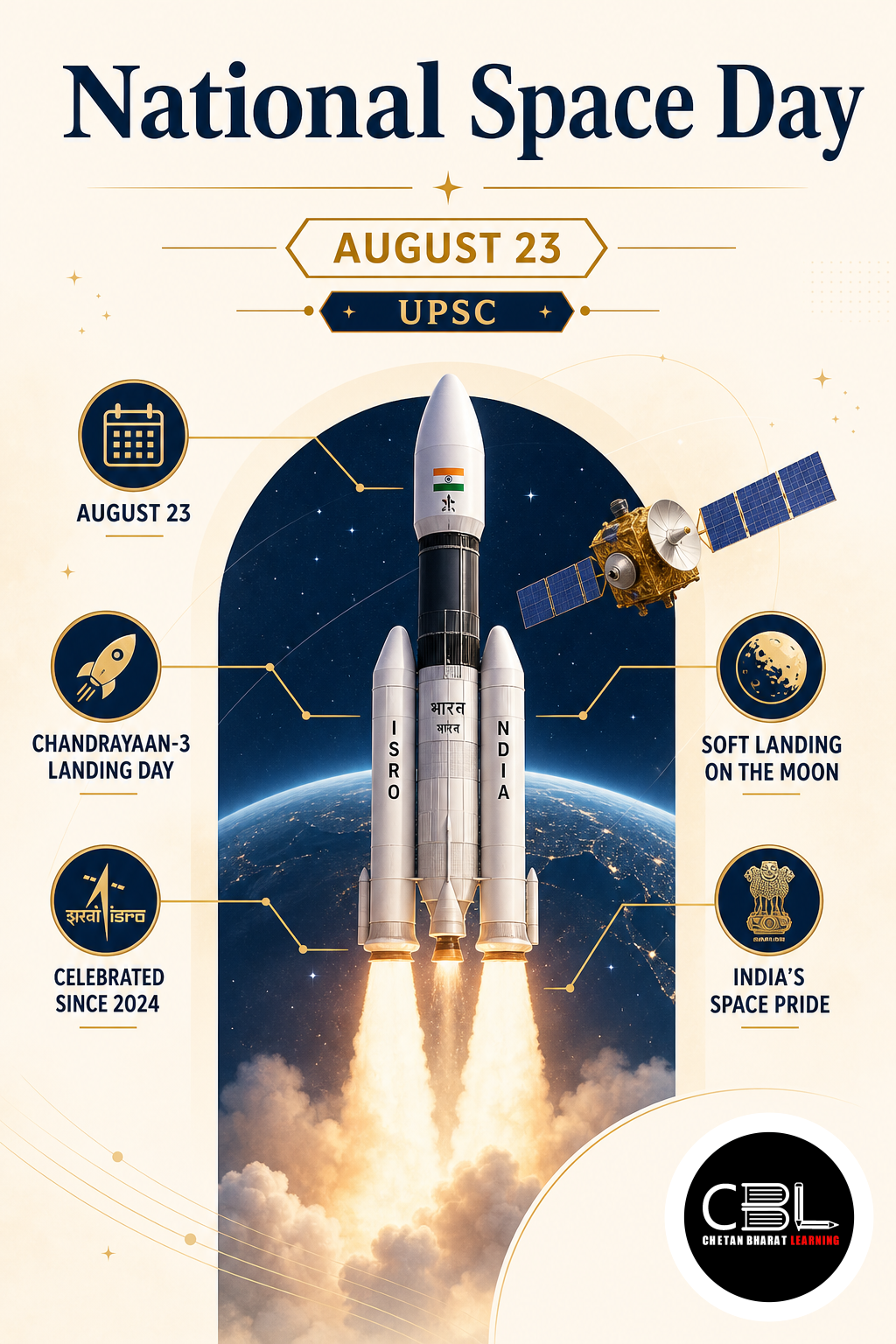
National Space Day is observed every year on August 23 in India to celebrate the successful landing of Chandrayaan-3’s Vikram lander near the Moon’s south polar region on that date in 2023. The landing site was subsequently named Shiv Shakti Point by the Prime Minister. The day honours India’s achievements in space exploration and inspires future generations.
India became the first country to land near the Moon’s south pole and the fourth nation (after the US, Russia, and China) to achieve a soft landing on the Moon. National Space Day also promotes awareness of space science and technology’s role in national development.
Why is National Space Day in News?
National Space Day is in the news annually as a reminder of India’s growing space capabilities. It serves as a platform for ISRO to announce new missions and technological developments. In 2026, the celebration may focus on upcoming missions like Gaganyaan and future lunar or interplanetary explorations.
The day also highlights India’s cost-effective space programme and its potential for commercial applications, such as satellite launches and earth observation. For official ISRO announcements, refer to the ISRO website.
Key Features of National Space Day
- Commemoration: Marks the soft landing of Chandrayaan-3 on August 23, 2023.
- Recognition: ISRO and scientists are honoured for their contributions.
- Educational outreach: Schools and colleges organise space-related events and competitions.
- Inspirational: Encourages youth to pursue careers in science and engineering.
- National pride: Showcases India’s technological prowess and self-reliance in space.
Challenges for India’s Space Programme
- Funding: Competing demands for government funds; private sector involvement is still nascent.
- Technology gaps: Heavy-lift launch capability and advanced propulsion systems need further development.
- Human spaceflight: Gaganyaan requires rigorous testing and safety assurance.
- International competition: Other nations and private companies are advancing rapidly.
- Space debris: Growing concern for sustainability of outer space activities.
For more on India’s space programme, visit the science & technology current affairs section.
Way Forward for India’s Space Programme
On National Space Day, India reaffirms its commitment to space exploration. The way forward includes completing the Gaganyaan human spaceflight mission, launching the Aditya-L1 solar mission, and planning a Venus orbiter. Increased collaboration with the private sector through the Indian National Space Promotion and Authorisation Centre (IN-SPACe) will boost innovation.
International partnerships, such as with NASA for the NISAR satellite, and commercial launches for other countries, will enhance India’s global standing. For global space cooperation, refer to the NASA page on international partnerships.
Prelims Practice Corner
- Q1. When is National Space Day celebrated in India?
(a) August 15 (b) August 23 (c) October 2 (d) January 26
Answer: (b) National Space Day is celebrated on August 23. - Q2. Which mission is commemorated on National Space Day?
(a) Chandrayaan-2 (b) Chandrayaan-3 (c) Mangalyaan (d) Gaganyaan
Answer: (b) Chandrayaan-3’s soft landing is commemorated. - Q3. Where did Chandrayaan-3 land?
(a) Lunar equator (b) Moon’s south polar region (c) Moon’s north pole (d) Lunar far side
Answer: (b) It landed near the Moon’s south pole at Shiv Shakti Point. - Q4. What is the name given to the Chandrayaan-3 landing site?
(a) Jawahar Point (b) Shiv Shakti Point (c) Vikram Point (d) Sagar Point
Answer: (b) The Prime Minister named it Shiv Shakti Point. - Q5. Which country was the first to land near the Moon’s south pole?
(a) USA (b) Russia (c) China (d) India
Answer: (d) India was the first country to land near the south pole.
Mains Practice Questions
-
Q1. Discuss the significance of Chandrayaan-3’s success for India’s space programme and its global standing. (15 marks)
Answer Structure
- Intro: Highlight the achievement and the date.
- Body: Discuss technological advancements, cost-effectiveness, international collaborations, and inspiration for youth. Also address future missions and commercial implications.
- Conclusion: Emphasise the role of space in national development and global partnerships.
-
Q2. Evaluate the role of the Indian Space Research Organisation (ISRO) in strengthening India’s scientific and technological capabilities. (10 marks)
Answer Structure
- Intro: Introduce ISRO and its core objectives.
- Body: Discuss major achievements (Chandrayaan, Mars, satellites), spin-off technologies, and contributions to society (communication, weather forecasting). Also mention challenges and private sector involvement.
- Conclusion: Stress the need for sustained funding and innovation.
FAQs on National Space Day
Why is August 23 chosen as National Space Day?
On August 23, 2023, Chandrayaan-3 successfully made a soft landing near the Moon’s south pole, a historic achievement for India.
What is the significance of Shiv Shakti Point?
It is the name given to the landing site of Chandrayaan-3’s Vikram lander, symbolising the nation’s scientific prowess and cultural heritage.
What are India’s future space missions?
Key upcoming missions include Gaganyaan (human spaceflight), Aditya-L1 (solar mission), and a Venus orbiter, along with enhanced private participation.
Related Current Affairs
Preparing for UPSC, PCS or HCS?
Talk to a mentor at Chetan Bharat Learning, Chandigarh. Free guidance on choosing the right exam and building a study plan.
Chat on WhatsAppCall 97793 53345UPSC / IAS / PCS coaching in Chandigarh · Trusted by aspirants across Punjab & Haryana
Leave a Reply
You must be logged in to post a comment.