
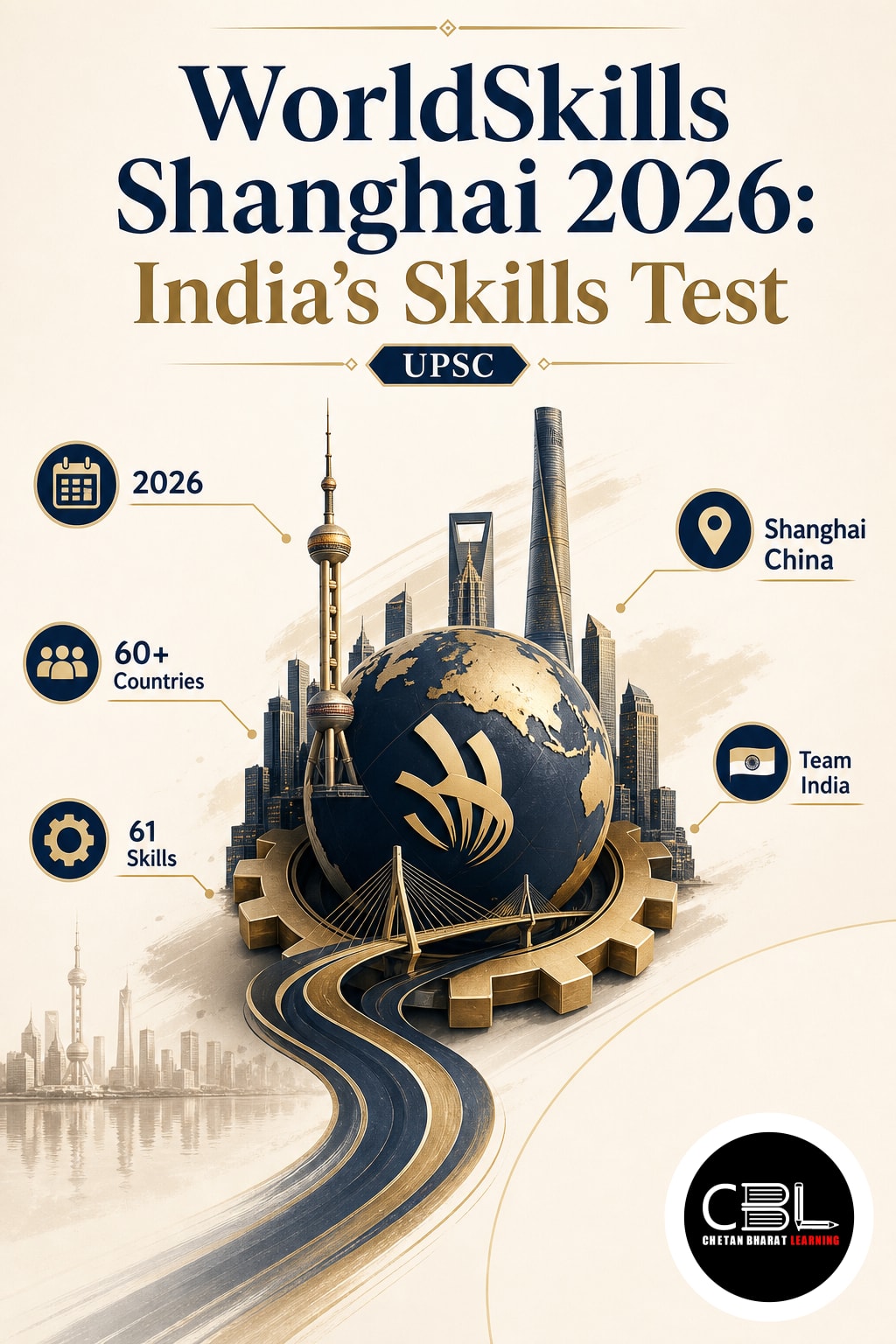

UPSC Mapping
| Exam Stage | Topic |
|---|---|
| Prelims | WorldSkills International, IndiaSkills and TVET |
| Mains | GS Paper II – Education, Skill Development and Employment |
Quick Facts
| Edition | 48th |
| Dates | 22–27 September 2026 |
| Host City | Shanghai, China |
| Skill Competitions | 64 |
| Competitors | Over 1,400 |
Article
What is WorldSkills Shanghai 2026?
WorldSkills Shanghai 2026 is the 48th edition of the world’s largest international competition for vocational and technical skills. WorldSkills International organises the biennial event with its members, industry partners and the host country. It allows young competitors to demonstrate practical expertise against demanding global benchmarks.
WorldSkills began in 1950 and developed into a global movement promoting skills excellence and technical education. Its competitions cover construction, manufacturing, engineering, information technology, transport, creative arts and personal services. The movement also strengthens Technical and Vocational Education and Training (TVET) through shared standards and international cooperation.
Why is WorldSkills Shanghai 2026 in News?
WorldSkills Shanghai 2026 is being held from 22 to 27 September at the National Exhibition and Convention Center in Shanghai. More than 1,400 competitors from over 70 countries and regions are participating across 64 skills. It is the largest edition by the number of competitions and includes seven newly introduced skills linked with evolving industries.
India has sent competitors selected and trained through its national skills ecosystem, including the IndiaSkills process. Their fields range from traditional crafts and service occupations to robotics, cybersecurity and advanced manufacturing. The official competition overview confirms the edition, schedule and Shanghai venue.
Key Features
The competition combines practical assessment, industrial standards and international knowledge exchange across diverse occupational fields.
- Real-world assignments: Competitors complete technically demanding projects under strict deadlines and professional quality requirements.
- Diverse skill categories: Covers traditional trades, creative occupations, digital technologies, advanced engineering, hospitality and personal services.
- International benchmarking: Helps countries compare training quality, occupational standards and workforce readiness.
- Industry participation: Employers provide equipment, expertise and evolving workplace insights.
- Policy dialogue: The WorldSkills Conference brings stakeholders together to discuss the future of skills.
Challenges
Competition success alone cannot resolve the broader education-employment mismatch affecting many young workers and enterprises.
- Uneven training quality: Institutions differ in equipment, instructor capability and curriculum relevance.
- Low social recognition: Vocational education is still viewed as inferior to academic degrees in many communities.
- Rapid technological change: Automation and AI can make curricula outdated quickly.
- Limited industry integration: Weak apprenticeship networks reduce workplace exposure.
- Participation barriers: Women, rural youth and disadvantaged communities may lack information and mobility.
Way Forward
India should convert lessons from WorldSkills Shanghai 2026 into improvements across its entire skills training system. International standards can inform curricula, trainer certification, assessment design and the modernisation of Industrial Training Institutes. National and state competitions should identify talent early while remaining connected with apprenticeships and actual employment pathways.
Policymakers must deepen collaboration among training institutions, industries, schools and local governments. District-level skill mapping can align programmes with regional production clusters and emerging green or digital occupations. The official IndiaSkills platform can support transparent selection, intensive training and the wider promotion of skills excellence as a respected career pathway.
Prelims Practice Corner
Q1. WorldSkills Shanghai 2026 represents which edition of the competition?
- (a) 46th
- (b) 47th
- (c) 48th
- (d) 49th
Answer: (c) 48th
Q2. What does TVET stand for?
- (a) Technical and Vocational Education and Training
- (b) Technology Validation and Employment Testing
- (c) Trade and Vocational Evaluation Treaty
- (d) Technical Ventures and Enterprise Training
Answer: (a) Technical and Vocational Education and Training
Q3. Which organisation conducts the global WorldSkills Competition?
- (a) International Labour Organization
- (b) WorldSkills International
- (c) World Trade Organization
- (d) UNESCO Institute for Statistics
Answer: (b) WorldSkills International
Q4. Approximately how many skill competitions formed the 2026 programme?
- (a) 24
- (b) 40
- (c) 52
- (d) 64
Answer: (d) 64
Q5. What is the principal role of IndiaSkills in the WorldSkills ecosystem?
- (a) Regulating universities
- (b) Selecting and developing skilled competitors
- (c) Issuing industrial patents
- (d) Financing foreign universities
Answer: (b) Selecting and developing skilled competitors
Mains Practice Questions
Q1. International skills competitions can improve vocational education only when their standards influence domestic institutions. Discuss. (250 words, 15 marks)
Answer Structure:
- Intro: Platforms for benchmarking and professional recognition.
- Body: Curriculum reform, trainer development, industrial exposure, assessment standards, inclusion and employment linkages.
- Conclusion: Institutionalise global benchmarks across the national training ecosystem.
Q2. How can India transform its demographic potential into a skilled and employable workforce? (150 words, 10 marks)
Answer Structure:
- Intro: Link young population with the need for productive and adaptable skills.
- Body: Foundational learning, apprenticeships, industry partnerships, digital skills, trainer quality and social inclusion.
- Conclusion: Demand-driven training connected with dignified employment and lifelong learning.
FAQs on WorldSkills Shanghai 2026
Why is WorldSkills called the Skills Olympics?
The competition brings leading young professionals together for intensive, standardised skill assessments. The expression reflects its international scale and competitive prestige, although it is separate from the Olympic Games.
How are Indian competitors selected?
India uses national and subnational competitions, assessments and specialised training to identify potential representatives. WorldSkills India and NSDC coordinate major parts of this preparation process.
Which types of occupations feature in WorldSkills?
The programme includes construction, engineering, digital technology, transport, creative arts and service occupations. It combines traditional trades and emerging technologies relevant to changing labour markets.
Related Current Affairs
Preparing for UPSC, PCS or HCS?
Talk to a mentor at Chetan Bharat Learning, Chandigarh. Free guidance on choosing the right exam and building a study plan.
Chat on WhatsAppCall 97793 53345UPSC / IAS / PCS coaching in Chandigarh · Trusted by aspirants across Punjab & Haryana
Leave a Reply
You must be logged in to post a comment.