
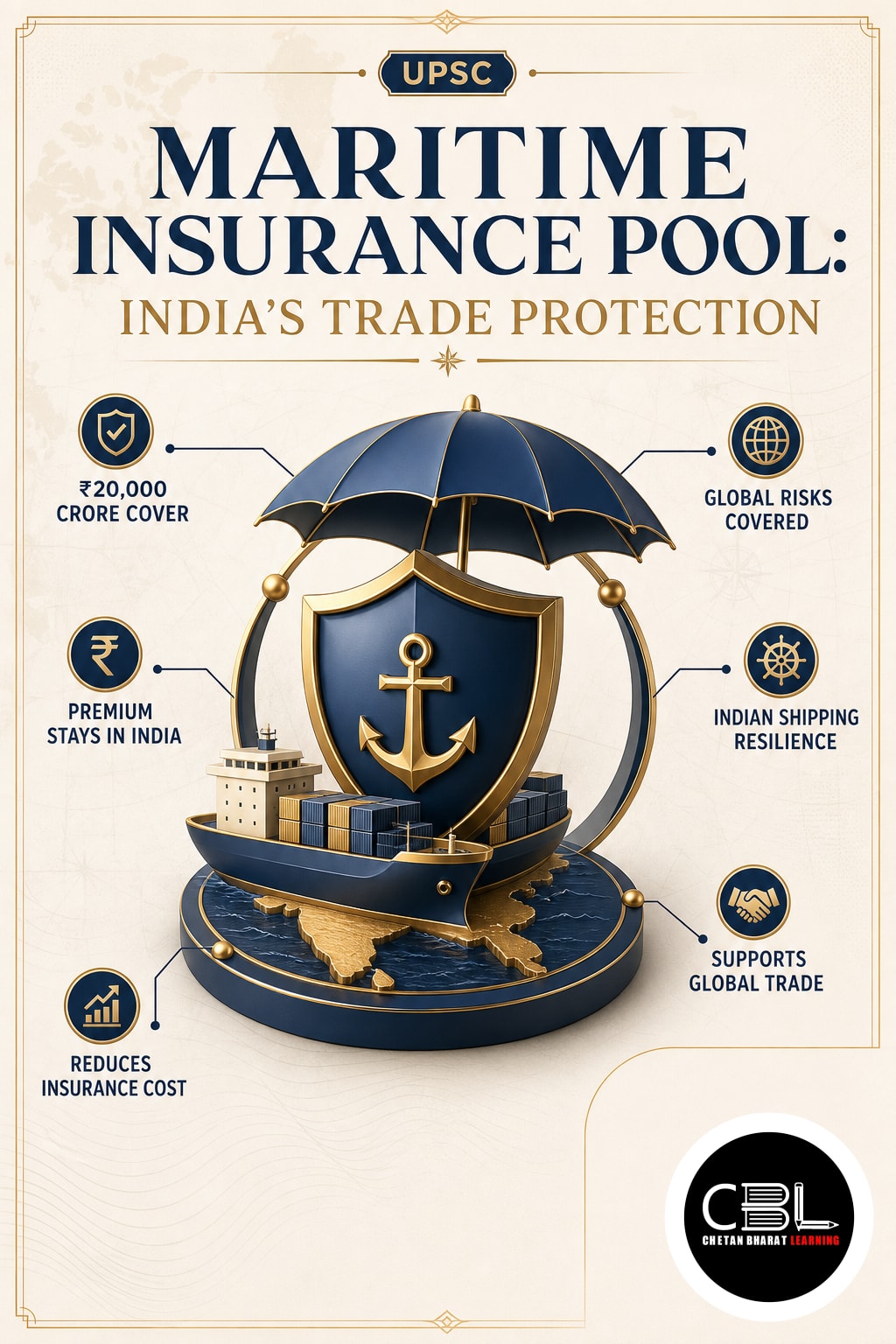

UPSC Mapping
- Prelims: Marine Insurance, GIC Re and BMIP Coverage
- Mains: GS Paper III – Infrastructure and Economic Security
Quick Facts
| Launch Date | 12 May 2026 |
|---|---|
| Nodal Department | Department of Financial Services |
| Pool Size | USD 1.5 Billion |
| Sovereign Guarantee | ₹12,980 Crore |
| Administrator | GIC Re |
Article
Maritime Insurance Pool strengthens India’s ability to protect ships and cargo. The sovereign-backed mechanism supports trade continuity when geopolitical tensions disrupt foreign insurance coverage. Aspirants can examine related developments through the daily current affairs archive, particularly topics involving maritime infrastructure, financial sovereignty and economic security.
What is the Maritime Insurance Pool?
The Maritime Insurance Pool is India’s first domestic arrangement for combining insurance capacity against major shipping risks. Officially called the Bharat Maritime Insurance Pool, it brings participating domestic insurers together under a shared framework. The Government supports it through a sovereign guarantee that acts as a financial backstop.
The mechanism covers hull and machinery, cargo, war risk and Protection and Indemnity insurance. P&I protection addresses third-party liabilities such as pollution, wreck removal, cargo damage, crew injury and collisions. Coverage extends to Indian-flagged or controlled vessels and ships carrying cargo to or from Indian ports.
Why is the Maritime Insurance Pool in News?
The Maritime Insurance Pool was launched by the Department of Financial Services in May 2026 amid heightened Middle East tensions. Conflicts, sanctions and restrictions in high-risk corridors can cause foreign insurers or reinsurers to withdraw coverage. Such withdrawal may halt voyages, raise premiums and disrupt India’s energy, commodity and manufactured-goods trade.
The pool issued its first hull-and-machinery war policy and cargo war policies at the launch event. A subsequent government workshop reported reductions of 27–48% in premiums for selected hull-war and cargo-war policies. The official Finance Ministry release explains its operational structure, eligible risks and claims mechanism.
Key Features
- Broad risk coverage: The pool protects vessels and cargo against machinery damage, third-party liabilities, accidents and specified war-related perils.
- Shared underwriting: Domestic member insurers issue policies and collectively reinsure risks according to their committed capacity within the pool.
- Sovereign backstop: The ₹12,980 crore guarantee activates for qualifying large claims only after available reserves, contributions and reinsurance arrangements are exhausted.
- Professional administration: GIC Re manages operations, reinsurance arrangements, performance statements and regulatory returns for the Maritime Insurance Pool.
- Institutional oversight: A Governing Body supervises the arrangement, while an Underwriting Committee promotes prudent and technically consistent risk assessment.
Challenges
- Concentrated losses: A major conflict, collision or pollution incident can generate several large claims within a short period.
- Fiscal exposure: Incorrect pricing or weak reserves could trigger the sovereign guarantee and transfer exceptional losses to public finances.
- Limited domestic expertise: Complex P&I claims require specialised maritime law, investigation, surveying, underwriting and international claims-management capacity.
- Global acceptance: Ports, lenders and charterers must recognise Indian-issued protection as credible and compliant with international shipping requirements.
- Sanctions compliance: Insurers must screen vessels, owners, cargo and transactions carefully while supporting legitimate trade discussed in the economy and infrastructure coverage.
Way Forward
The Maritime Insurance Pool should develop transparent risk-based pricing, strong reserves and independent actuarial review. Member insurers must diversify exposures across vessel classes, cargo types and shipping corridors. Regular stress tests should evaluate the pool’s capacity under simultaneous war, pollution and collision claims.
India should build a credible domestic P&I ecosystem supported by trained underwriters, maritime lawyers and specialised surveyors. Collaboration with global clubs can expand claims networks without recreating excessive foreign dependence. The government’s maritime insurance roadmap supports domestic P&I products, wider vessel coverage and compatibility with international standards.
Prelims Practice Corner
-
Q1. Which institution administers the Bharat Maritime Insurance Pool?
- (a) Reserve Bank of India
- (b) GIC Re
- (c) Shipping Corporation of India
- (d) IRDAI
Answer: (b) General Insurance Corporation of India, or GIC Re, serves as the pool administrator.
-
Q2. What is the value of the sovereign guarantee supporting BMIP?
- (a) ₹950 crore
- (b) ₹5,000 crore
- (c) ₹12,980 crore
- (d) ₹25,000 crore
Answer: (c) The Union Government supports the pool with a ₹12,980 crore sovereign guarantee.
-
Q3. Which risks fall within the pool’s coverage?
- (a) Hull and machinery
- (b) Cargo and war risk
- (c) Protection and indemnity
- (d) All of the above
Answer: (d) The pool covers hull, machinery, cargo, P&I and war-related maritime risks.
-
Q4. Protection and Indemnity insurance mainly covers what?
- (a) Third-party maritime liabilities
- (b) Port construction costs
- (c) Customs duties
- (d) Ship purchase loans
Answer: (a) P&I insurance covers liabilities such as pollution, wreck removal, crew injury and collision claims.
-
Q5. When can the sovereign guarantee support claims exceeding USD 100 million?
- (a) Immediately after claim filing
- (b) Before using reinsurance
- (c) After exhausting pool resources and reinsurance
- (d) Only after parliamentary approval
Answer: (c) The guarantee operates as a last-resort backstop after other specified financial resources are exhausted.
Mains Practice Questions
-
Q1. Examine the role of domestic marine insurance capacity in strengthening India’s economic and maritime security. (250 words, 15 marks)
Answer Structure:
- Intro: Connect maritime insurance with shipping continuity and India’s dependence on seaborne trade.
- Body: Cover geopolitical risks, foreign dependence, P&I protection, domestic expertise, sovereign support and fiscal exposure.
- Conclusion: Recommend commercially disciplined insurance capacity supported by specialised maritime institutions.
-
Q2. Sovereign guarantees can strengthen strategic sectors but may also create contingent fiscal liabilities. Discuss with reference to maritime insurance. (150 words, 10 marks)
Answer Structure:
- Intro: Define a sovereign guarantee as a government-backed contingent financial commitment.
- Body: Examine trade continuity, affordable premiums, moral hazard, risk pricing, reserves and public-finance exposure.
- Conclusion: Support transparent guarantees combined with actuarial oversight and last-resort activation.
FAQs on the Maritime Insurance Pool
- Why did India create BMIP?
- India created it to maintain insurance coverage during sanctions, conflicts and withdrawals by foreign insurers. It also promotes domestic maritime risk capacity and trade continuity.
- Does the government pay every BMIP claim?
- No, member capacity, accumulated reserves and reinsurance arrangements service claims initially. The sovereign guarantee functions as a last-resort backstop for qualifying larger losses.
- Which vessels can receive coverage?
- Coverage includes Indian-flagged or controlled vessels and ships carrying cargo to or from India. Eligibility therefore supports both Indian shipping and India-linked trade.
Related Current Affairs
Preparing for UPSC, PCS or HCS?
Talk to a mentor at Chetan Bharat Learning, Chandigarh. Free guidance on choosing the right exam and building a study plan.
Chat on WhatsAppCall 97793 53345UPSC / IAS / PCS coaching in Chandigarh · Trusted by aspirants across Punjab & Haryana
Leave a Reply
You must be logged in to post a comment.