
UPSC Mapping
- Prelims: Article 324 and Election Commissioners Act, 2023
- Mains: GS Paper II – Constitutional Bodies and Electoral Reforms
Quick Facts
| Constitutional Basis | Article 324 |
|---|---|
| Appointing Authority | President of India |
| Current Office-Holder | Gyanesh Kumar |
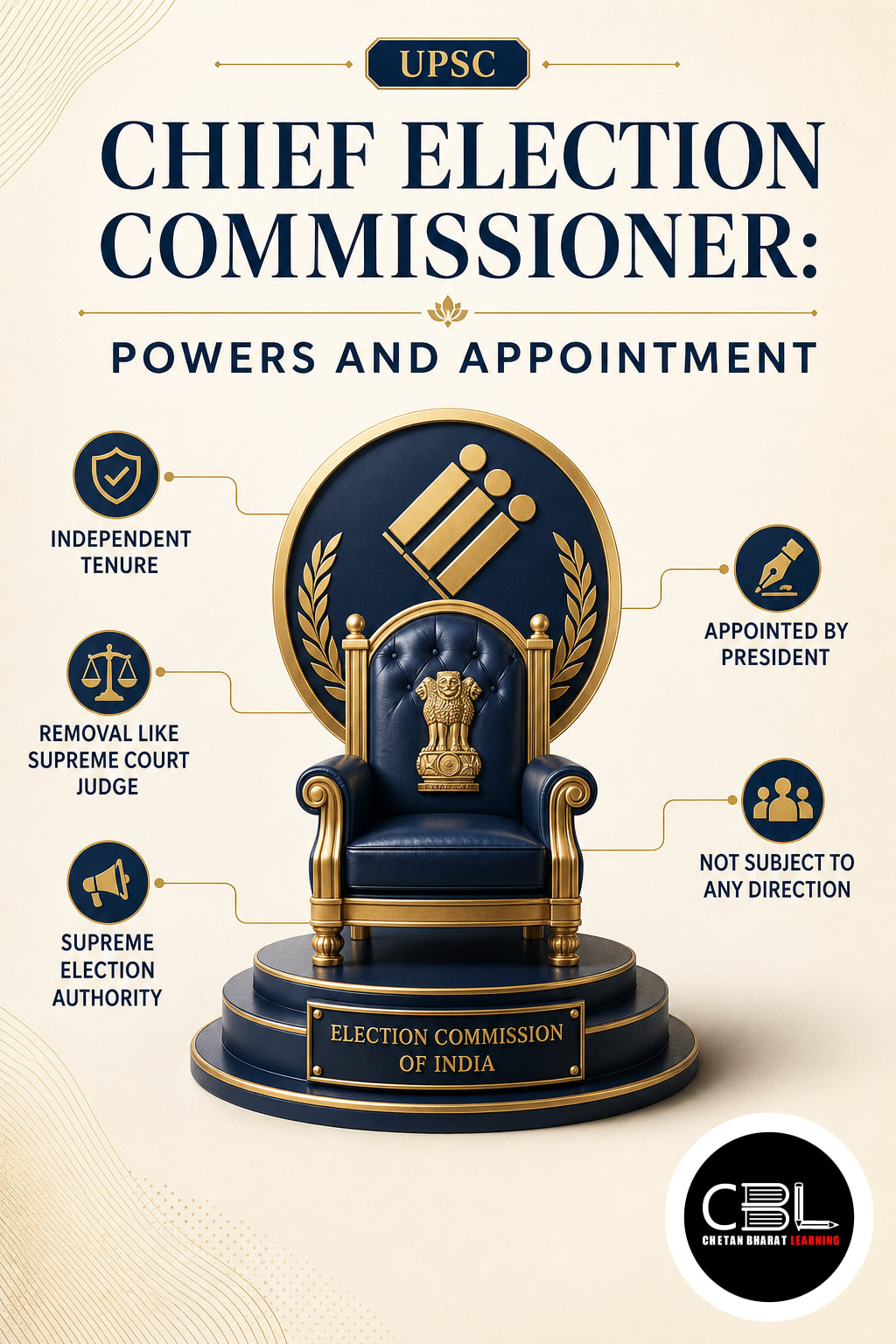
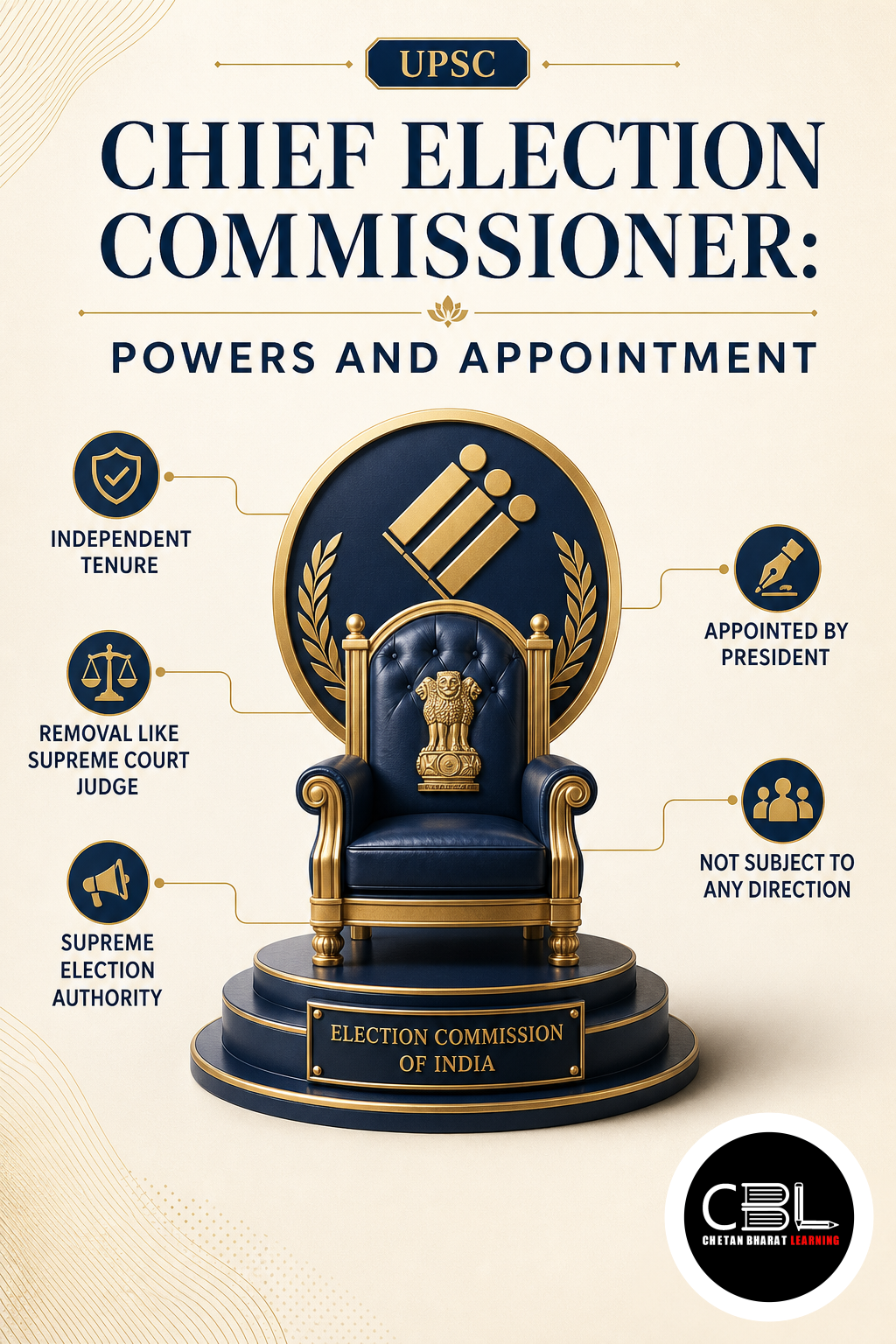
| Maximum Tenure | Six Years or Age 65 |
| Removal Standard | Same as Supreme Court Judge |
What is the Chief Election Commissioner?
The Chief Election Commissioner heads the constitutionally established Election Commission of India. Article 324 grants the Commission superintendence, direction and control over electoral rolls and specified elections. Its jurisdiction covers elections to Parliament, State Legislatures and the offices of the President and Vice-President.
The Chief Election Commissioner does not exercise greater voting power than the other Election Commissioners. The Commission generally seeks unanimity, but it decides disagreements through a majority decision. The position therefore combines institutional leadership with collective responsibility inside a multi-member constitutional body.
Why is the Chief Election Commissioner in News?
The Chief Election Commissioner is in focus following renewed scrutiny of the 2023 appointment law and reported disagreements within the Commission. The Supreme Court delivered a split decision in September 2026 on challenges involving the appointment framework. The matter was placed before the Chief Justice of India to consider a larger or Constitution Bench.
The controversy primarily concerns the composition of the selection committee and the institutional independence of election authorities. Critics question whether an executive-dominated panel provides sufficient safeguards, while the law’s supporters rely on Parliament’s authority under Article 324. The official text of the 2023 Act specifies the appointment process, tenure, service conditions and transaction of business.
Key Features
The constitutional and statutory framework combines presidential appointment, fixed tenure and protected removal conditions.
- Selection committee: The Prime Minister, Lok Sabha Opposition Leader and a Union Cabinet Minister nominated by the Prime Minister recommend appointments.
- Search mechanism: A committee headed by the Union Law Minister prepares a panel of five eligible candidates for consideration.
- Eligibility standard: Candidates must hold or have held Secretary-equivalent positions and possess integrity and election-management experience.
- Protected tenure: The Chief Election Commissioner serves for six years or until age 65, whichever occurs earlier, without reappointment.
- Collective functioning: Commission business should proceed unanimously where possible, while differences receive resolution through majority opinion.
Challenges
The institution faces concerns involving appointment neutrality, internal transparency and public confidence in electoral decisions.
- Executive predominance: Two members of the three-person selection panel belong to or are nominated by the Union executive.
- Limited selection transparency: The public receives little information about candidate evaluation, comparative merit or reasons supporting the final recommendation.
- Internal disagreements: Unresolved differences among Commissioners can raise doubts when records, dissenting views and institutional reasoning remain unavailable.
- Unequal removal safeguards: Other Election Commissioners can be removed on the CEC’s recommendation, while the CEC receives stronger constitutional protection.
- Public confidence: Controversies involving electoral rolls or enforcement require prompt, reasoned explanations, as discussed in the Indian polity analysis.
Way Forward
The Chief Election Commissioner requires an appointment process that commands confidence across political divisions. Parliament can introduce clearer evaluation criteria, wider consultation and recorded reasons without weakening administrative efficiency. A balanced committee containing executive, opposition and independent representation could strengthen both legitimacy and institutional autonomy.
The Commission should publish reasoned decisions, important dissenting opinions and transparent procedures wherever electoral confidentiality permits. A permanent independent secretariat and secure financial arrangements can further reduce executive dependence. The official Commission profile provides current information about its members, while broader reforms must preserve impartial election administration.
Prelims Practice Corner
-
Q1. Which article establishes the constitutional framework for the Election Commission of India?
(a) Article 280 (b) Article 315 (c) Article 324 (d) Article 338
Answer: (c) Article 324 vests election supervision, direction and control in the Election Commission.
-
Q2. Who formally appoints the CEC and Election Commissioners?
(a) Prime Minister (b) Parliament (c) President of India (d) Chief Justice of India
Answer: (c) The President appoints them by warrant under his hand and seal.
-
Q3. Which person is not included in the selection committee established by the 2023 Act?
(a) Prime Minister (b) Lok Sabha Opposition Leader (c) Chief Justice of India (d) Nominated Union Cabinet Minister
Answer: (c) The 2023 Act does not include the Chief Justice of India in the selection committee.
-
Q4. What is the maximum age for holding office under the 2023 Act?
(a) 60 years (b) 62 years (c) 65 years (d) 70 years
Answer: (c) The term ends after six years or upon attaining 65 years, whichever occurs earlier.
-
Q5. How are disagreements within the multi-member Election Commission decided?
(a) Presidential direction (b) Majority opinion (c) CEC’s exclusive decision (d) Supreme Court reference
Answer: (b) Matters proceed by majority opinion when the Commissioners cannot reach unanimity.
Mains Practice Questions
-
Q1. Examine whether the appointment mechanism created by the Election Commissioners Act, 2023 adequately protects the independence of the Election Commission. (250 words, 15 marks)
Answer Structure:
- Intro: Explain Article 324 and the constitutional importance of an impartial Election Commission.
- Body: Examine committee composition, executive predominance, parliamentary authority, transparency and judicial scrutiny.
- Conclusion: Recommend a balanced and transparent process that commands multipartisan confidence.
-
Q2. Institutional independence requires more than security of tenure. Discuss with reference to the Election Commission of India. (150 words, 10 marks)
Answer Structure:
- Intro: Relate independent election administration to free and fair elections.
- Body: Cover appointments, finances, secretariat control, internal deliberations, enforcement consistency and public accountability.
- Conclusion: Support comprehensive institutional safeguards alongside constitutional removal protection.
FAQs on the Chief Election Commissioner
- Who is India’s current CEC?
- Gyanesh Kumar took charge as India’s 26th CEC on 19 February 2025. He had previously served as an Election Commissioner.
- Can the President remove the CEC directly?
- No, removal requires the same parliamentary process and grounds applicable to a Supreme Court judge. The grounds are proved misbehaviour or incapacity.
- Does the CEC have greater voting power than other Commissioners?
- No, every Commissioner has an equal vote in Commission decisions. The CEC acts as chairperson, while disagreements receive resolution through majority opinion.
Related Current Affairs
Preparing for UPSC, PCS or HCS?
Talk to a mentor at Chetan Bharat Learning, Chandigarh. Free guidance on choosing the right exam and building a study plan.
Chat on WhatsAppCall 97793 53345UPSC / IAS / PCS coaching in Chandigarh · Trusted by aspirants across Punjab & Haryana
Leave a Reply
You must be logged in to post a comment.