

UPSC Mapping
| Prelims | Environment, Climate Initiatives and NAPCC |
|---|---|
| Mains | GS Paper III — Environment and Climate Change |
| Launch Date | 16 September 2026 |
|---|---|
| Nodal Ministry | MoEFCC |
| Portal Participation | Voluntary |
| Dashboard Coverage | 9 Missions, 28 States and 8 UTs |
What is the Net Zero Portal?
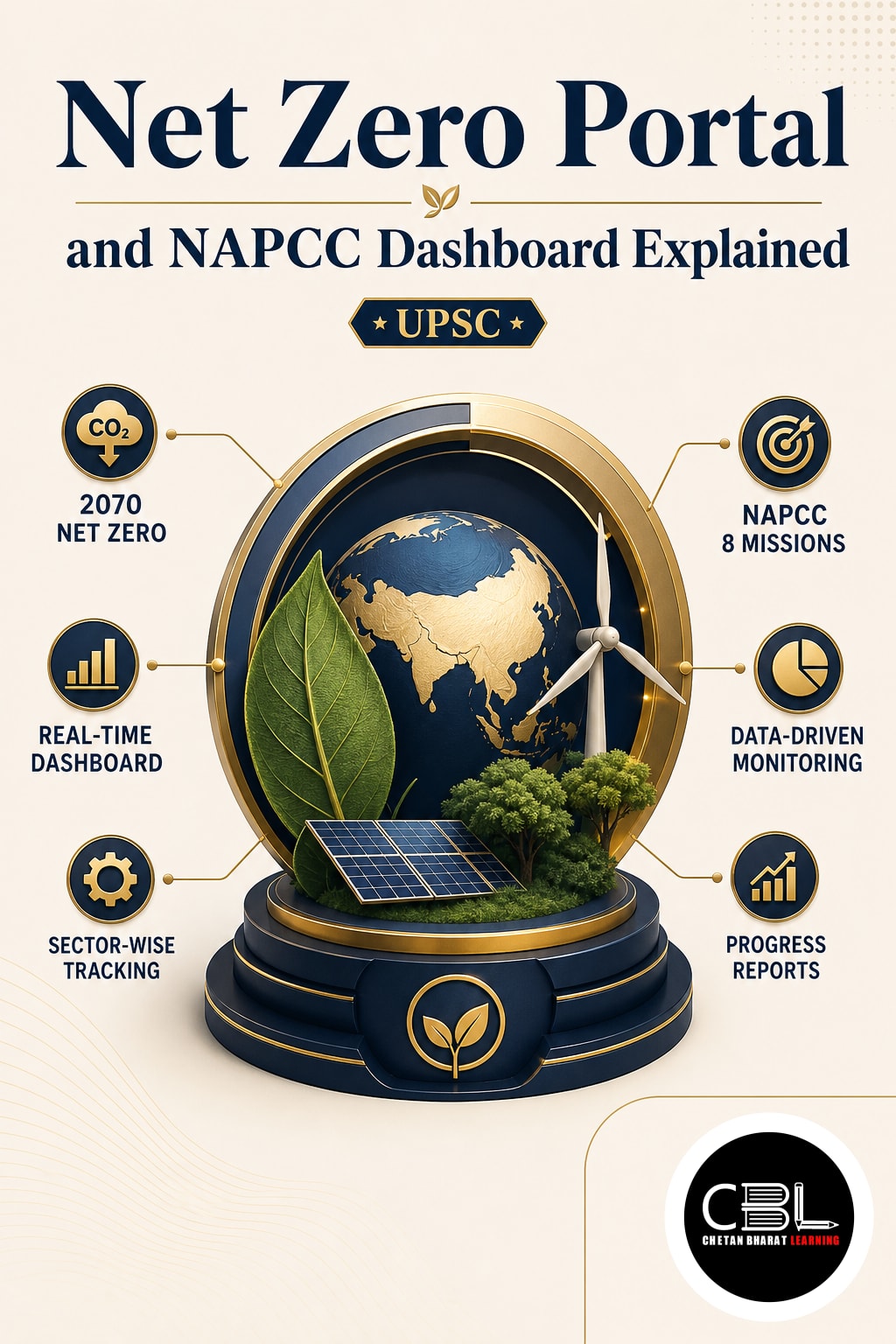
The Net Zero Portal is a centralised government platform where Indian entities can voluntarily register and disclose their net-zero commitments. Participating organisations can provide information about their greenhouse-gas emissions, target year, decarbonisation measures and annual progress. Public availability of these declarations seeks to improve transparency around commitments that were previously dispersed across corporate reports and individual websites.
The accompanying NAPCC Dashboard presents a consolidated view of progress under the National Action Plan on Climate Change. It covers nine national missions alongside profiles of 28 states and eight Union Territories. The platform can help ministries identify implementation gaps, compare progress and coordinate climate action across different administrative levels.
Why is the Net Zero Portal in News?
The Net Zero Portal and the national dashboard were launched in Mumbai on World Ozone Day, observed on 16 September 2026. Union Minister of State for Environment, Forest and Climate Change Kirti Vardhan Singh launched the platforms. The initiative places voluntary commitments and national mission monitoring within a common digital climate-governance framework.
Entities can use the official climate disclosure platform to record targets and update their progress. The system encourages reporting of Scope 1 and Scope 2 emissions, while value-chain or Scope 3 disclosure remains voluntary. Acknowledgement of a declaration by the ministry records participation but should not automatically be treated as independent certification of the claim.
Key Features
- Voluntary registration: Companies, industries, public bodies and other organisations can voluntarily declare their net-zero targets without converting participation into a compulsory regulatory obligation.
- Public disclosure: Registered entities can place their targets, emissions information and decarbonisation strategies in a consolidated repository accessible to citizens, researchers and policymakers.
- Annual progress updates: Participating organisations can periodically report measurable action involving renewable energy, efficiency improvements, industrial changes and carbon-removal measures.
- Mission-level monitoring: The NAPCC platform brings information from national climate missions together, allowing ministries to examine progress and identify implementation gaps.
- Federal coverage: State and Union Territory profiles connect central missions with subnational climate plans, supporting coordination across India’s multi-level governance structure.
Challenges
- Voluntary participation: Entities with weak targets or high emissions may choose not to register, limiting the platform’s coverage and representativeness across economic sectors.
- Verification limitations: Self-reported declarations can create misleading impressions unless independent assurance, common accounting standards and clear evidence support the submitted information.
- Scope 3 complexity: Value-chain emissions are difficult to calculate because they depend on suppliers, transport, product use and disposal beyond an organisation’s direct control.
- Uneven administrative capacity: States, Union Territories and mission authorities possess different technical resources, potentially producing irregular updates and incomparable implementation data.
- Risk of greenwashing: Long-term targets without interim milestones may conceal slow action, requiring closer scrutiny through reliable environment and climate coverage.
Way Forward
The Net Zero Portal should gradually adopt standardised reporting formats, sector-specific guidance and safeguards against misleading claims. Organisations must disclose baseline years, covered gases, operational boundaries, interim targets and their expected reliance on carbon removals. Independent assurance and transparent revision histories can strengthen credibility and comparability without undermining voluntary participation.
The NAPCC Dashboard requires timely data from mission ministries and state governments, supported by common indicators and capacity-building. Policymakers should connect reported outcomes with India’s updated Nationally Determined Contribution and its 2070 net-zero objective. Regular public reviews through the Ministry of Environment, Forest and Climate Change can convert digital reporting into evidence-based climate action.
Prelims Practice Corner
Q1. Which ministry administers India’s new digital platforms for net-zero commitments and NAPCC monitoring?
(a) Ministry of Power (b) Ministry of Environment, Forest and Climate Change (c) Ministry of Corporate Affairs (d) Ministry of Statistics and Programme Implementation
Answer: (b) The Ministry of Environment, Forest and Climate Change is the nodal ministry.
Q2. Registration and disclosure on India’s platform for organisational net-zero commitments are:
(a) Mandatory for every company (b) Limited to state governments (c) Voluntary (d) Restricted to power producers
Answer: (c) Organisations participate and disclose their commitments voluntarily.
Q3. Scope 2 emissions are primarily associated with:
(a) Direct emissions from owned sources (b) Purchased electricity, heat, steam or cooling (c) Historical deforestation only (d) International aviation alone
Answer: (b) Scope 2 covers indirect emissions associated with purchased energy.
Q4. Consider the following statements: 1. The NAPCC was launched in 2008. 2. The new dashboard covers national missions and subnational profiles. 3. The dashboard applies only to coastal states. Which statements are correct?
(a) 1 only (b) 1 and 2 only (c) 2 and 3 only (d) 1, 2 and 3
Answer: (b) The dashboard covers national missions, states and Union Territories rather than only coastal states.
Q5. Net-zero emissions are achieved when:
(a) All economic activity ends (b) Renewable energy becomes the only energy source (c) Human-caused emissions are balanced by removals (d) Carbon dioxide becomes absent from the atmosphere
Answer: (c) Net zero balances remaining human-caused greenhouse-gas emissions with corresponding removals.
Mains Practice Questions
Q1. Digital disclosure platforms can strengthen climate accountability, but transparency alone cannot guarantee emission reductions. Discuss. (15 marks)
Answer Structure:
- Intro: Explain how public disclosure connects climate commitments with measurable progress.
- Body: Discuss transparency, comparison and coordination alongside voluntary coverage, verification gaps, greenwashing and data-quality concerns.
- Conclusion: Recommend standardised disclosures, interim targets and independent assurance.
Q2. Examine the role of cooperative federalism and digital monitoring in implementing India’s National Action Plan on Climate Change. (15 marks)
Answer Structure:
- Intro: Present the NAPCC as a national framework implemented through missions and subnational action.
- Body: Cover mission coordination, state plans, common indicators, capacity differences, public data and alignment with national targets.
- Conclusion: Advocate timely reporting, shared standards and stronger Centre-state institutional coordination.
FAQs on the Net Zero Portal
Is registration on the Net Zero Portal mandatory?
No. Registration and disclosure are voluntary for participating entities. Public reporting can still create reputational pressure for credible targets and regular progress updates.
What does the NAPCC Dashboard monitor?
It consolidates information about India’s national climate missions and subnational climate action. Ministries can use it to assess progress, identify gaps and improve coordination.
Does ministry acknowledgement certify a net-zero target?
Acknowledgement records an entity’s successful declaration on the platform. It should not automatically be treated as independent verification or certification of the reported target.
Related Current Affairs
Preparing for UPSC, PCS or HCS?
Talk to a mentor at Chetan Bharat Learning, Chandigarh. Free guidance on choosing the right exam and building a study plan.
Chat on WhatsAppCall 97793 53345UPSC / IAS / PCS coaching in Chandigarh · Trusted by aspirants across Punjab & Haryana
Leave a Reply
You must be logged in to post a comment.