
UPSC Mapping
- Prelims: RBI, Monetary Policy and Government Securities
- Mains: GS Paper III — Indian Economy and Monetary Policy
Article
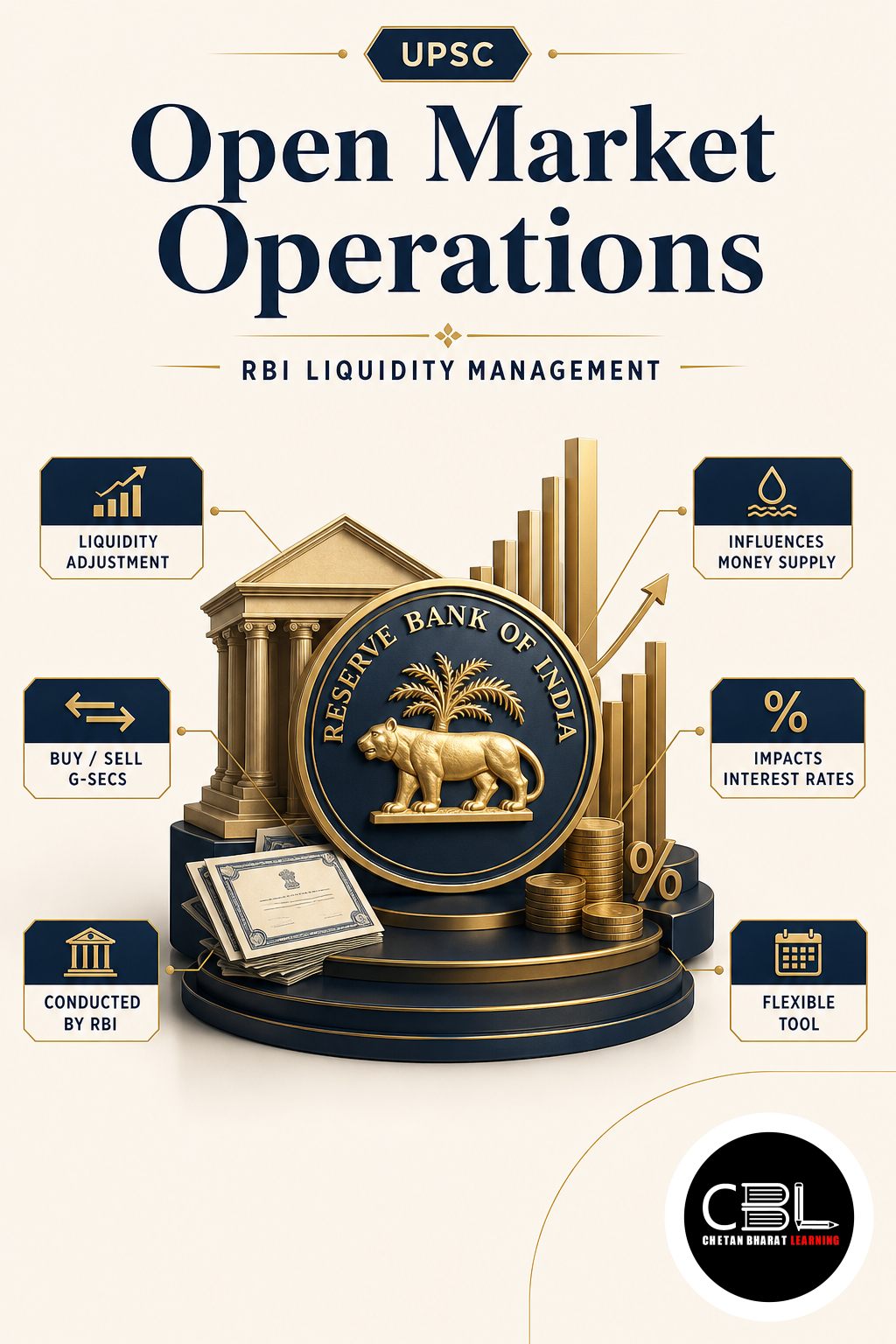
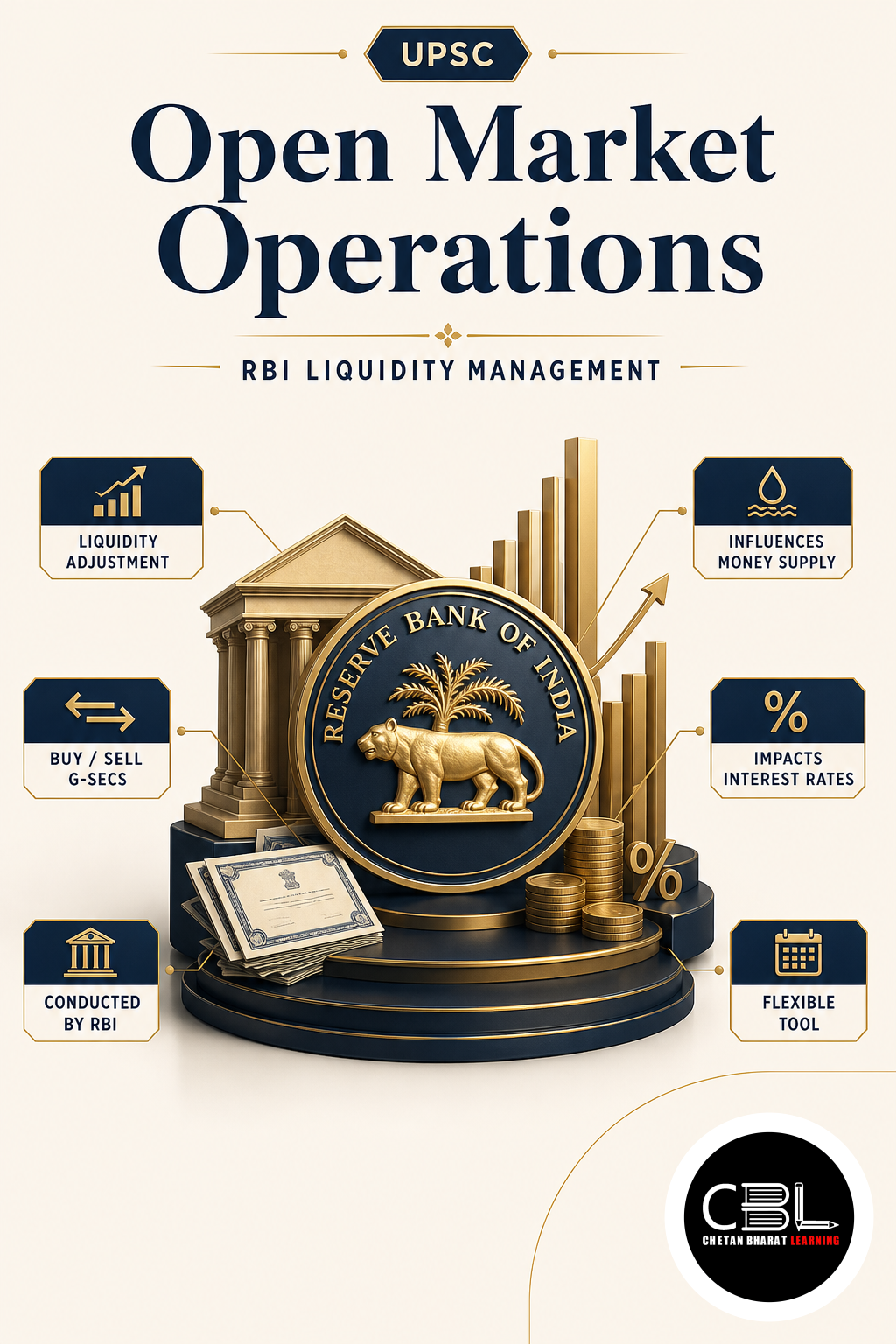
Open Market Operations allow the Reserve Bank of India to regulate durable liquidity through government securities. Their direction influences bank reserves, bond yields, credit conditions and monetary-policy transmission across the economy. Aspirants can connect this instrument with other policy measures through the Indian economy current affairs archive.
Quick Facts
| Conducting Authority | Reserve Bank of India |
|---|---|
| Primary Instrument | Government Securities |
| RBI Purchase | Injects Liquidity |
| RBI Sale | Absorbs Liquidity |
What are Open Market Operations?
Open Market Operations refer to the RBI’s outright purchase or sale of government securities in the financial market. The central bank uses them to adjust the amount of durable rupee liquidity available within the banking system. Unlike a temporary loan, an outright transaction changes liquidity until another operation offsets its effect.
When the RBI purchases securities, it pays market participants and increases banking-system reserves. When it sells securities, buyers transfer funds to the RBI, reducing the money available with banks. These transactions can influence short-term rates, government bond yields and the broader availability of credit.
Why are Open Market Operations in News?
The Open Market Operations framework entered the news after the RBI announced government-security sale auctions worth ₹1 lakh crore in three tranches. A sale withdraws surplus funds from banks because participating institutions pay the central bank for the securities. The announcement indicated the RBI’s intention to address prevailing liquidity conditions without changing the policy rate itself.
The RBI also announced auctions of 91-day, 182-day and 364-day Treasury Bills. Treasury Bill issuance primarily supports the Union government’s short-term borrowing and cash-management requirements, while an RBI security sale serves a monetary-liquidity purpose. The central bank publishes auction calendars, results and liquidity measures through its official press releases.
Key Features
- Outright transactions: Permanent purchase or sale of selected government securities.
- Liquidity injection: Security purchase adds funds to banks, easing financial conditions.
- Liquidity absorption: Security sale removes funds from banks to contain excess liquidity.
- Government securities: Tradable debt issued by Union or state governments.
- Yield influence: Purchases can moderate yields; large sales may raise yields.
Challenges
- Liquidity estimation: Daily cash positions can shift due to currency circulation, government balances and tax payments.
- Bond-market volatility: Unexpected operations can sharply move yields.
- Conflicting signals: Liquidity withdrawal in an accommodative cycle may confuse markets.
- Uneven transmission: Additional reserves don’t guarantee stronger lending under weak demand.
- Fiscal interaction: Large government borrowing can complicate liquidity management.
Way Forward
The RBI should base liquidity action on transparent assessments of durable and temporary funding conditions. Predictable communication can reduce bond volatility while preserving flexibility during external shocks. A balanced mix of outright transactions, repo facilities and variable-rate auctions can improve operational precision.
Effective Open Market Operations should support price stability while keeping money-market rates aligned with the monetary-policy stance. Coordination with the government’s borrowing calendar can reduce market pressure without compromising central-bank independence. The RBI monetary policy repository explains how liquidity management fits within the wider framework.
Prelims Practice Corner
-
Q1. What generally happens when the RBI sells government securities to the market?
- (a) Rupee liquidity increases
- (b) Rupee liquidity decreases
- (c) Fiscal deficit disappears
- (d) Currency notes become invalid
- Answer: (b) Buyers transfer funds to the RBI, which absorbs liquidity from the banking system.
-
Q2. Consider the following statements about Government Securities: 1. They acknowledge a government debt obligation. 2. Both the Union and state governments can issue Treasury Bills. Which statement is correct?
- (a) 1 only
- (b) 2 only
- (c) Both 1 and 2
- (d) Neither 1 nor 2
- Answer: (a) Government securities represent debt obligations, but only the Union government issues Treasury Bills.
-
Q3. Which of the following Treasury Bill maturities are commonly issued in India?
- (a) 30, 60 and 90 days
- (b) 91, 182 and 364 days
- (c) 100, 200 and 400 days
- (d) 365, 730 and 1,095 days
- Answer: (b) The Union government issues Treasury Bills with 91-day, 182-day and 364-day maturities.
-
Q4. State government dated securities are generally known by which name?
- (a) Cash Management Bills
- (b) Ways and Means Notes
- (c) State Development Loans
- (d) Sovereign Gold Deposits
- Answer: (c) Marketable dated securities issued by states are called State Development Loans.
-
Q5. How does an outright RBI security purchase differ from a repo transaction?
- (a) It provides a durable liquidity injection
- (b) It always raises tax revenue
- (c) It eliminates government debt
- (d) It applies only to foreign banks
- Answer: (a) An outright purchase adds durable liquidity, while a repo provides funds for a specified period.
Mains Practice Questions
-
Q1. Explain how the RBI uses purchases and sales of government securities to manage liquidity and monetary-policy transmission. (15 marks)
Answer Structure:
- Intro: Define outright security transactions as a durable liquidity-management instrument.
- Body: Explain purchase and sale effects, bank reserves, interest rates, bond yields, credit conditions and transmission challenges.
- Conclusion: Emphasise calibrated operations supported by transparent communication and accurate liquidity assessment.
-
Q2. Distinguish between Treasury Bills, dated government securities and State Development Loans. (10 marks)
Answer Structure:
- Intro: Describe government securities as marketable instruments acknowledging public-debt obligations.
- Body: Compare issuers, maturity periods, interest structures, discount issuance and roles in government borrowing.
- Conclusion: Link an efficient government-securities market with fiscal financing and monetary-policy implementation.
FAQs on Open Market Operations
- Why does an RBI security sale reduce banking liquidity?
- Banks and other buyers pay the RBI for the securities they purchase. This transfer removes funds from the banking system and can tighten short-term financial conditions.
- Are government securities free from every type of risk?
- They carry negligible domestic default risk because governments issue them. Their market prices can still fall when interest rates rise, creating market risk for investors.
- Do Treasury Bill auctions and RBI security sales serve the same purpose?
- Treasury Bill auctions primarily meet the Union government’s short-term borrowing requirements. RBI security sales primarily absorb liquidity as part of monetary management, although both involve government debt instruments.
Related Current Affairs
Preparing for UPSC, PCS or HCS?
Talk to a mentor at Chetan Bharat Learning, Chandigarh. Free guidance on choosing the right exam and building a study plan.
Chat on WhatsAppCall 97793 53345UPSC / IAS / PCS coaching in Chandigarh · Trusted by aspirants across Punjab & Haryana
Leave a Reply
You must be logged in to post a comment.