
UPSC Mapping
| Prelims | Mains |
|---|---|
| Mineral Resources, Copper Properties and Producing Regions | GS Paper III — Economy, Resources and Infrastructure |
Quick Facts
| Chemical Symbol | Cu |
|---|---|
| Atomic Number | 29 |
| Metal Category | Non-ferrous Base Metal |
| Leading Mine Producer | Chile |
What is the Copper Market?
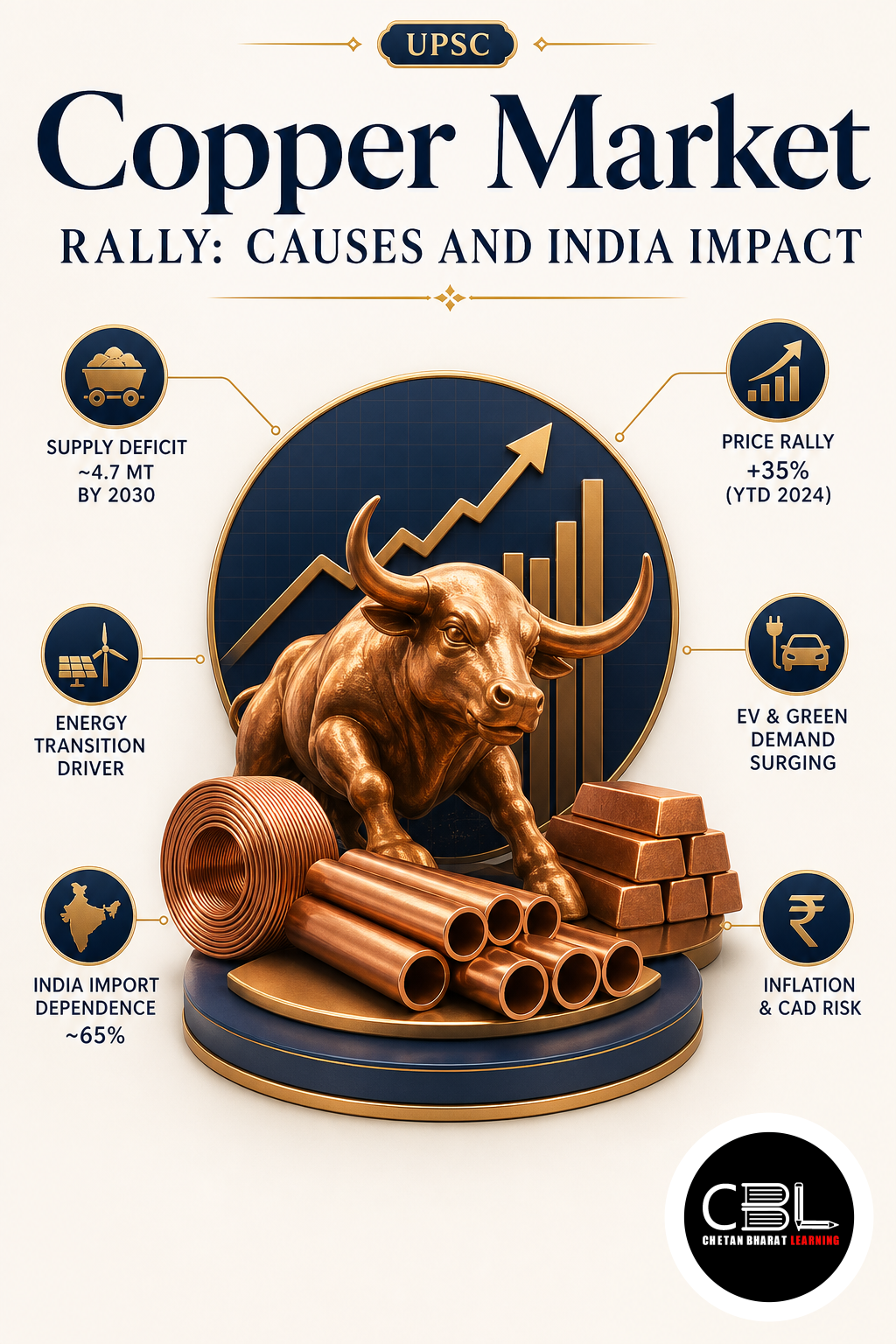
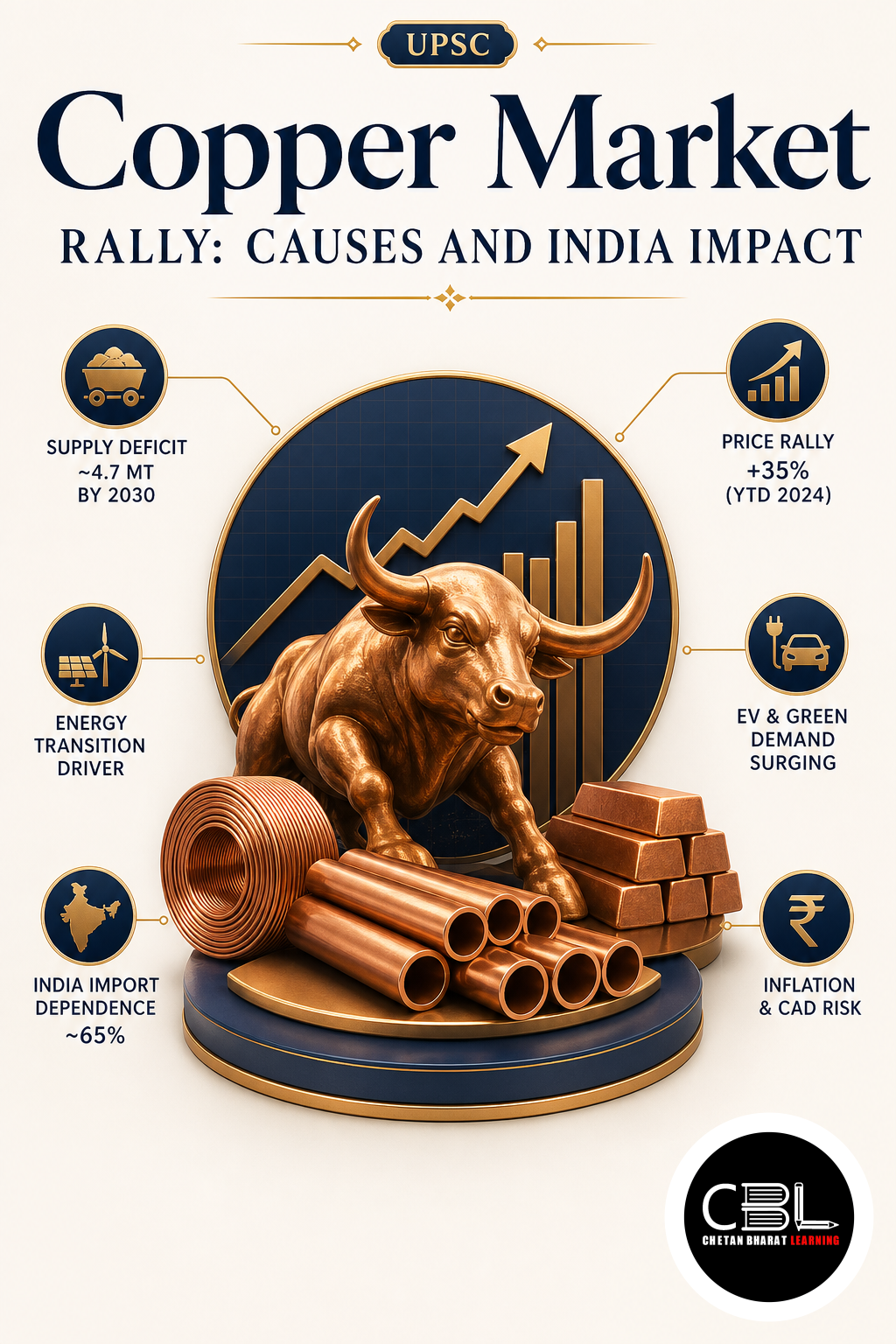
The Copper Market includes the mining, processing, trading and consumption of copper across the global economy. Producers extract copper-bearing ores and convert them into concentrates, refined metal, rods, sheets and other industrial products. Prices respond to present supply conditions and expectations about future economic activity.
Copper is a reddish-brown, non-ferrous metal with exceptionally high electrical and thermal conductivity. It is also ductile, malleable, corrosion-resistant and recyclable without substantial loss of performance. These properties make it essential for electrical cables, construction, electronics, machinery, transport equipment and renewable-energy systems.
Why is the Copper Market in News?
The Copper Market entered the news after benchmark prices climbed to record levels amid concerns about constrained supplies. Mine disruptions, declining ore quality, slow project development and tight availability of refined metal influenced market expectations. Financial positioning and changing trade policies also amplified short-term price movements.
Demand expectations remain strong because power grids, electric vehicles, renewable-energy installations and data centres require substantial copper-intensive equipment. Traders often call the metal “Dr Copper” because its widespread industrial use can reveal changes in global economic activity. The London Metal Exchange copper page tracks international reference prices, inventories and contract information.
Key Features
- High conductivity: Copper efficiently carries electricity and heat, making it indispensable for wiring, transformers, motors, generators, telecommunications and electronic equipment.
- Ductility and malleability: Manufacturers can draw the metal into thin wires or shape it into sheets without easily breaking the material.
- Energy-transition role: Solar plants, wind turbines, electric vehicles, charging networks and upgraded grids use copper in cables, motors and power-management systems.
- Alloy formation: Copper combines with zinc to form brass and with tin to form bronze, expanding its engineering, artistic and monetary applications.
- Recycling potential: Recovered copper can re-enter manufacturing, reducing pressure on mines and supporting a circular mineral economy when collection systems operate effectively.
Challenges
- Long project timelines: Exploration, environmental assessment, land acquisition, financing and mine development can take years before additional production reaches consumers.
- Concentrated global supply: Production depends heavily on a limited group of countries, exposing buyers to political disruption, regulatory change and logistical bottlenecks.
- Import dependence: India’s domestic demand exceeds its mined supply, creating exposure to international prices, freight costs and exchange-rate movements.
- Environmental impacts: Mining and smelting can affect forests, water, soil and air unless operators apply strict safeguards, restoration measures and pollution controls.
- Recycling gaps: Informal collection, weak segregation and inadequate processing can reduce metal recovery while exposing workers to unsafe handling practices.
High prices can increase costs for electricity networks, housing, transport equipment and consumer electronics. Sudden price declines can also discourage investment in mines that require large initial expenditure. Chetan Bharat Learning’s environment and resource coverage helps aspirants examine the ecological dimensions of mineral extraction.
Way Forward
India should accelerate scientific exploration while ensuring transparent auctions, timely approvals and enforceable environmental standards. Public and private investment can modernise mines, beneficiation facilities, smelters and refineries. Overseas mineral partnerships can diversify supply, but they should complement domestic production and responsible sourcing.
A resilient Copper Market also requires urban mining, formal recycling networks and product designs that simplify material recovery. Manufacturers can improve copper efficiency without compromising electrical safety or infrastructure quality. The Ministry of Mines can coordinate exploration, mineral security, international partnerships and resource-efficiency policies across the value chain.
Prelims Practice Corner
-
Q1. What are the chemical symbol and atomic number of copper, respectively?
- (a) Co and 27
- (b) Cu and 29
- (c) Cr and 24
- (d) Ca and 20
Answer: (b) Copper has the chemical symbol Cu and atomic number 29.
-
Q2. Why is copper sometimes described as Dr Copper?
- (a) It has medicinal properties
- (b) Its demand indicates industrial conditions
- (c) It prevents all metal corrosion
- (d) It is used only in hospitals
Answer: (b) Its broad industrial use makes price and demand trends useful signals of economic activity.
-
Q3. Which country is the leading global producer of mined copper?
- (a) Chile
- (b) Japan
- (c) Germany
- (d) Singapore
Answer: (a) Chile remains the leading producer of mined copper globally.
-
Q4. Consider the following properties of copper: 1. High electrical conductivity 2. Ductility 3. Ability to form alloys 4. Complete resistance to every form of corrosion. How many statements are correct?
- (a) Only one
- (b) Only two
- (c) Only three
- (d) All four
Answer: (c) Statements 1, 2 and 3 are correct, while copper is not immune to every form of corrosion.
-
Q5. Which Indian states are associated with important copper deposits or production?
- (a) Madhya Pradesh, Rajasthan and Jharkhand
- (b) Kerala, Haryana and Bihar
- (c) Punjab, Goa and Assam
- (d) Odisha, Sikkim and Uttar Pradesh only
Answer: (a) Important copper resources and mining centres occur in Madhya Pradesh, Rajasthan and Jharkhand.
Mains Practice Questions
-
Q1. Explain the factors driving the global copper price rally and assess its implications for the Indian economy. (15 marks)
Answer Structure:
- Intro: Establish copper’s role as an industrial metal and economic indicator.
- Body: Examine supply constraints, electrification demand, trade factors, import costs, inflation and infrastructure implications.
- Conclusion: Advocate diversified supplies, domestic exploration, efficient consumption and stronger recycling systems.
-
Q2. A clean-energy transition can replace fuel dependence with mineral dependence. Discuss with reference to copper. (10 marks)
Answer Structure:
- Intro: Link renewable energy and electrification with rising demand for conductive metals.
- Body: Cover grids, electric vehicles, supply concentration, import risks, mining impacts and circular-economy opportunities.
- Conclusion: Emphasise responsible mining, material efficiency, recycling and diversified international partnerships.
FAQs on Copper Market
- Why are copper prices rising?
- Prices reflect concerns about constrained mine supplies and expectations of stronger demand from electrification. Financial activity, inventories and trade policies can intensify short-term movements.
- Why is copper important for renewable energy?
- Copper efficiently conducts electricity and appears in cables, motors, transformers and grid connections. Solar, wind and electric-vehicle systems therefore require significant copper-based equipment.
- How can India improve copper security?
- India can expand exploration, improve domestic processing and diversify overseas supply partnerships. Formal recycling and efficient product design can further reduce pressure on primary mineral resources.
Related Current Affairs
Preparing for UPSC, PCS or HCS?
Talk to a mentor at Chetan Bharat Learning, Chandigarh. Free guidance on choosing the right exam and building a study plan.
Chat on WhatsAppCall 97793 53345UPSC / IAS / PCS coaching in Chandigarh · Trusted by aspirants across Punjab & Haryana
Leave a Reply
You must be logged in to post a comment.