

Important for
Quick Facts
What are Copper Prices?
Copper Prices represent the market value of refined metal traded through physical contracts and commodity exchanges. The London Metal Exchange and the US Commodity Exchange provide widely followed futures benchmarks. These contracts help miners, manufacturers and traders manage price risk across different delivery periods.
Copper conducts electricity efficiently and supports buildings, machinery, electronics, defence systems and transport networks. Power grids, renewable projects, electric vehicles and data centres have expanded its strategic importance. Its broad industrial use explains the nickname Dr Copper, because movements often signal changing economic activity.
Why are Copper Prices in News?
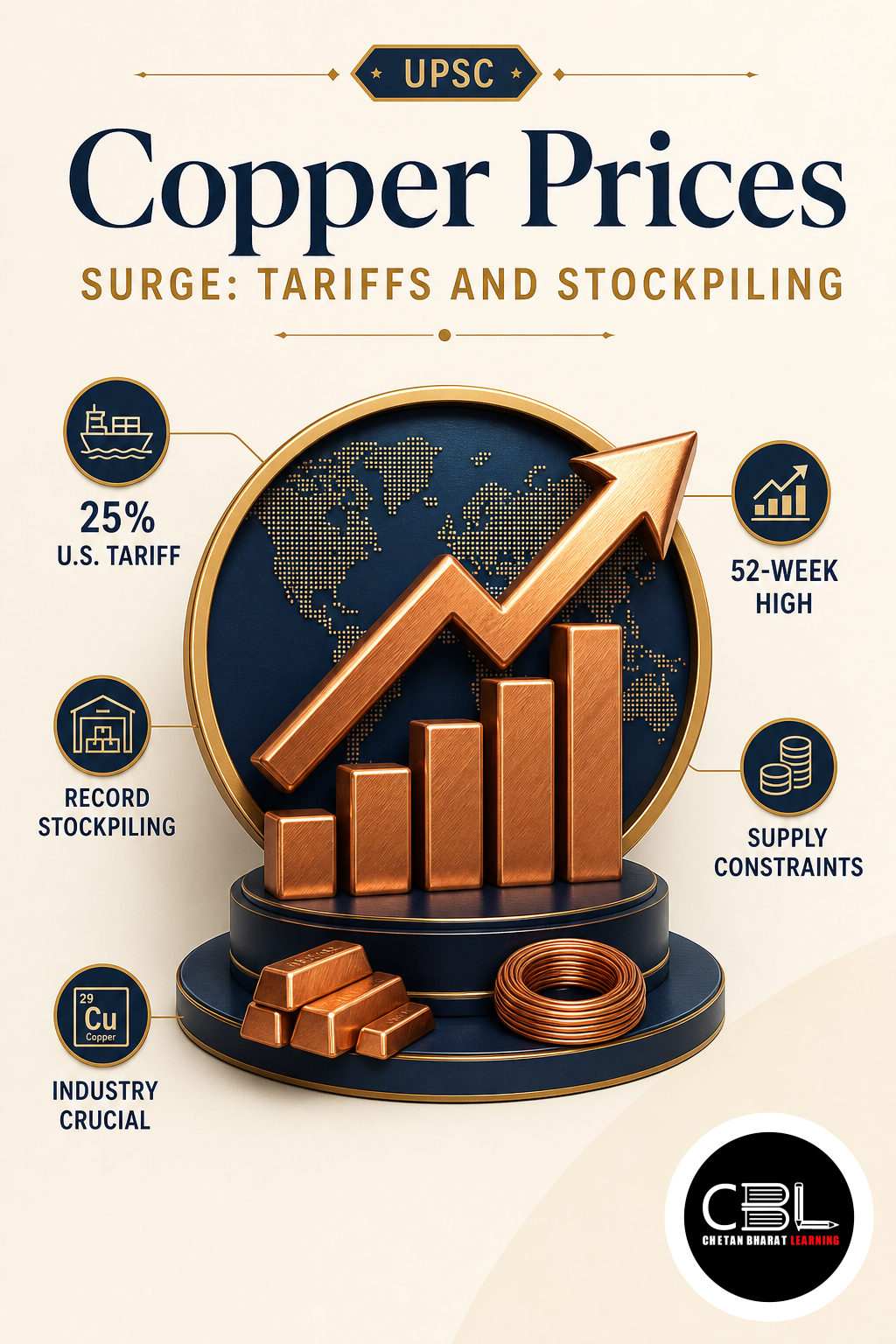
Copper Prices recently touched an all-time high of USD 14,708 per tonne after sharp volatility. LME three-month futures remained above USD 14,000 through much of August before rising further in September 2026. The move occurred amid trade disputes, the West Asia conflict and concerns about weaker global demand.
Traders moved refined metal towards American warehouses while anticipating possible US duties on refined imports. Existing US measures apply a 50 per cent tariff to specified semi-finished and copper-intensive derivative products, while refined cathodes remain outside that measure. The official US tariff fact sheet explains the current product coverage and national-security rationale.
Key Features
- Tariff anticipation: Expectations of possible refined-copper duties encouraged buyers to secure material early and redirect shipments towards the United States.
- Warehouse rebalancing: Higher American inventories coincided with tighter tradable stocks in London and Shanghai, increasing competition for immediately deliverable metal elsewhere.
- Exchange arbitrage: Price gaps between COMEX and LME contracts rewarded traders who bought in cheaper markets and sold equivalent positions in costlier markets.
- Constrained mine supply: Operational disruptions, declining ore grades and slow project development restrict the industry’s ability to respond quickly to higher quotations.
- Structural demand: Electricity networks, renewable power, electric mobility, defence production and data centres require large quantities of conductive material over long periods.
Challenges
- Higher input costs: Expensive metal raises costs for cables, electrical equipment, construction, transport, renewable projects and other manufacturing value chains.
- Policy-driven volatility: A delayed, reduced or abandoned refined-metal tariff could reverse warehouse flows and trigger a sudden correction in international quotations.
- Import exposure: India’s expanding infrastructure and clean-energy programmes increase its sensitivity to overseas supply disruptions, freight costs and currency movements.
- Long project timelines: New mines and smelters require substantial capital, environmental clearances, supporting infrastructure and several years before commercial production begins.
- Sustainability pressures: Mining and refining must manage water use, waste, emissions, land impacts, worker safety and community concerns.
Way Forward
India should diversify import sources, strengthen domestic exploration and improve recovery from scrap and industrial waste. Policymakers can support modern smelting, transparent inventories and risk-management access for smaller manufacturers without distorting market signals. Strategic partnerships should combine supply security with responsible mining, efficient water use and credible environmental safeguards.
Governments should communicate tariff decisions clearly because prolonged uncertainty encourages costly stockpiling and fragmented trade flows. The IEA mineral-security analysis highlights diversified supply, innovation and recycling for clean-energy transitions. Stable Copper Prices ultimately require wider production, circular use and predictable trade policy rather than dependence on geographically concentrated inventories.
Prelims Practice Corner
Q1. Why is copper often called Dr Copper?
(a) It has medicinal uses (b) Its broad use signals economic activity (c) Doctors regulate its trade (d) It trades only in hospitals
Answer: (b) Copper’s wide industrial use makes its demand sensitive to economic activity.
Q2. What does commodity-market arbitrage involve?
(a) Exploiting price differences (b) Fixing one global price (c) Banning warehouse storage (d) Cancelling futures contracts
Answer: (a) Traders exploit price differences for the same commodity across markets.
Q3. Which exchange is associated with a major global three-month copper benchmark?
(a) London Metal Exchange (b) Bombay Stock Exchange (c) National Commodity Board (d) International Monetary Fund
Answer: (a) The London Metal Exchange provides a widely followed three-month contract.
Q4. Why can stockpiling raise a regional commodity benchmark?
(a) It increases immediate availability (b) It reduces tradable stocks elsewhere (c) It eliminates industrial demand (d) It fixes exchange rates
Answer: (b) Redirecting stocks can tighten immediately available supply in other markets.
Q5. Which activity creates substantial long-term copper demand?
(a) Power-grid expansion (b) Monetary-policy voting (c) Census delimitation (d) Foodgrain procurement
Answer: (a) Electricity networks require extensive conductive wiring and equipment.
Mains Practice Questions
Q1. Explain how tariff expectations and inventory movements can distort global commodity markets. (250 words, 15 marks)
Answer Structure:
Intro: Distinguish policy-driven price movements from a conventional demand-led rally.
Body: Cover front-loading, warehouse shifts, regional scarcity, arbitrage and reversal risks.
Conclusion: Emphasise predictable trade rules and transparent market information.
Q2. Assess the implications of an expensive copper market for India’s development strategy. (150 words, 10 marks)
Answer Structure:
Intro: Link the metal with infrastructure, electrification and manufacturing.
Body: Examine import costs, inflation, project viability, supply diversification, recycling and domestic capacity.
Conclusion: Advocate resilient sourcing with responsible production and circular use.
FAQs on Copper Prices
What primarily caused the latest copper rally?
Tariff expectations encouraged traders to move refined metal into American warehouses. This reduced immediately tradable stocks in other major markets.
Does the record level prove that global growth is strong?
Not necessarily, because inventory relocation and trade-policy uncertainty can raise benchmarks independently. Demand fundamentals remain important for the rally’s durability.
Why does this development matter for India?
India needs the metal for grids, transport, housing, renewable energy and manufacturing. Higher import costs strengthen the case for diversified sourcing, recycling and efficient domestic production.
Related Current Affairs
Preparing for UPSC, PCS or HCS?
Talk to a mentor at Chetan Bharat Learning, Chandigarh. Free guidance on choosing the right exam and building a study plan.
Chat on WhatsAppCall 97793 53345UPSC / IAS / PCS coaching in Chandigarh · Trusted by aspirants across Punjab & Haryana
Leave a Reply
You must be logged in to post a comment.