
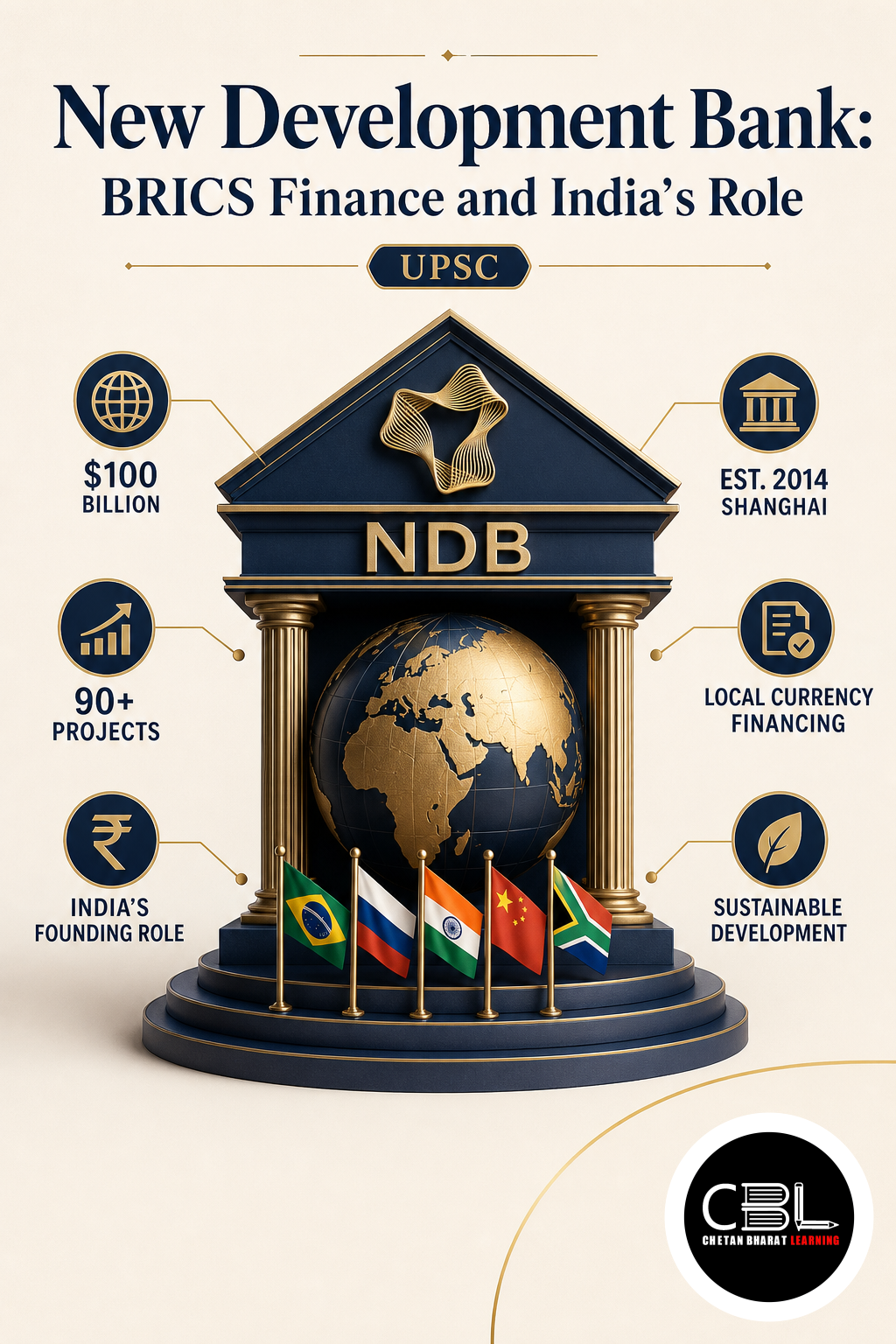

UPSC Mapping
| Prelims | International Organisations and BRICS |
|---|---|
| Mains | GS Paper II — International Relations |
Quick Facts
| Established | 2015 |
|---|---|
| Headquarters | Shanghai, China |
| Founding Members | Brazil, Russia, India, China and South Africa |
| Authorised Capital | US$100 billion |
Article
New Development Bank represents a significant effort by emerging economies to influence global development finance. The BRICS-founded institution finances infrastructure and sustainable development projects while promoting local-currency lending and institutional equality. Its expanding membership has renewed debate about reforming the international financial architecture and increasing the voice of developing countries. Aspirants can connect this institution with related developments in the international relations archive.
What is New Development Bank?
New Development Bank is a multilateral development institution established by the five original BRICS countries. It mobilises resources for infrastructure and sustainable development projects in emerging markets and developing countries. Its operational focus includes clean energy, transport, water, sanitation, digital connectivity, environmental protection and social infrastructure.
BRICS leaders first discussed the proposal at their New Delhi summit in 2012. They signed the founding agreement at Fortaleza, Brazil, in 2014, and the institution began operations in 2015. Its headquarters are in Shanghai, while regional offices support project development in different member regions. Indian banker K. V. Kamath served as its first president.
Why is New Development Bank in News?
New Development Bank has attracted attention because its membership and development role continue to expand. Bangladesh, the United Arab Emirates, Egypt and Algeria joined after the five founding members. Uzbekistan became a member in June 2026, taking the institution beyond its original BRICS composition and strengthening its presence across Asia, Africa and the Middle East.
Its expansion has coincided with wider BRICS discussions about improving access to development finance and increasing the representation of emerging economies. The bank admits United Nations members under the conditions prescribed by its Articles of Agreement. Countries approved by its Board of Governors become full members only after depositing their accession instruments. The official NDB membership page distinguishes existing members from prospective members.
Key Features
The institution combines a development mandate with governance arrangements designed around emerging-economy priorities.
- Equal founding shares: The five founding countries began with equal subscriptions and voting power, preventing any single founding member from obtaining veto authority.
- Infrastructure mandate: Financing targets projects that expand productive capacity, public services, connectivity, climate resilience and sustainable economic development.
- Local-currency finance: Lending and bond issuance in members’ currencies can reduce exchange-rate exposure and dependence on dollar-denominated borrowing.
- Rotational leadership: The presidency rotates among the founding members, reflecting the principle of institutional participation among the original shareholders.
- Flexible instruments: The bank can provide sovereign loans, non-sovereign finance, guarantees, equity participation and project-preparation support within its mandate.
Its authorised capital stands at US$100 billion, while the initial subscribed capital amounted to US$50 billion. Authorised capital defines the maximum capital permitted under the founding framework. Subscribed capital represents the amount members commit to provide through paid-in and callable portions. This structure supports borrowing from capital markets while protecting the institution’s financial credibility.
The General Strategy for 2022–2026 set targets for US$30 billion in approved financing. It also sought to direct 40 per cent of approvals towards climate mitigation and adaptation, including energy transition. Other targets included providing 30 per cent of total financing in local currencies, expanding non-sovereign operations and increasing co-financing with partner development banks.
Challenges
New Development Bank must balance ambitious expansion with financial strength, project quality and institutional credibility.
- Resource mobilisation: Large infrastructure gaps require substantial lending capacity, but borrowing costs and credit ratings influence how cheaply the institution can raise funds.
- Geopolitical pressures: Strategic tensions involving member countries can affect market access, partnerships, payment channels and perceptions of institutional independence.
- Project quality: Rapid approval must not weaken environmental assessment, social safeguards, procurement integrity or long-term debt sustainability.
- Currency risks: Local-currency lending reduces borrower exposure but requires deep bond markets, effective hedging tools and careful asset-liability management.
- Membership balance: Expansion must protect the voice of founding members while providing credible representation and incentives to newly admitted countries.
The institution also operates alongside established multilateral development banks rather than replacing them. The World Bank, Asian Development Bank and other regional institutions possess larger balance sheets and extensive implementation experience. NDB can add value through faster processing, local knowledge, co-financing and financial innovation, provided that it maintains transparent standards and measurable outcomes.
For India, the bank offers another source of long-term funding for urban services, transport, renewable energy and water infrastructure. India also gains a platform for shaping South-South cooperation and multilateral reform. Project selection must nevertheless remain consistent with national priorities, sound public finance and effective implementation. Related economic institutions are covered in the economy current affairs section.
Way Forward
The bank should expand its capital base gradually while protecting prudent lending standards. Strong project preparation, independent evaluation and transparent environmental safeguards can improve development outcomes. Co-financing with national institutions and other multilateral banks can distribute risk, mobilise private capital and transfer technical expertise.
New Development Bank should deepen viable local-currency markets and design financing suitable for climate-resilient infrastructure. Its next strategy must publish clear targets for project outcomes, private-sector participation and regional balance. The official general strategy framework illustrates its existing priorities. India can use its founding role to promote accountable lending, equitable governance and practical cooperation among developing economies.
Prelims Practice Corner
Q1. Where is the headquarters of the NDB located?
(a) New Delhi (b) Johannesburg (c) Shanghai (d) Brasília
Answer: (c) Shanghai, China.
Q2. Which countries established the NDB?
(a) ASEAN members (b) Original BRICS members (c) G7 members (d) SAARC members
Answer: (b) Brazil, Russia, India, China and South Africa.
Q3. What is the principal mandate of the NDB?
(a) Settling territorial disputes (b) Financing infrastructure and sustainable development (c) Regulating international oil prices (d) Administering global trade rules
Answer: (b) Infrastructure and sustainable development.
Q4. Consider the following statements: 1. Membership is open to UN members. 2. Every country approved by the Board becomes a full member immediately. 3. The founding members initially received equal voting rights. How many statements are correct?
(a) Only one (b) Only two (c) All three (d) None
Answer: (b) Two statements (1 and 3).
Q5. Local-currency lending by a multilateral bank primarily helps borrowers reduce which risk?
(a) Exchange-rate risk (b) Geological risk (c) Electoral risk (d) Demographic risk
Answer: (a) Exchange-rate risk.
Mains Practice Questions
Q1. Examine the role of the NDB in reforming development finance for emerging economies. (250 words, 15 marks)
Answer Structure:
Intro: BRICS-created multilateral development bank.
Body: Infrastructure finance, equal rights, local currencies, climate funding, membership expansion, geopolitical constraints, safeguards.
Conclusion: Complementary institution needing transparency and measurable outcomes.
Q2. How can India use its founding membership of the NDB to advance national and Global South priorities? (150 words, 10 marks)
Answer Structure:
Intro: Link India’s infrastructure needs with emerging-economy cooperation.
Body: Climate finance, urban infrastructure, local-currency lending, institutional reform, project standards, knowledge exchange.
Conclusion: Leadership combining national benefits with equitable development finance.
FAQs on New Development Bank
Why did the BRICS countries establish this institution?
They created it to mobilise additional resources for infrastructure and sustainable development in emerging economies and to provide another platform within the international financial system.
Which countries are its members?
Founding members (Brazil, Russia, India, China, South Africa) plus Bangladesh, the UAE, Egypt, Algeria and Uzbekistan. Other approved members must complete accession procedures.
How is the NDB different from the BRICS Contingent Reserve Arrangement?
The NDB finances infrastructure and sustainable development, whereas the Contingent Reserve Arrangement offers a financial safety mechanism for short-term balance-of-payments needs.
Related Current Affairs
Preparing for UPSC, PCS or HCS?
Talk to a mentor at Chetan Bharat Learning, Chandigarh. Free guidance on choosing the right exam and building a study plan.
Chat on WhatsAppCall 97793 53345UPSC / IAS / PCS coaching in Chandigarh · Trusted by aspirants across Punjab & Haryana
Leave a Reply
You must be logged in to post a comment.