

UPSC Mapping
| Prelims | Constitutional Provisions and Official Languages |
|---|---|
| Mains | GS Paper II — Constitution and Federalism |
Quick Facts
| Compromise Adopted | 14 September 1949 |
|---|---|
| Constitutional Part | Part XVII |
| Union Language | Hindi in Devanagari Script |
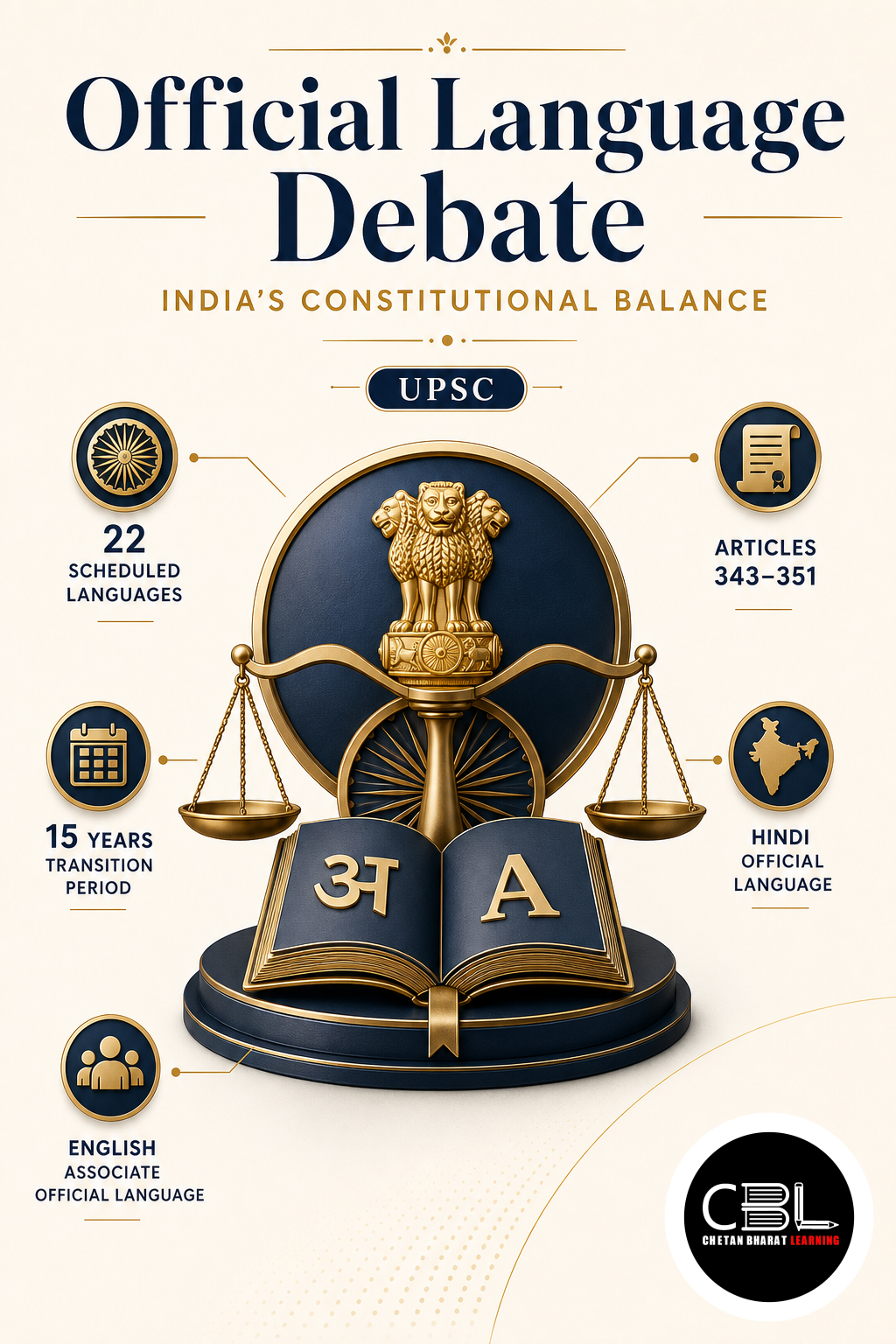
| Initial Transition | 15 Years |
What is Official Language Debate?
Official Language Debate refers to the Constituent Assembly’s deliberations over the language of Union administration, legislation, courts and intergovernmental communication. The issue involved competing demands for Hindi, Hindustani, English and regional languages. It also raised broader questions about national integration, democratic participation, administrative continuity and minority protection.
Some members demanded that Hindi immediately replace English and serve as the national language. Representatives from several non-Hindi-speaking regions opposed compulsory linguistic uniformity and warned against majoritarian domination. Moderate leaders supported the gradual use of Hindi while retaining English for administration, law, higher education and communication during a transition. The Constitution eventually adopted the Munshi–Ayyangar formula as a workable compromise.
Why is Official Language Debate in News?
Official Language Debate returned to public attention around Hindi Diwas, observed annually on 14 September. On this date in 1949, the Constituent Assembly adopted the compromise underlying Article 343. Revisiting the deliberations clarifies that the Assembly chose Hindi as the official language of the Union, not as India’s constitutionally declared national language.
The historical discussion remains relevant whenever language policy affects recruitment, education, parliamentary work, judicial access or communication between governments. India’s constitutional design accommodates both language promotion and linguistic diversity. The official Constitution of India places these provisions in Part XVII and distributes language-related responsibilities among Parliament, the Union, states and constitutional authorities.
Key Features
The constitutional settlement combines Union-level provisions with safeguards for states, courts and linguistic minorities.
- Article 343: It declares Hindi in Devanagari script as the Union’s official language and adopts the international form of Indian numerals for official purposes.
- Continuance of English: The Constitution permitted English to continue for Union purposes during an initial fifteen-year period, while Parliament retained power to extend its use.
- State autonomy: Article 345 allows a state legislature to adopt one or more languages used in that state, or Hindi, for official purposes.
- Judicial language: Article 348 provides for English in the Supreme Court, High Courts and authoritative legislative texts unless constitutionally permitted alternatives apply.
- Linguistic safeguards: Articles 350A and 350B address mother-tongue instruction at the primary stage and the Special Officer for Linguistic Minorities.
Article 344 provides for an Official Language Commission and a parliamentary committee to review the progressive use of Hindi and restrictions on English. Article 351 directs the Union to promote Hindi while drawing upon Hindustani and other languages listed in the Eighth Schedule. This duty does not eliminate constitutional respect for India’s linguistic pluralism.
The Eighth Schedule originally contained fourteen languages and now contains twenty-two. Inclusion recognises languages for specified constitutional purposes, including representation in the Official Language Commission. Scheduled-language status does not automatically make a language an official language in every state or at the Union level.
Challenges
Official Language Debate continues to influence governance because language connects identity, opportunity, federalism and access to public institutions.
- Perceived imposition: Rapid or compulsory promotion of one language may create resistance among communities that associate regional languages with cultural and political identity.
- Administrative capacity: Translation, terminology standardisation and multilingual staffing require sustained investment across departments, courts and public-service institutions.
- Equality of opportunity: Language requirements in examinations or employment may disadvantage capable candidates educated through different linguistic media.
- Judicial accessibility: English supports consistency across higher courts, yet many citizens face difficulty understanding proceedings and authoritative legal materials.
- Digital inequality: Government platforms and emerging technologies often provide uneven support for Indian languages, scripts and specialised administrative vocabulary.
The Official Languages Act, 1963, permits English to continue alongside Hindi for specified Union purposes after 1965. Its operation reflects the political understanding that language transition must depend on consent and administrative readiness. The Official Language Rules, 1976, guide implementation across regions while recognising differences in the use of Hindi.
Language policy must also distinguish promotion from compulsion. The Union can expand translations, terminology resources and Hindi training without weakening other Indian languages. States retain substantial constitutional space to conduct their affairs in languages selected by their legislatures. Such accommodation forms an important dimension of contemporary governance developments.
Way Forward
India should strengthen multilingual governance through high-quality translation, language-neutral recruitment safeguards and accessible public services. Courts and legislatures can expand authenticated Indian-language materials while maintaining consistency in authoritative texts. Technology-supported translation should undergo expert review, particularly for constitutional, scientific and legal terminology.
The constitutional lesson from Official Language Debate is that unity need not require linguistic uniformity. Consultation with states and linguistic communities can preserve trust while enabling wider use of Indian languages. The Department of Official Language provides statutory material and implementation guidance. A cooperative approach can advance administrative inclusion without disturbing India’s federal and cultural balance.
Prelims Practice Corner
Q1. According to Article 343, what is the official language of the Union?
(a) Hindi in Devanagari script (b) Sanskrit in Devanagari script (c) English in Roman script (d) Hindustani in Persian script
Show answer
Answer: (a) Article 343 declares Hindi in Devanagari script as the official language of the Union.
Q2. Which Article empowers a state legislature to adopt one or more official languages for that state?
(a) Article 344 (b) Article 345 (c) Article 348 (d) Article 351
Show answer
Answer: (b) Article 345 deals with the official language or languages of a state.
Q3. Consider the following statements: 1. The Constitution declares Hindi as India’s national language. 2. Hindi in Devanagari script is the Union’s official language. 3. Parliament may provide for the continued use of English. How many statements are correct?
(a) Only one (b) Only two (c) All three (d) None
Show answer
Answer: (b) Statements 2 and 3 are correct; the Constitution does not declare any national language.
Q4. Article 350B provides for which constitutional authority?
(a) Finance Commission (b) Official Language Commission (c) Special Officer for Linguistic Minorities (d) Inter-State Council
Show answer
Answer: (c) The President appoints the Special Officer for Linguistic Minorities under Article 350B.
Q5. Which constitutional provision directs the Union to promote the spread and development of Hindi?
(a) Article 348 (b) Article 349 (c) Article 350A (d) Article 351
Show answer
Answer: (d) Article 351 contains the directive concerning the development and spread of Hindi.
Mains Practice Questions
Q1. The Constituent Assembly’s language settlement balanced national integration with linguistic diversity. Discuss. (250 words, 15 marks)
Answer Structure
Intro: Introduce the competing language positions and the Munshi–Ayyangar compromise.
Body: Explain Articles 343–351, the English transition, state autonomy, judicial language, minority safeguards and continuing federal concerns.
Conclusion: Emphasise accommodation and consultation as foundations of India’s multilingual unity.
Q2. How can India promote Indian languages without undermining equality of opportunity and cooperative federalism? (150 words, 10 marks)
Answer Structure
Intro: Present language as both a cultural resource and an instrument of governance.
Body: Cover translation, education, recruitment safeguards, judicial access, digital tools, state consultation and protection of linguistic minorities.
Conclusion: Recommend multilingual capacity-building based on consent rather than compulsory uniformity.
FAQs on Official Language Debate
Does India have a national language under the Constitution?
No. The Constitution does not designate any language as India’s national language. Article 343 identifies Hindi in Devanagari script as the official language of the Union.
What was the Munshi–Ayyangar formula?
It was a compromise that accepted Hindi as the Union’s official language while continuing English during a transitional period. It also provided mechanisms for reviewing language use and protected space for regional languages.
Why does English continue in Union administration?
Parliament authorised its continued use through the Official Languages Act, 1963. English remains important for intergovernmental communication, higher courts, legislation and administration across linguistically diverse regions.
Related Current Affairs
Preparing for UPSC, PCS or HCS?
Talk to a mentor at Chetan Bharat Learning, Chandigarh. Free guidance on choosing the right exam and building a study plan.
Chat on WhatsAppCall 97793 53345UPSC / IAS / PCS coaching in Chandigarh · Trusted by aspirants across Punjab & Haryana
Leave a Reply
You must be logged in to post a comment.