
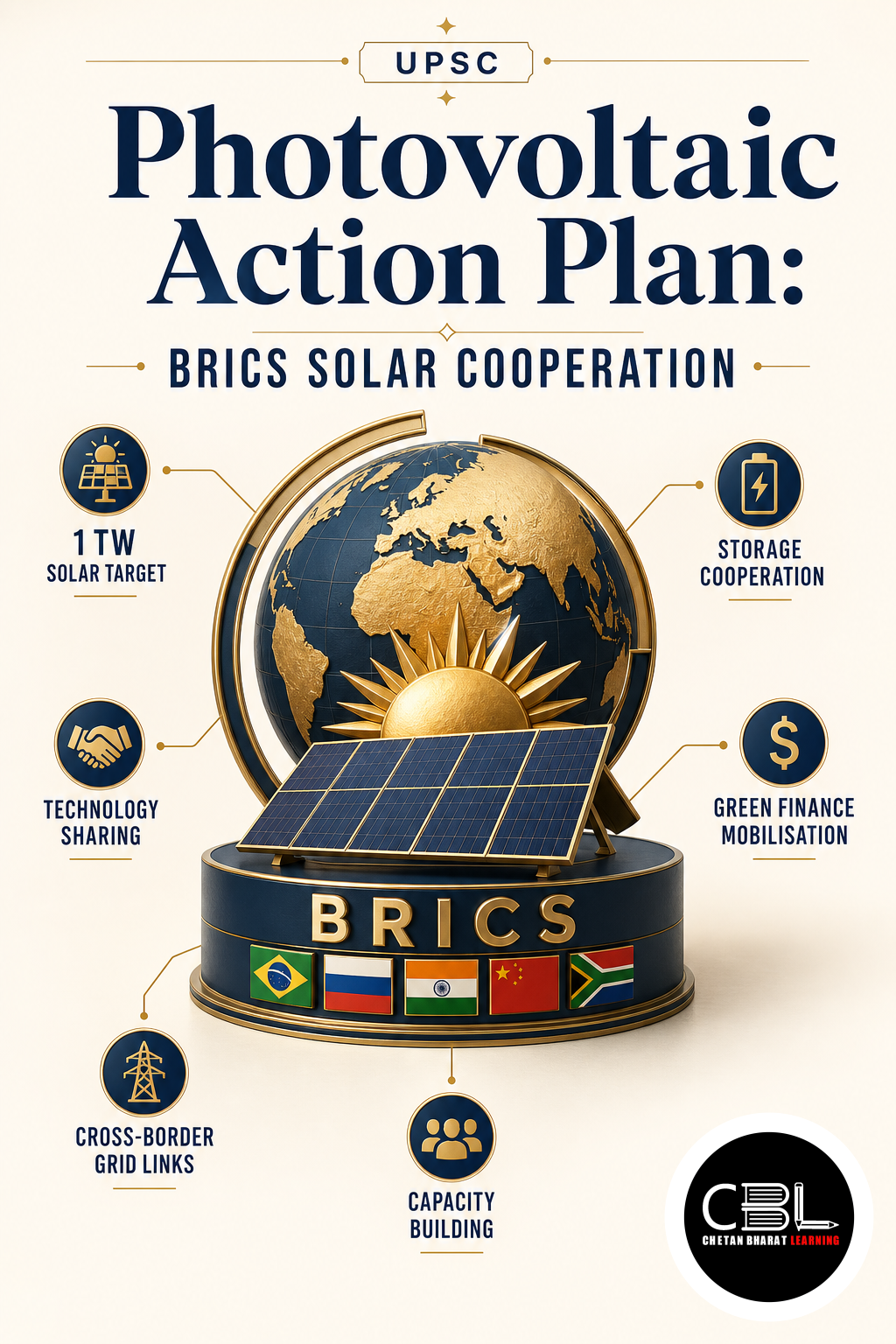
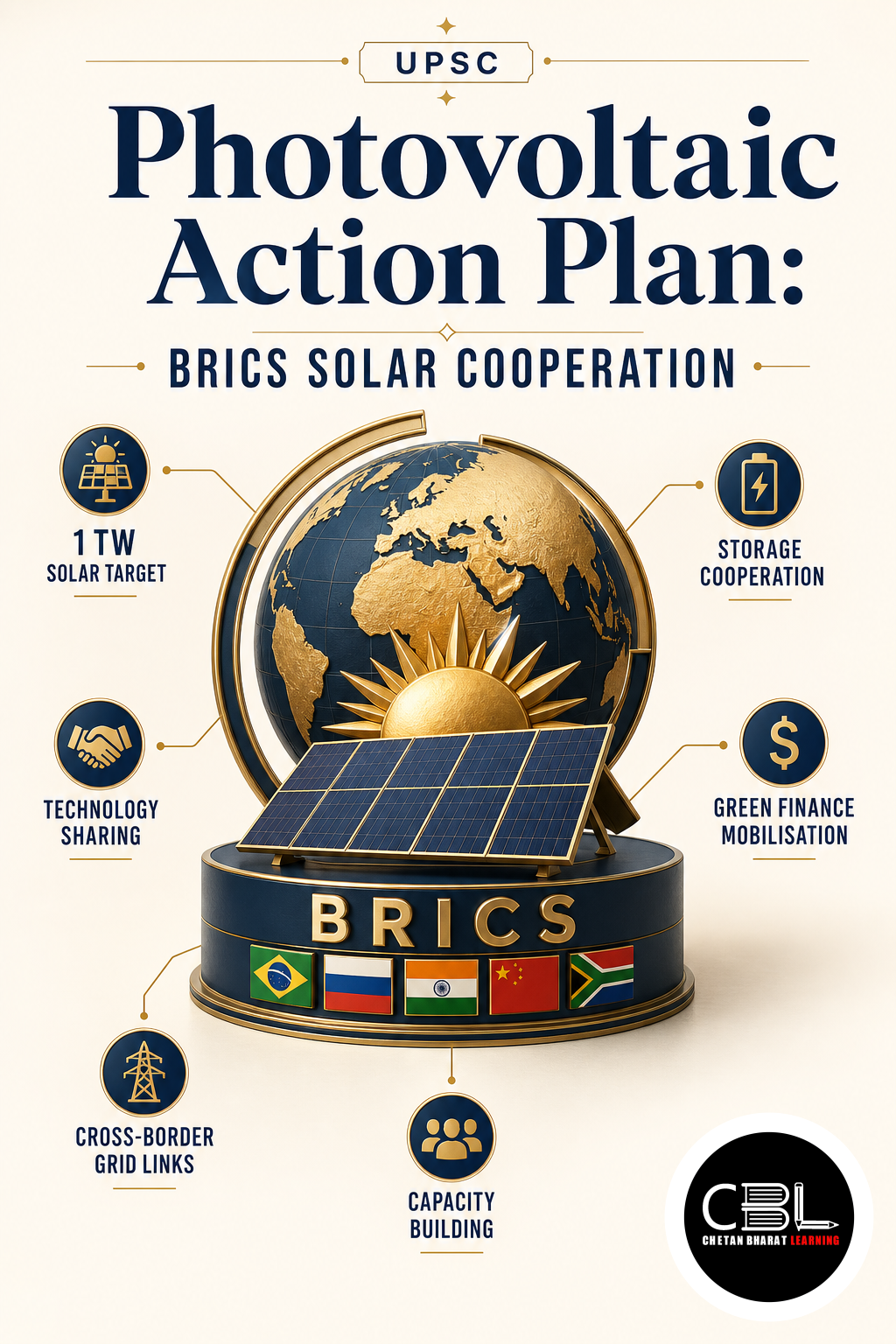
What is Photovoltaic Action Plan?
The Photovoltaic Action Plan is a framework for strengthening industrial cooperation across the BRICS solar sector. It encourages members to coordinate policies, exchange technical knowledge and identify commercially viable joint initiatives. The framework does not create a common subsidy or legally binding production target.
Photovoltaic technology converts sunlight directly into electricity through semiconductor materials used in solar cells. Its manufacturing chain generally moves from polysilicon to ingots, wafers, cells and finished modules. A competitive ecosystem also requires machinery, testing laboratories, inverters, logistics, research institutions and responsible recycling systems.
Why is Photovoltaic Action Plan in News?
The Photovoltaic Action Plan entered the news after BRICS Industry Ministers adopted it in Jaipur in August 2026. The 18th BRICS Summit in New Delhi subsequently welcomed the initiative. The development forms part of the group’s wider effort to deepen industrial and clean-energy cooperation under India’s chairship.
The initiative matters because BRICS members represent major markets, manufacturing centres and sources of industrial raw materials. Cooperation could reduce supply disruptions while supporting affordable solar deployment across developing economies. The official BRICS 2026 platform provides the institutional context for India’s priorities and summit-level engagements.
Key Features
The framework combines industrial coordination with practical measures for building a more capable and connected photovoltaic ecosystem.
- National knowledge portals: Members are encouraged to create portals that share solar policies, manufacturing developments, project experience and replicable practices across participating economies.
- Technology cooperation: The members can pursue research partnerships, manufacturing innovation, quality testing and technical exchanges across different stages of the solar value chain.
- Financing support: Cooperation can help identify bankable projects, reduce investment barriers and connect manufacturers with development institutions and suitable financial instruments.
- Capacity building: Training programmes can strengthen expertise among engineers, technicians, regulators, laboratories and enterprises working with photovoltaic equipment and production processes.
- PartNIR mechanism: The BRICS Photovoltaic Industry Working Group provides a specialised channel under the Partnership on New Industrial Revolution, established in 2018 to advance cooperation in industrialisation, digitalisation, innovation, inclusiveness and investment.
Challenges
The Photovoltaic Action Plan must address structural differences among members before broad commitments can produce durable industrial outcomes.
- Unequal industrial capabilities: Members possess different manufacturing strengths, domestic demand profiles and technology levels, which may complicate the selection of balanced joint projects.
- Upstream import dependence: Expanding module assembly does not automatically secure supplies of polysilicon, ingots, wafers, specialised machinery or other essential production inputs.
- Standards and intellectual property: Different certification systems, quality requirements and commercial protections may restrict technology exchange or mutual recognition of products.
- Financing constraints: High capital requirements, currency risks and uncertain demand can raise borrowing costs, particularly for smaller manufacturers and emerging technologies.
- Environmental safeguards: Policymakers must address mining impacts, industrial energy use, hazardous materials and growing volumes of end-of-life solar equipment through circular-economy systems.
Trade restrictions and competing national incentives may also limit cross-border integration. India must balance international collaboration with domestic value addition and reliable access to critical inputs.
Way Forward
BRICS members should convert broad priorities into transparent, project-based cooperation with measurable timelines. Joint research centres, shared training programmes and recognised testing procedures can lower duplication without weakening national quality requirements. Development banks can support viable projects while applying sound financial, environmental and social safeguards.
For India, the Photovoltaic Action Plan should complement stable domestic policies for upstream manufacturing, research, skills and recycling. The country can use cooperation to strengthen wafer and cell capabilities while retaining competition and supply diversity. The Ministry of New and Renewable Energy can align instruments such as the PLI scheme and ALMM framework with quality, innovation and long-term energy security.
Prelims Practice Corner
- Q1. The photovoltaic effect directly enables which process?
Answer: (a) Conversion of sunlight into electricity. - Q2. Order in a conventional solar PV chain: polysilicon → ingot → wafer → cell → module. Which sequence? Answer: (b) Polysilicon–ingot–wafer–cell–module.
- Q3. PartNIR is primarily concerned with which field? Answer: (b) Industrial transformation and innovation.
- Q4. Priority areas of the BRICS solar initiative? Answer: (b) Technology, financing and capacity building.
- Q5. The ALMM framework is administered by which ministry? Answer: (c) Ministry of New and Renewable Energy.
Mains Practice Questions
- Q1. Examine how BRICS cooperation can strengthen resilient and inclusive solar photovoltaic supply chains. (15 marks)
- Answer Structure: Intro, body (capabilities, technology exchange, financing, standards, skills, supply security, environmental safeguards), conclusion.
- Q2. India’s solar ambitions require movement from module assembly towards deeper domestic value addition. Discuss. (10 marks)
- Answer Structure: Intro (value chain), body (upstream dependence, technology gaps, finance, PLI incentives, ALMM standards, research, recycling), conclusion.
FAQs on Photovoltaic Action Plan
- What does the BRICS solar industry initiative seek to achieve?
It seeks stronger industrial cooperation through technology exchange, financing and capacity building, and shared portals for policies and practices. - What is PartNIR?
PartNIR is the BRICS Partnership on New Industrial Revolution, promoting cooperation in industrialisation, digitalisation, innovation, inclusiveness and investment. - Why does BRICS solar cooperation matter for India?
It supports access to technology, capital, skills and diversified inputs, helping India deepen domestic value addition while enhancing supply-chain resilience.
Related Current Affairs
Preparing for UPSC, PCS or HCS?
Talk to a mentor at Chetan Bharat Learning, Chandigarh. Free guidance on choosing the right exam and building a study plan.
Chat on WhatsAppCall 97793 53345UPSC / IAS / PCS coaching in Chandigarh · Trusted by aspirants across Punjab & Haryana
Leave a Reply
You must be logged in to post a comment.