
UPSC Syllabus Mapping
| GS Paper | GS-I and GS-III |
|---|---|
| Subject | Distribution of Mineral Resources, Mining, Industrial Resources and Environmental Issues |
What is Karlapat Bauxite Block?
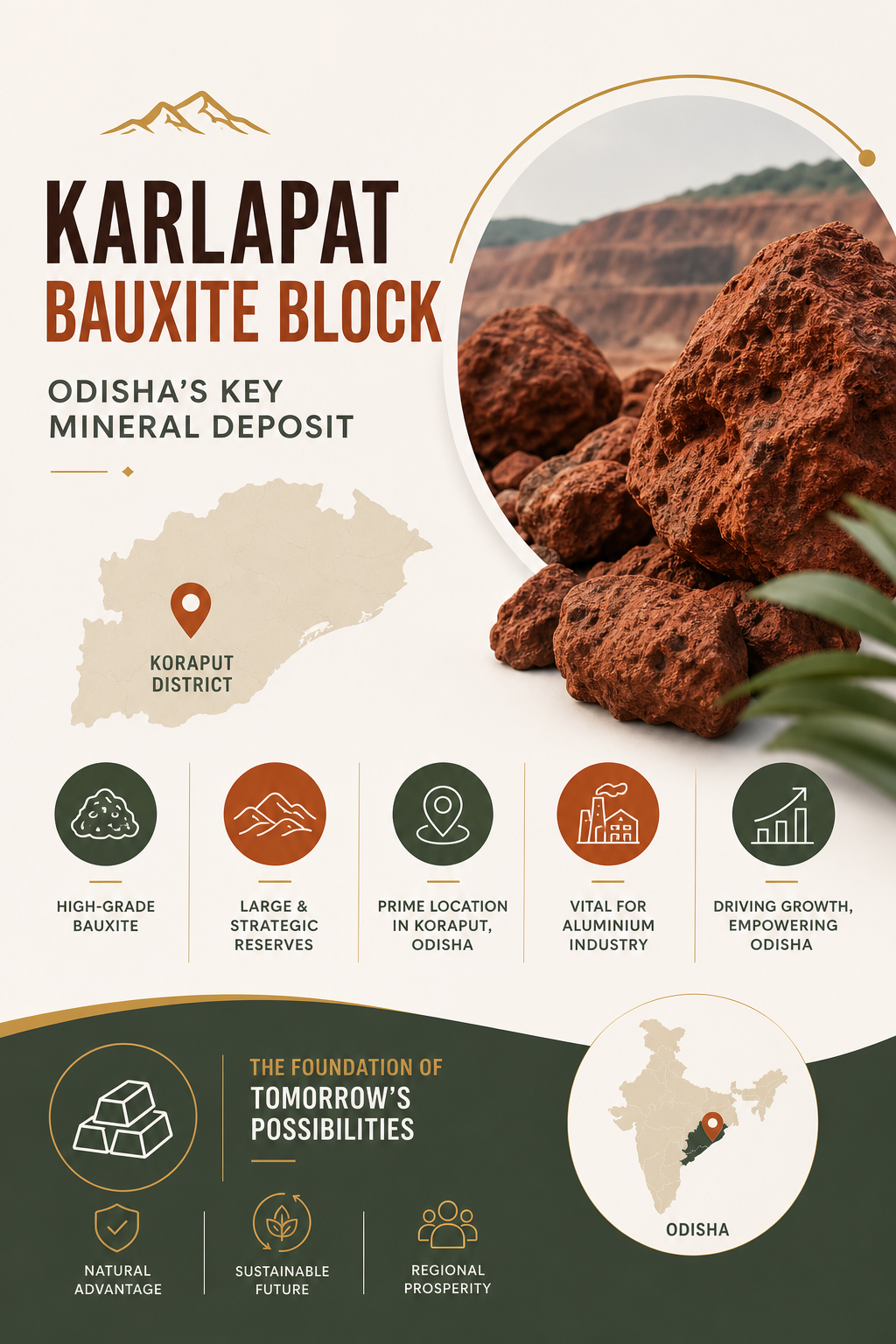
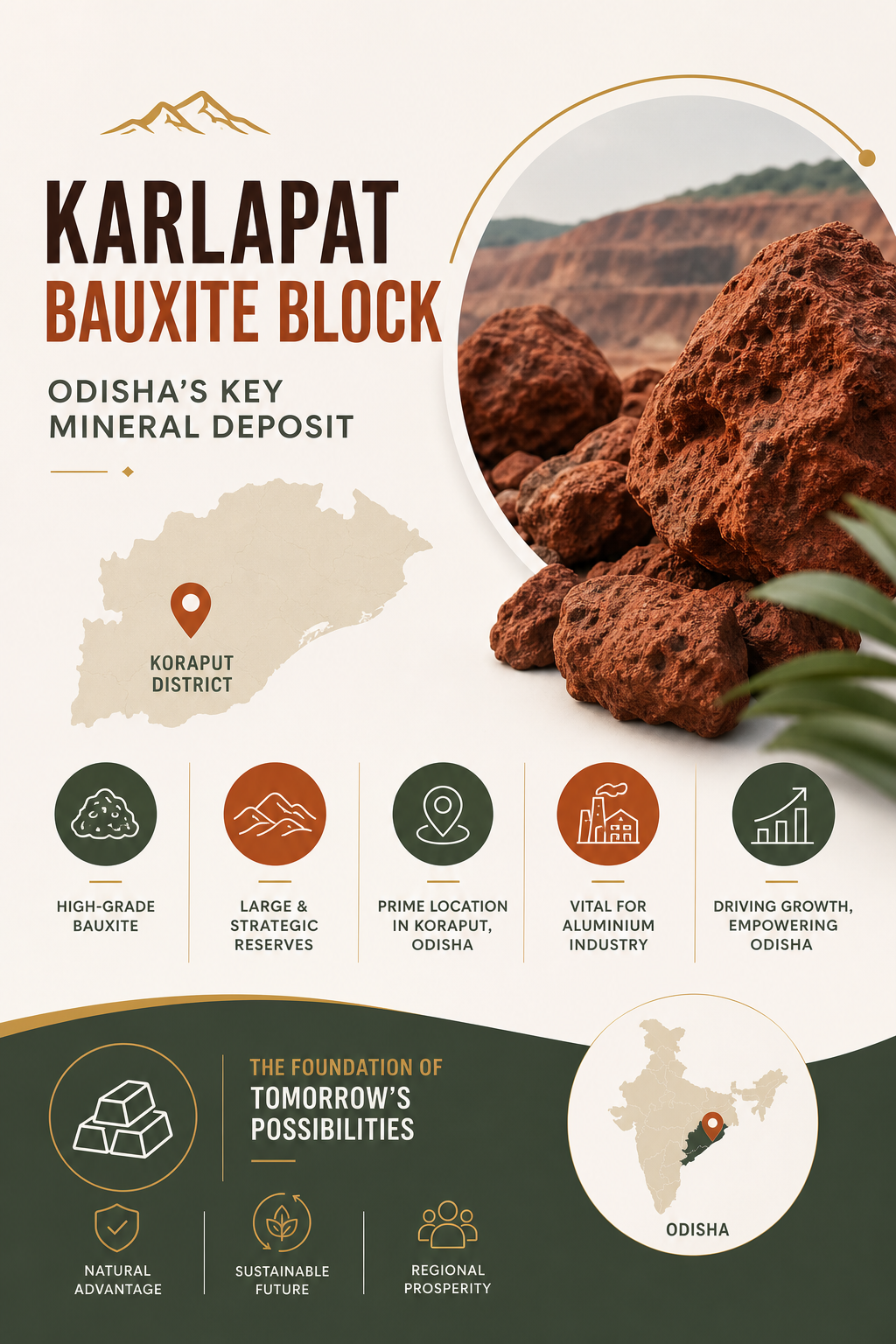
It is a significant bauxite deposit located in Kalahandi district of Odisha. It is described as a greenfield mining block, meaning that the deposit has not previously undergone commercial mining development. The block extends across a plateau area of approximately 9.6 square kilometres, where the bauxite-bearing ore has an average thickness of nearly 12 metres.
The deposit has an estimated resource of about 207 million tonnes, comprising around 153 million tonnes classified as proved and approximately 54 million tonnes under the possible category. The ore reportedly contains around 45.2 per cent alumina and relatively low silica. Ore quality matters economically because the composition of bauxite influences its suitability and processing requirements for producing alumina, which is subsequently converted into aluminium metal.
Why is Karlapat Bauxite Block in News?
The mineral block entered current affairs after several major Indian industrial groups reportedly showed interest in the deposit. The commercial attention reflects the strategic importance of securing long-term raw-material supplies for India’s aluminium industry. Large deposits can be particularly important for integrated producers because reliable access to bauxite supports downstream alumina refining and aluminium production.
The development is also relevant to India’s broader policy of auctioning mineral blocks through transparent and competitive mechanisms while increasing domestic mineral production. However, mineral extraction must operate within statutory requirements concerning mining, forests, environment and affected communities. Aspirants can consult the Ministry of Mines for authoritative information on India’s mineral policies, auctions and resource sector.
Key Features of Odisha’s Bauxite Resources
India’s important bauxite resources occur in the East Coast deposits, particularly across Odisha and Andhra Pradesh. Odisha possesses extensive plateau-type deposits and is one of India’s most important bauxite-bearing States. Reported resource estimates place Odisha’s bauxite resources at roughly 2,057 million tonnes, representing about 41 per cent of the country’s resources. This concentration gives the State considerable importance within India’s aluminium value chain.
- Location: The mineral block is situated in Kalahandi district of Odisha.
- Greenfield character: It has not previously been commercially mined, distinguishing it from an operating or brownfield mine.
- Resource base: The deposit is estimated to contain about 207 million tonnes of bauxite resources.
- Plateau deposit: The block extends across approximately 9.6 square kilometres of plateau terrain.
- Ore characteristics: The deposit records substantial alumina content along with comparatively low silica.
- Regional concentration: Odisha’s bauxite occurs across districts including Kalahandi, Koraput, Rayagada, Kandhamal, Balangir, Malkangiri, Kendujhar and Sundargarh.
Bauxite is a residual rock rich in aluminium-bearing minerals and commonly develops through intense chemical weathering in tropical and subtropical environments. Heavy rainfall and prolonged weathering can leach more soluble materials while leaving concentrations of relatively insoluble aluminium compounds. Plateau and hilltop deposits in peninsular India therefore provide an important link between geomorphology, climatic weathering processes and economic mineral geography.
Challenges Related to Karlapat Bauxite Block
Large-scale bauxite mining can generate substantial economic value, but plateau mining also requires careful environmental management. Removal of vegetation and overburden can alter drainage, soil stability and local ecological conditions. Mining plans therefore need appropriate environmental assessment, progressive reclamation, water management and restoration measures. The environmental cost of extraction must be considered across the entire life cycle rather than only during mine development.
Social considerations are equally important in mineral-rich regions. Mining projects may intersect with the livelihoods and customary resource use of local and tribal communities. Land acquisition, rehabilitation, compensation and benefit sharing must consequently comply with applicable legal safeguards. District Mineral Foundations and other institutional mechanisms can help channel a portion of mining-related benefits towards communities affected by extraction when implemented transparently and effectively.
Another challenge is ensuring that mineral extraction contributes to domestic value addition rather than functioning merely as raw-material removal. Aluminium production is energy intensive, so competitiveness depends not only on bauxite availability but also on efficient refining, reliable power, transport and low-carbon technologies. Aspirants can connect mineral-sector developments with infrastructure and sustainable industrialisation through the UPSC current affairs library.
Way Forward for Sustainable Bauxite Mining
Future development should combine mineral security with responsible extraction. Scientific mine planning can minimise unnecessary land disturbance, while progressive reclamation can restore mined areas in stages rather than postponing rehabilitation until operations end. Water management, biodiversity assessment and transparent environmental monitoring are especially important for plateau ecosystems and surrounding communities.
India should also maximise domestic value addition from its mineral endowment. Bauxite can feed alumina refining and aluminium manufacturing, which in turn supports transport, electrical systems, construction, packaging, renewable-energy infrastructure and advanced manufacturing. Recycling is an important complementary strategy because secondary aluminium can reduce dependence on fresh ore extraction and lower the resource intensity associated with the aluminium life cycle.
The Karlapat Bauxite Block illustrates the policy trade-off involved in converting geological resources into industrial development while protecting ecological and community interests. The Indian Bureau of Mines provides official information on mineral resources and the Indian mining sector. Transparent auctions, rigorous safeguards, local benefit sharing, efficient processing and recycling can together help India use its bauxite resources more sustainably.
Prelims Practice Corner
-
Q1. Karlapat bauxite deposit is located in which district?
- a) Koraput
- b) Kalahandi
- c) Sundargarh
- d) Kendujhar
Answer: (b) The deposit is located in Kalahandi district of Odisha.
-
Q2. A greenfield mining block generally refers to:
- a) A mine exclusively producing green minerals
- b) A deposit not previously developed for commercial mining
- c) An abandoned underground mine
- d) A mine located only inside grasslands
Answer: (b) Greenfield generally denotes a new project or deposit without previous commercial development.
-
Q3. Bauxite is commercially most important as an ore of:
- a) Copper
- b) Aluminium
- c) Zinc
- d) Manganese
Answer: (b) Bauxite is the principal commercial ore used for producing aluminium.
-
Q4. India’s major East Coast bauxite deposits are particularly associated with:
- a) Odisha and Andhra Pradesh
- b) Punjab and Haryana
- c) Bihar and Uttar Pradesh
- d) Rajasthan and Punjab
Answer: (a) Important East Coast bauxite resources are concentrated particularly in Odisha and Andhra Pradesh.
-
Q5. Bauxite deposits are commonly associated with which process?
- a) Intense chemical weathering and leaching
- b) Glacial deposition only
- c) Marine coral formation
- d) Riverine salt precipitation
Answer: (a) Many bauxite deposits develop through intense chemical weathering and leaching that concentrate aluminium-bearing minerals.
Mains Practice Questions
-
Q1. Explain the geographical distribution and economic importance of bauxite resources in India. (10 marks)
Outline: Introduce bauxite as aluminium ore; explain weathering and plateau occurrence; discuss East Coast deposits with emphasis on Odisha and Andhra Pradesh; connect with aluminium industries; conclude with sustainable resource use.
-
Q2. Mineral-rich regions often face the challenge of balancing industrial development with ecological protection and community rights. Discuss in the context of bauxite mining. (15 marks)
Outline: Explain economic importance; discuss land disturbance, water and biodiversity concerns; examine tribal livelihoods, rehabilitation and benefit sharing; highlight value addition and recycling; recommend scientific mining, reclamation and transparent governance.
FAQs on Odisha’s Bauxite Resources
Where is the Karlapat Bauxite Block located?
It is located in Kalahandi district of Odisha and forms part of the State’s extensive bauxite-bearing mineral geography.
How large is the estimated resource?
The deposit is estimated to contain about 207 million tonnes of bauxite resources, including proved and possible resource categories.
Why is bauxite strategically important?
Bauxite is the principal commercial ore for aluminium, a widely used industrial metal important for transport, construction, electricity, manufacturing, packaging and emerging clean-energy infrastructure.
Related Current Affairs
Preparing for UPSC, PCS or HCS?
Talk to a mentor at Chetan Bharat Learning, Chandigarh. Free guidance on choosing the right exam and building a study plan.
Chat on WhatsAppCall 97793 53345UPSC / IAS / PCS coaching in Chandigarh · Trusted by aspirants across Punjab & Haryana
Leave a Reply
You must be logged in to post a comment.