

UPSC Mapping
| Prelims | Transport Infrastructure and Economic Geography |
|---|---|
| Mains | GS Paper III — Infrastructure and Economy |
Quick Facts
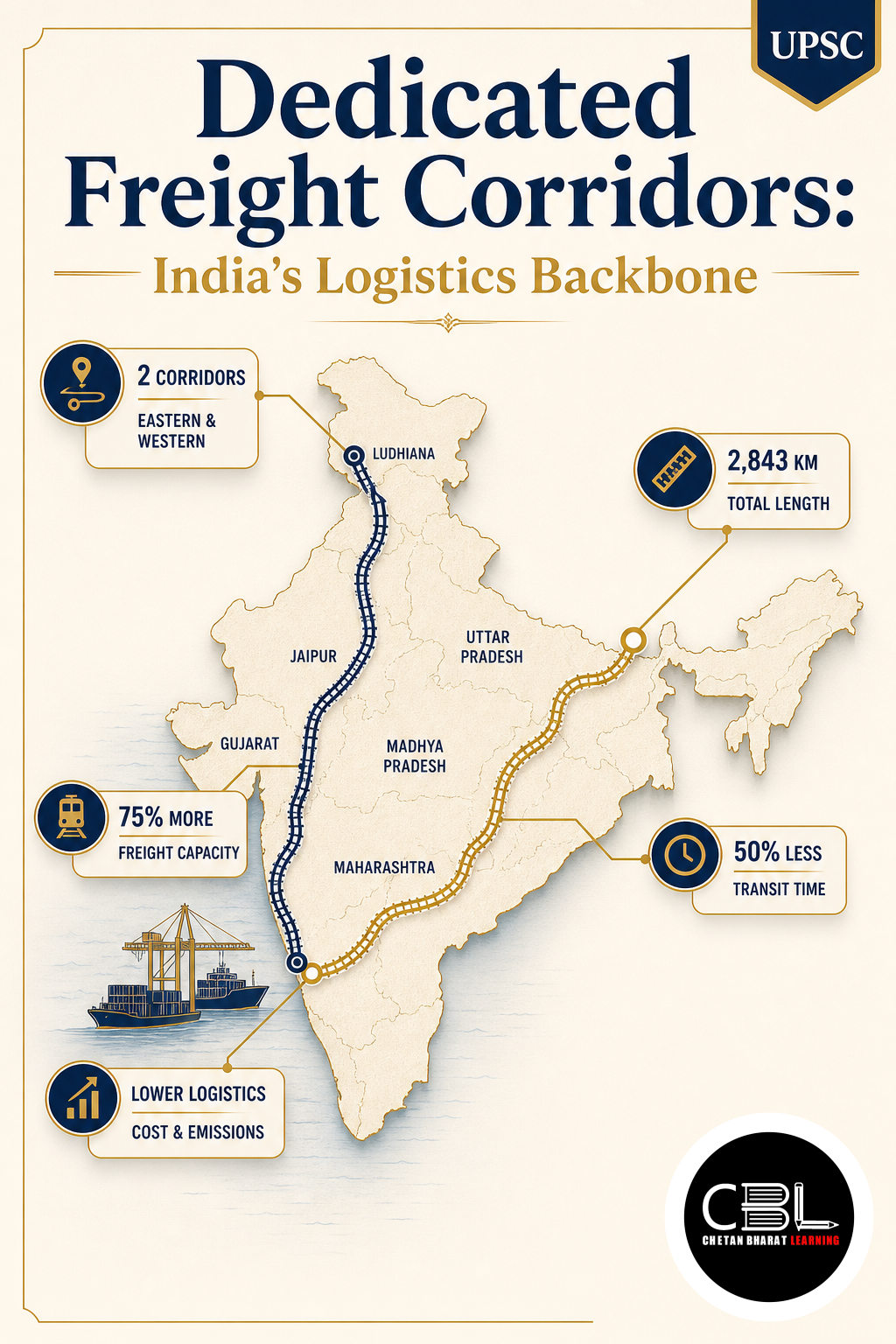
| Operational Network | 2,843 km |
|---|---|
| Eastern Corridor | Ludhiana–Sonnagar, 1,337 km |
| Western Corridor | Dadri–JNPT, 1,506 km |
| Implementing Agency | DFCCIL |
Article
What are Dedicated Freight Corridors?
Dedicated Freight Corridors are high-capacity railway routes designed primarily for transporting goods. They separate freight operations from passenger services on heavily used sections of the conventional railway network. This separation allows operators to run longer and heavier trains with predictable schedules, higher axle loads and fewer operational interruptions.
The Eastern Dedicated Freight Corridor serves major coal, steel, power and industrial regions between Ludhiana and Sonnagar. The Western Dedicated Freight Corridor links Dadri near the National Capital Region with Jawaharlal Nehru Port near Mumbai. Dedicated Freight Corridor Corporation of India Limited, a Ministry of Railways enterprise, plans, develops and operates this specialised network.
Why are Dedicated Freight Corridors in News?
Dedicated Freight Corridors entered a decisive operational phase after completion of the core 2,843-km eastern and western backbone. The western route now provides continuous freight connectivity between Dadri and Jawaharlal Nehru Port. This milestone creates a direct rail artery between northern manufacturing centres, western industrial clusters and India’s largest container port.
Attention has also shifted towards expanding the network beyond these two corridors. Indian Railways began fast-tracking the proposed Dankuni–Surat corridor, covering about 2,100 km across six states. The proposal seeks stronger east-west freight connectivity, advanced signalling and high-capacity electrification. The official Indian Railways announcement outlines the proposed alignment and preparatory work.
Key Features
The freight-only design combines specialised engineering with a corridor-based approach to economic development.
- Higher carrying capacity: Stronger track structures and higher axle-load standards enable longer, heavier freight trains to transport larger cargo volumes per movement.
- Operational segregation: Separate routes prevent slow freight services from competing with faster passenger trains for the same track paths and station capacity.
- Efficient container movement: The western route supports double-stack container operations on suitable sections, improving the productivity of locomotives, wagons and train paths.
- Industrial connectivity: Feeder routes and terminals connect ports, logistics parks, manufacturing clusters, power plants and mineral-producing regions with national markets.
- Modern operations: Electrification, automatic signalling, centralised traffic management and improved monitoring support safer operations with greater reliability and throughput.
Faster and more predictable trains can reduce the time that goods remain in transit. Manufacturers then require smaller inventories and less working capital to manage uncertain delivery schedules. Ports also benefit when railways evacuate containers promptly and prevent cargo from accumulating within terminals.
The corridors may encourage a gradual shift of suitable long-distance cargo from roads to rail. Such a transition can lower fuel consumption, reduce highway congestion and limit freight-related emissions. The benefits depend on competitive tariffs, dependable service and efficient first-mile and last-mile connections.
Challenges
Dedicated Freight Corridors need supporting infrastructure and coordinated governance to deliver their full economic value.
- Last-mile bottlenecks: Congested feeder lines, weak road approaches and limited terminal access can delay cargo before it enters or after it leaves the main corridor.
- Port evacuation constraints: A high-capacity railway cannot eliminate delays when port yards, customs processes, warehouses or connecting tracks operate below the required capacity.
- Traffic aggregation: Rail transport works best with large and regular cargo volumes, while smaller businesses often generate fragmented consignments requiring consolidation.
- Land and environmental issues: New routes require timely acquisition, fair compensation, ecological safeguards and effective rehabilitation of affected households and businesses.
- Network coordination: DFCCIL, Indian Railways, ports, state governments and private terminal operators must align investment plans, schedules and operating procedures.
The corridors must also maintain financial sustainability without making rail freight unattractive. Excessive tariffs could push price-sensitive consignments towards roads, while inadequate revenue may constrain maintenance and capacity upgrades. Policymakers must balance commercial viability with the wider economic and environmental gains from rail-based transport.
Industrial nodes along the routes require planned land use, reliable power, skilled workers and urban services. Unregulated growth may create congestion and environmental stress around terminals. These linkages make the project relevant to broader themes in the Indian economy updates.
Way Forward
India should develop terminals, warehouses, port links and multimodal logistics parks alongside corridor capacity. Authorities can integrate project planning with PM GatiShakti, Sagarmala and highway programmes to remove interface bottlenecks. Digital cargo tracking, simpler documentation and coordinated customs procedures would further improve reliability for exporters and domestic producers.
Future Dedicated Freight Corridors should follow realistic traffic projections, rigorous environmental appraisal and phased construction. The proposed Dankuni–Surat route can strengthen east-west supply chains if authorities secure effective feeder connectivity and timely implementation. The DFCCIL portal provides institutional information on corridor development. Ultimately, India must treat freight railways as part of an integrated national logistics system, rather than as isolated tracks.
Prelims Practice Corner
Q1. Which organisation implements India’s freight corridor programme?
Answer: (b) DFCCIL is the Ministry of Railways enterprise responsible for developing and operating the specialised corridors.
Q2. The Western Dedicated Freight Corridor connects Dadri with which port?
Answer: (c) The western route links Dadri in Uttar Pradesh with Jawaharlal Nehru Port near Mumbai.
Q3. Which statement best describes a freight-only railway corridor?
Answer: (b) Operational separation allows goods trains to run with fewer conflicts on heavily used railway routes.
Q4. Consider the following pairs: 1. Eastern corridor — Ludhiana to Sonnagar; 2. Western corridor — Dadri to JNPT. Which pairs are correctly matched?
Answer: (c) Both pairs represent the endpoints of the operational eastern and western routes.
Q5. What is a likely consequence of shifting suitable long-distance freight from roads to rail?
Answer: (c) Rail can move large cargo volumes efficiently and reduce pressure on highways.
Mains Practice Questions
Q1. Examine how freight-only railway infrastructure can improve India’s logistics efficiency and industrial competitiveness. (250 words, 15 marks)
Answer Structure:
- Intro: Define freight-only corridors and identify the operational eastern and western routes.
- Body: Discuss capacity, transit reliability, port connectivity, inventory savings, modal shift and regional industrial development; then address last-mile and coordination gaps.
- Conclusion: Emphasise integrated multimodal planning and reliable services for converting railway capacity into economic gains.
Q2. Infrastructure corridors generate their full value only when supported by efficient terminal and last-mile networks. Discuss. (150 words, 10 marks)
Answer Structure:
- Intro: Explain why mainline capacity forms only one component of an end-to-end logistics chain.
- Body: Cover feeder railways, port evacuation, road access, multimodal parks, warehousing, customs processes and digital cargo coordination.
- Conclusion: Recommend coordinated investments under an integrated national logistics framework.
FAQs on Dedicated Freight Corridors
What is the combined length of India’s operational eastern and western freight routes?
The two operational routes together cover 2,843 km. The eastern route accounts for 1,337 km, while the western route covers 1,506 km.
How do these corridors benefit passenger rail services?
They transfer substantial goods traffic away from mixed-use railway lines. Indian Railways can then use released track capacity for additional passenger services, improved punctuality and maintenance blocks.
Why is last-mile connectivity important for freight railways?
Cargo must travel between factories, farms, mines, warehouses, terminals and ports before reaching its final market. Weak connecting infrastructure can offset the speed and capacity achieved on the main railway corridor.
Related Current Affairs
Preparing for UPSC, PCS or HCS?
Talk to a mentor at Chetan Bharat Learning, Chandigarh. Free guidance on choosing the right exam and building a study plan.
Chat on WhatsAppCall 97793 53345UPSC / IAS / PCS coaching in Chandigarh · Trusted by aspirants across Punjab & Haryana
Leave a Reply
You must be logged in to post a comment.