

UPSC Mapping
| Prelims | Science and Technology, Disaster Management |
|---|---|
| Mains | GS Paper III: Disaster Management |
What is Cell Broadcast System?
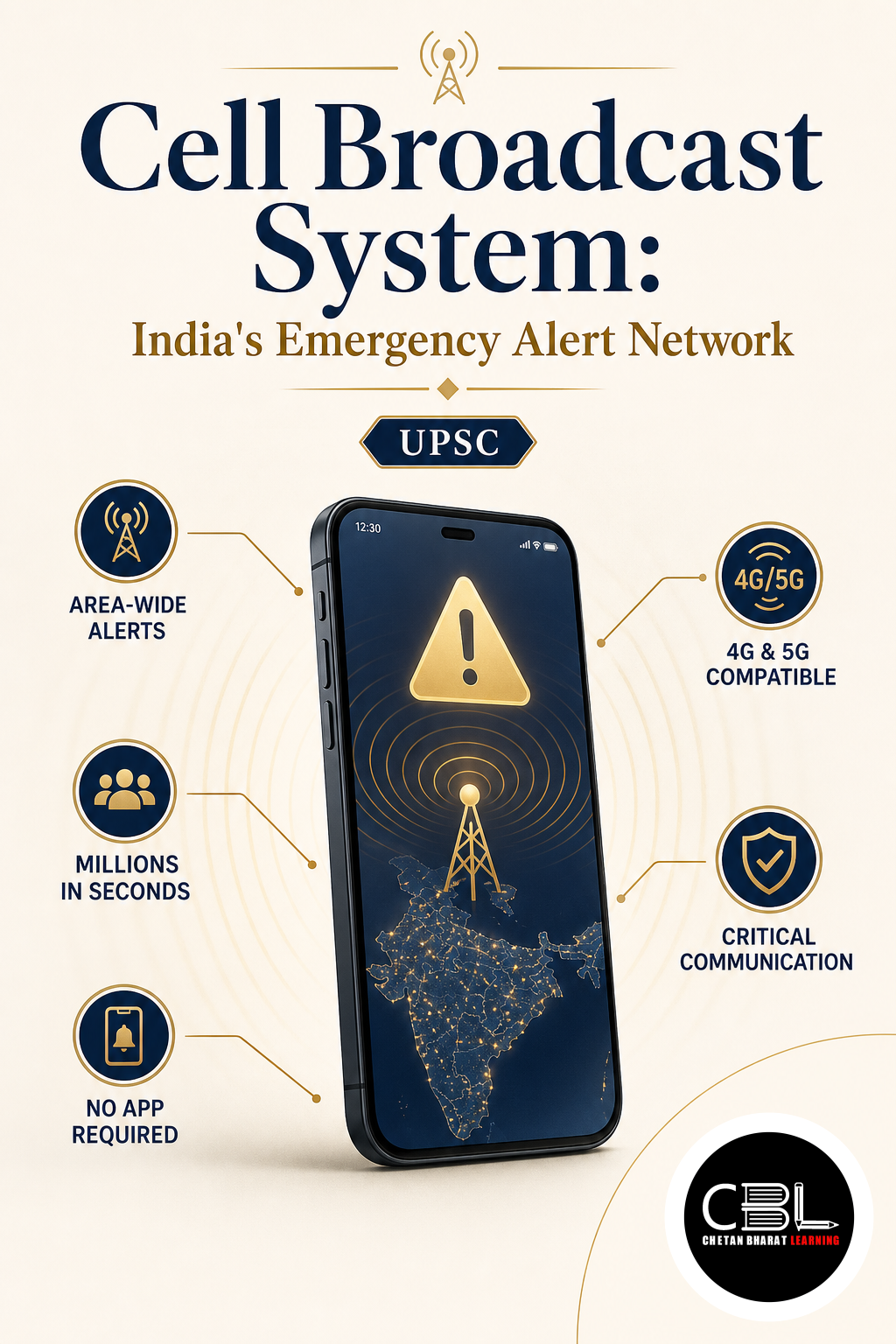
A Cell Broadcast System is a telecom-enabled public warning service that sends one message simultaneously to compatible phones connected within a selected cellular area. Authorities target individual towers, groups of towers or broader regions instead of addressing separate telephone numbers. This one-to-many architecture lets administrators warn a large population without building a recipient list.
The technology differs from ordinary SMS, which travels as separate point-to-point messages and may face queues during heavy traffic; cell broadcast repeatedly transmits an authorised alert through chosen network cells, helping newly arriving users receive the warning. A compatible handset must remain connected to a supported mobile network, so the service does not replace sirens, radio or community outreach. Its value lies in rapid geographic targeting, network resilience and direct official communication; because the network selects cells rather than personal records, authorities can warn people present in an area without compiling phone-number databases, while governance controls must protect authorised access, cyber security, message authenticity and the integrity of the national warning chain.
Why is Cell Broadcast System in News?
India launched the Cell Broadcast System nationwide on 2 May 2026 after completing pan-India trials and training across States and Union Territories. The Centre for Development of Telematics developed the indigenous solution under the Department of Telecommunications. It worked with the National Disaster Management Authority and Ministry of Home Affairs to link telecom delivery with authorised emergency management.
The launch included a nationwide test that sent emergency messages with a distinctive alert tone; the system now supports near-real-time, multilingual warnings for hazards such as flash floods, earthquakes, lightning, gas leaks and chemical incidents. The official launch release states that trials reached users in Andhra Pradesh, Odisha and Uttarakhand. It also records operational use for the Char Dham Yatra, showing how public warning infrastructure can serve disasters and large gatherings.
Key Features
The architecture combines telecom reach, authorised alerting and standardised instructions for quick protective action.
- Precise geo-targeting: Authorities can select one tower, a cluster or a larger zone, limiting alerts to people near the relevant threat; this approach reduces unrelated warnings, helps residents interpret each message as locally actionable and allows district officials to focus evacuation support on exposed communities.
- Near-real-time delivery: The network broadcasts a message simultaneously instead of creating an individual SMS transaction for every recipient; it therefore avoids ordinary queuing delays when emergency traffic pressures calls and mobile data, while giving response agencies more time to move people and resources.
- Wide network compatibility: The indigenous solution supports 2G, 3G, 4G and 5G networks, extending coverage across varied handsets and locations; it also reaches roaming users inside the selected area, including tourists, migrants, pilgrims and travellers who may not understand local warning channels.
- Multilingual priority alerts: Messages can appear as pop-up notifications with a distinct loud tone, while supported handsets can read the text aloud; regional-language delivery improves comprehension when warnings contain short deadlines, unfamiliar hazards and specific safety directions for shelter, evacuation or avoiding dangerous routes.
- CAP-SACHET integration: The service connects with the Common Alerting Protocol-based SACHET platform for consistent dissemination across channels; CAP helps authorised agencies express hazard, severity, location, timing and response information in a standard machine-readable format that different dissemination services can process consistently.
Challenges
Effective warnings require more than technical transmission; administrators must secure public trust, inclusive access and operational accuracy throughout the alert chain.
- Handset readiness: Older or incorrectly configured devices may display alerts differently, while unsupported accessibility features can exclude some users; regular operator and manufacturer testing must verify tones, scripts, screen behaviour, battery states and readable formatting across popular models, operating systems and accessibility settings.
- Geographic precision: Radio cells rarely match administrative or hazard boundaries exactly, creating possible spillover beyond a threatened zone or gaps at its edge; alert managers need updated network maps, live hazard polygons, field reports and conservative safety buffers to balance transmission speed with targeting accuracy.
- Language and accessibility: Literal translation may not communicate local risk clearly, especially when technical terms or unfamiliar instructions appear; authorities should prepare plain-language templates, test regional vocabulary with communities and support people facing visual, hearing, literacy or cognitive barriers.
- Alert fatigue and misinformation: Frequent tests or poorly graded warnings can make users ignore later messages, while fraudulent lookalikes may weaken confidence; every alert needs a clear source, severity level, timestamp, expiry time and practical instruction backed by drills, sustained public awareness and prompt correction of false information.
- Last-mile continuity: Damaged towers, power failures and weak coverage can still interrupt delivery in the places facing greatest danger; India must retain sirens, radio, satellite links, community volunteers and local warning systems alongside the new network to protect places where telecom infrastructure fails; readers can track related governance issues in the daily current affairs archive.
Way Forward
India should institutionalise scheduled drills that test the complete chain from hazard agency to handset, not merely message transmission. NDMA, DoT, States, telecom operators and manufacturers should publish common performance measures for delivery time, geographic accuracy and device compatibility. Independent post-event reviews can identify missed areas while protecting operational security and user privacy; the Cell Broadcast System should also use graded templates so recipients distinguish tests, advisories and immediate life-safety directions.
Authorities should expand local-language testing, accessible formats and community education before hazard seasons and major gatherings; the National Disaster Alert Portal demonstrates how geo-targeted warnings can travel through SMS, applications, browser notifications and RSS feeds. Linking broadcast alerts with these channels creates redundancy when one medium fails. Clear responsibility, verified message origin and periodic audits can convert early warning into timely protective action.
Prelims Practice Corner
-
Q1. Which organisation developed India’s indigenous cell broadcast solution?
(a) ISRO (b) C-DOT (c) CERT-In (d) NIC
Answer: (b) C-DOT developed the solution under the Department of Telecommunications. -
Q2. What is the primary delivery model used by cell broadcast technology?
(a) One-to-one email (b) Satellite television (c) One-to-many cellular broadcast (d) Postal notification
Answer: (c) It simultaneously broadcasts alerts through selected cellular network areas. -
Q3. SACHET is based on which standard?
(a) Common Alerting Protocol (b) Border Gateway Protocol (c) Bluetooth Low Energy (d) Digital Signature Standard
Answer: (a) SACHET uses the Common Alerting Protocol recommended by the ITU. -
Q4. Consider the following statements about India’s cell broadcast solution: 1. It supports networks from 2G to 5G. 2. It can target individual towers or tower clusters. Which is correct?
(a) 1 only (b) 2 only (c) Both 1 and 2 (d) Neither 1 nor 2
Answer: (c) The official launch release confirms both network support and precise targeting. -
Q5. Which bodies collaborated with C-DOT on the indigenous solution?
(a) RBI and SEBI (b) NDMA and MHA (c) NITI Aayog and UGC (d) ECI and UPSC
Answer: (b) C-DOT collaborated with NDMA and the Ministry of Home Affairs.
Mains Practice Questions
-
Q1. Explain how telecom-based public warning systems can strengthen India’s disaster preparedness. (150 words, 10 marks)
Answer Structure:- Intro: Define location-based public warning and connect it with early action.
- Body: Cover delivery speed, geo-targeting, network resilience, multilingual access and integration with SACHET.
- Conclusion: Stress redundant channels, drills and inclusive message design.
-
Q2. Technology alone cannot ensure effective last-mile disaster communication. Discuss. (250 words, 15 marks)
Answer Structure:- Intro: Frame warning as a chain linking hazard detection, communication and public action.
- Body: Examine device access, language, disability, trust, alert fatigue, damaged infrastructure and local institutional capacity.
- Conclusion: Recommend a people-centred, multi-channel and regularly audited warning ecosystem.
FAQs on Cell Broadcast System
How does cell broadcast differ from an SMS alert?
Cell broadcast sends one warning through selected network cells to compatible phones in that area. SMS normally addresses recipients individually and can face queues during unusually heavy traffic.
Does the service require mobile data or an application?
No mobile-data connection or separate application is required for the broadcast itself. The handset must support the feature and connect to a participating cellular network in the targeted area.
Which agencies manage India’s emergency alert chain?
C-DOT developed the telecom solution under DoT with NDMA and MHA. Authorised disaster agencies supply warnings, while telecom infrastructure delivers geographically targeted messages to users.
Related Current Affairs
Preparing for UPSC, PCS or HCS?
Talk to a mentor at Chetan Bharat Learning, Chandigarh. Free guidance on choosing the right exam and building a study plan.
Chat on WhatsAppCall 97793 53345UPSC / IAS / PCS coaching in Chandigarh · Trusted by aspirants across Punjab & Haryana
Leave a Reply
You must be logged in to post a comment.