
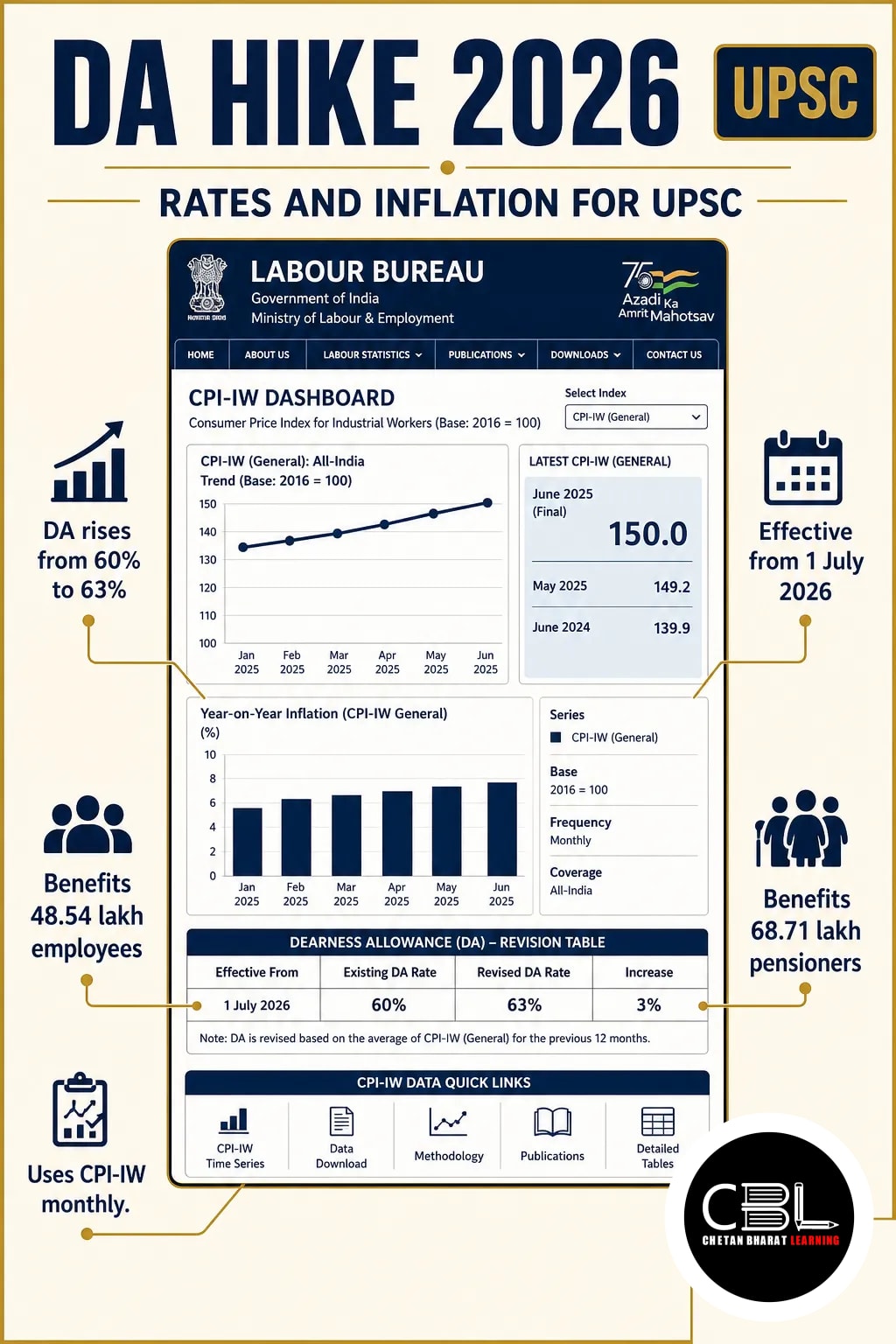
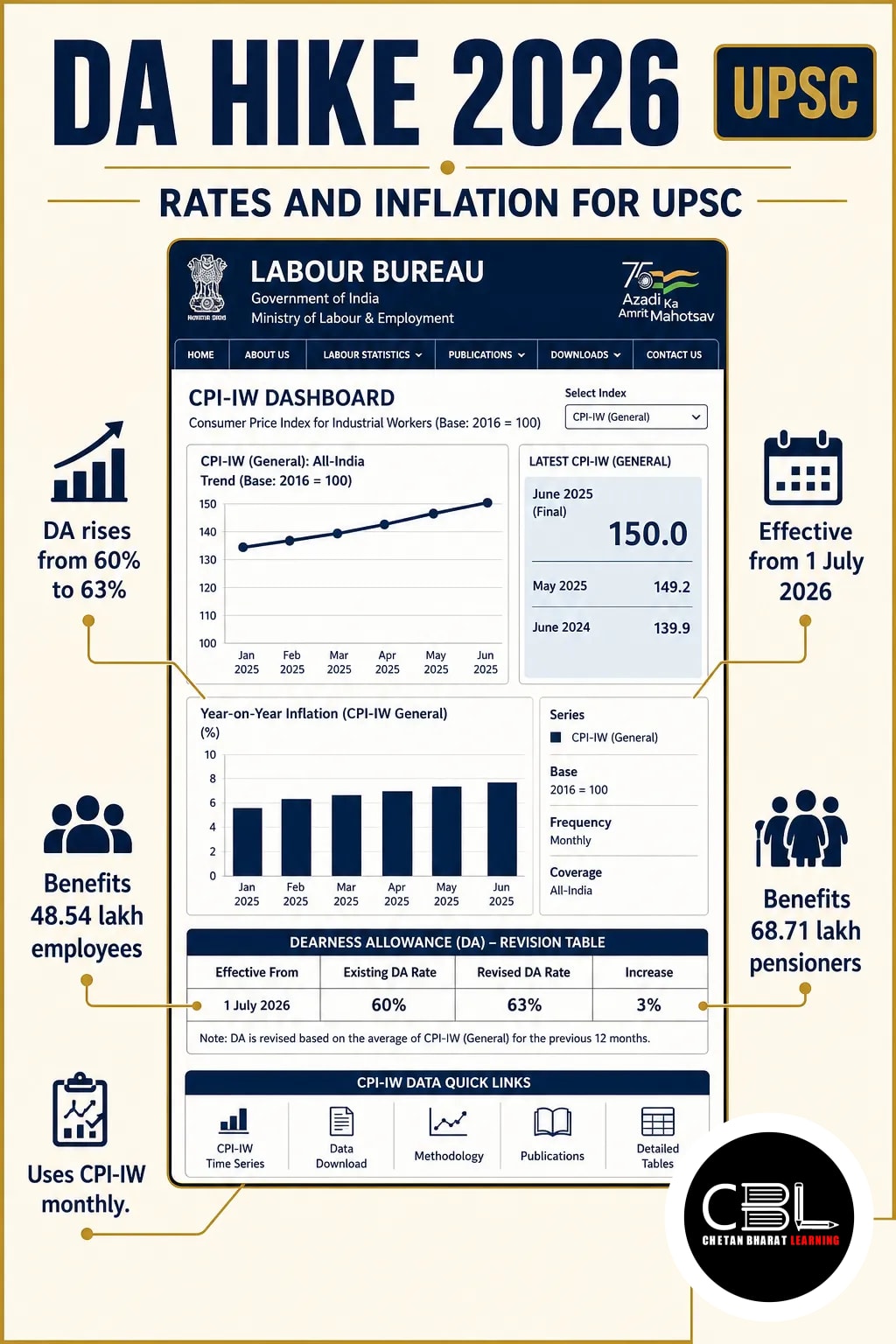
DA hike 2026 raises the central rate from 60% to 63% of basic pay and pension. The decision also invites comparison with Punjab’s dearness allowance and fiscal challenge.
Quick answer: The Centre announced the DA hike 2026 ahead of Diwali, raising dearness allowance and dearness relief to 63%. The increase applies retrospectively from 1 July 2026. It aims to cushion rising living costs and benefits about 48.54 lakh central employees and 68.71 lakh pensioners.
What is dearness allowance?
Dearness allowance (DA) is a payment that helps government employees cope with rising living costs. Inflation reduces purchasing power; therefore, the government generally revises DA twice a year.
Dearness relief (DR) serves a similar purpose for pensioners. DA is linked to basic pay, whereas DR is linked to basic pension.
Why is the DA hike 2026 in the news?
The Centre announced a three-percentage-point increase ahead of Diwali, with retrospective effect from 1 July 2026. Consequently, the rate rose from 60% to 63% for central employees and pensioners.
The decision benefits about 48.54 lakh employees and 68.71 lakh pensioners. The combined annual outgo associated with the hike is Rs 10,016.10 crore.
How is the allowance calculated?
The government uses the Consumer Price Index for Industrial Workers (CPI-IW) to calculate DA and DR. The Labour Bureau releases this index monthly; the accepted formula follows the 7th Central Pay Commission’s recommendations.
The previous revision used the percentage increase in the 12-monthly average of the All India Consumer Price Index. For prelims, distinguish a percentage-point change in the allowance rate from a percentage increase in the rate itself.
| Revision | Rate and effective date |
|---|---|
| Announced 1 October 2025 | 55% to 58%; effective 1 July 2025 |
| Announced 18 April 2026 | 58% to 60%; effective 1 January 2026 |
| Latest revision | 60% to 63%; effective 1 July 2026 |
What are the fiscal and policy implications?
The DA hike 2026 supports beneficiaries’ purchasing power, but it also adds to government expenditure.
- Inflation protection: Higher allowances help employees and pensioners meet rising costs; however, their effect depends on individual spending patterns.
- Budget pressure: The annual outgo must be accommodated alongside other public spending priorities.
- Retrospective effect: The July effective date precedes the announcement; therefore, the timing matters when assessing payments.
Going forward, governments must balance inflation protection with transparent expenditure planning. Regular index-based revisions also make the basis of adjustment easier to understand.
Source: Indian Express Explained, 29 October 2026
- Dearness allowance: Punjab’s fiscal challenge (2 Sep 2026)
Asked in UPSC: Previous Year Questions
- UPSC CSE Prelims 2020 (GS Paper I): Which statements are correct: CPI gives food greater weight than WPI; WPI excludes services unlike CPI; and RBI uses WPI for policy rates?
UPSC compares inflation indices and their uses, so revise their coverage alongside the CPI-IW.
State PCS candidates should connect allowance revisions with employee compensation and state budget management. However, the central rate and effective date should not be assumed to apply automatically to state employees.
Prelims Practice Corner
Mains Practice Questions
Frequently Asked Questions
What is the new central DA rate in 2026?
The new rate is 63% of basic pay or pension. It follows a three-percentage-point increase from 60%.
When does the latest increase take effect?
It takes effect retrospectively from 1 July 2026. Therefore, its effective date precedes the announcement.
Which index is used to calculate DA and DR?
The government uses CPI-IW. The Labour Bureau releases this index monthly.
What is the difference between DA and DR?
DA applies to employees, while DR applies to pensioners. Both help beneficiaries cope with rising living costs.
Related Current Affairs
Preparing for UPSC, PCS or HCS?
Talk to a mentor at Chetan Bharat Learning, Chandigarh. Free guidance on choosing the right exam and building a study plan.
Chat on WhatsAppCall 97793 53345UPSC / IAS / PCS coaching in Chandigarh · Trusted by aspirants across Punjab & Haryana
Leave a Reply
You must be logged in to post a comment.