
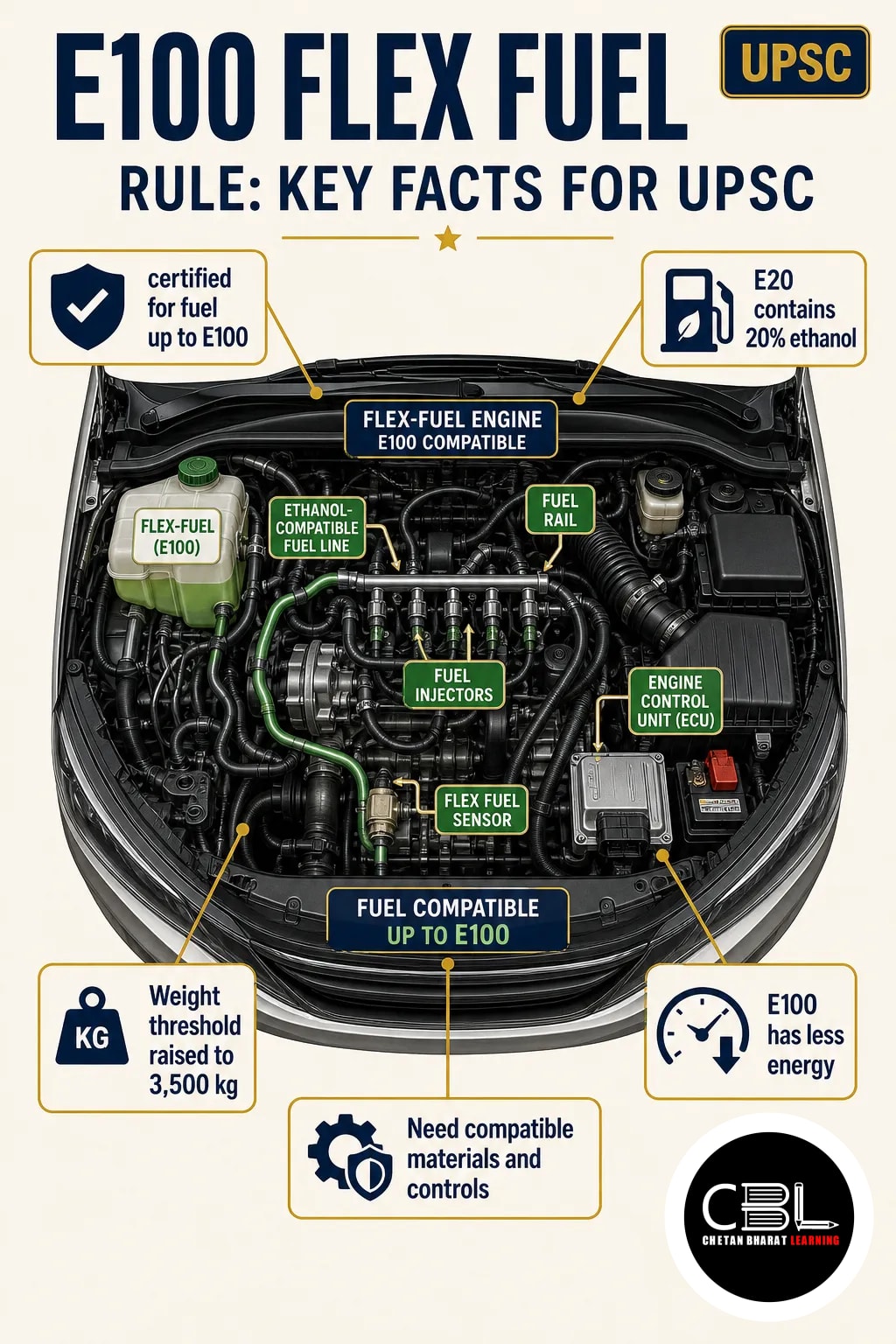

E100 flex fuel vehicles can now be certified for nearly pure ethanol under an amendment to the Central Motor Vehicles Rules, 1989. For related developments, explore CBL’s current affairs coverage.
Quick answer: On 26 October 2026, the Centre amended vehicle rules to permit certification of specially designed vehicles for fuels up to E100 flex fuel, or nearly pure ethanol. However, an ordinary petrol vehicle approved for E20 cannot automatically use E100. The amendment also raised a light-vehicle weight threshold from 3,000 to 3,500 kg.
What is E100 flex fuel?
E100 refers to nearly pure ethanol used as fuel in a vehicle designed and certified for it. A flex-fuel vehicle can run on petrol, ethanol or their mixtures, within its certified fuel range.
Ethanol is an alcohol produced from plant sugars or starches. In India, common sources include sugarcane and grains; agricultural residues and other plant material can also provide feedstock.
Why is the rule in the news?
On 26 October 2026, the government expanded the fuel range for which specially designed vehicles can be certified. It also amended technical and vehicle-classification provisions under the Central Motor Vehicles Rules, 1989.
Crucially, the change does not authorise every petrol car to use E100. A conventional car approved for E20, a petrol blend containing 20% ethanol, should not be filled with E85 or E100.
What are the key facts about the amendment?
The amendment addresses both fuel certification and a light-vehicle weight threshold.
| Feature | Key fact |
|---|---|
| Fuel range | Up to E100 for appropriately designed and certified vehicles |
| E20 | Petrol containing 20% ethanol |
| Light petrol and diesel vehicles | Weight threshold raised from 3,000 kg to 3,500 kg |
| Ethanol energy content | E100 has about 30% less energy per gallon than petrol, according to the US Department of Energy |
Why do flex-fuel vehicles need special components?
High-ethanol fuels require compatible materials and engine controls because ethanol behaves differently from petrol.
- Fuel delivery: Ethanol contains less energy per litre; therefore, comparable power generally requires more fuel injection.
- Materials: Pumps, pipes, seals and injectors must tolerate ethanol, which can affect some metals, plastics and rubber.
- Electronic controls: Sensors and engine controls adjust the air-fuel mixture and ignition timing. Calibration also supports reliable starting at different temperatures.
- Octane: Ethanol has a high octane rating; therefore, an engine optimised for it can benefit from greater resistance to knocking.
What are the benefits and challenges?
Domestic ethanol can replace some petrol and support farmers and producers, but its benefits depend on production methods.
- Energy security: Ethanol can reduce demand for imported crude oil. Blending also allows partial substitution without immediately replacing the existing vehicle fleet.
- Running costs: Higher ethanol blends may reduce kilometres per litre; therefore, fuel price alone cannot determine cost per kilometre.
- Land and water: Crop-based production raises resource and food-competition concerns. For example, sugarcane cultivation requires substantial water.
- Emissions: Ethanol blending can lower certain pollutants; however, it does not eliminate vehicle emissions. Overall greenhouse gas effects also depend on cultivation, production and transport.
What is the way forward?
Fuel choices should follow each vehicle’s certified range, while policy should consider the full resource and emissions costs of ethanol. In addition, agricultural residues offer a feedstock option alongside crops.
Source: Indian Express Explained, 29 October 2026
Asked in UPSC: Previous Year Questions
- UPSC CSE Prelims 2020 (GS Paper I): Under the National Policy on Biofuels, which can be biofuel raw materials: cassava, damaged wheat grains, groundnut seeds, horse gram, rotten potatoes and sugar beet?
UPSC tests biofuel feedstocks as well as policy provisions, so revise both.
State PCS General Studies can test ethanol feedstocks, vehicle compatibility and the resource implications of biofuels. In addition, candidates should connect agricultural residues with the broader question of biofuel production.
Prelims Practice Corner
Mains Practice Questions
Frequently Asked Questions
What does E100 mean?
E100 means nearly pure ethanol used as fuel. However, a vehicle must be designed and certified to use it.
Can an E20 petrol car use E100?
No, an ordinary car approved for E20 cannot automatically use E100. High-ethanol fuel requires compatible components and suitable engine calibration.
Does ethanol guarantee lower running costs?
No, because ethanol has less energy per litre than petrol. Cost per kilometre also depends on fuel price and vehicle efficiency.
What changed for light petrol and diesel vehicles?
The amendment raised their weight threshold from 3,000 kg to 3,500 kg. It also changed provisions concerning flex-fuel vehicle certification.
Related Current Affairs
Preparing for UPSC, PCS or HCS?
Talk to a mentor at Chetan Bharat Learning, Chandigarh. Free guidance on choosing the right exam and building a study plan.
Chat on WhatsAppCall 97793 53345UPSC / IAS / PCS coaching in Chandigarh · Trusted by aspirants across Punjab & Haryana
Leave a Reply
You must be logged in to post a comment.