
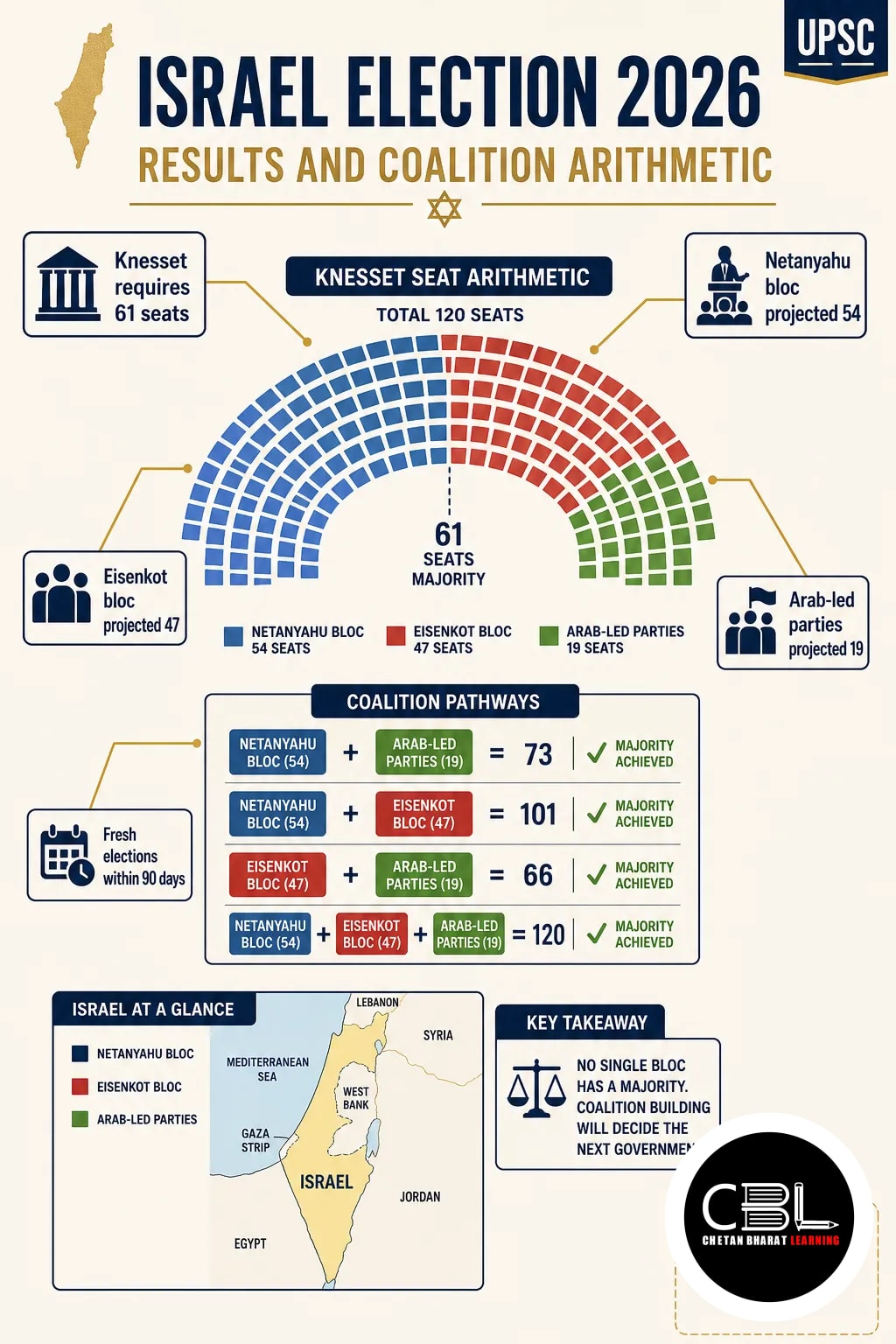
Israel election 2026 has produced a fragmented Knesset, with neither major bloc projected to secure a majority. The result places coalition negotiations, judicial reform and the Israeli-Palestinian conflict on the current affairs agenda for UPSC aspirants.
Quick answer: In the Israel election 2026, a partial count on 28 October projected 54 seats for Benjamin Netanyahu’s bloc, 47 for Gadi Eisenkot’s opposition bloc and 19 for Arab-led parties. The 120-member Knesset requires 61 seats for a majority. Therefore, government formation depends on negotiations across bloc lines.
Who are the main players in the election?
Benjamin Netanyahu leads the outgoing government’s bloc, while Gadi Eisenkot leads the principal opposition bloc. Arab-led parties form a third group whose projected seats could prove decisive in government formation.
Netanyahu’s bloc lost ground in the partial count, but remained a substantial force. Meanwhile, the opposition’s projected tally fell short of a majority. The figures below are projections from a count still underway on 28 October, not final results.
| Group | Projected seats |
|---|---|
| Netanyahu-led bloc | 54 |
| Eisenkot-led opposition bloc | 47 |
| Arab-led parties | 19 |
On these figures, the opposition and Arab-led parties together have 66 seats. However, arithmetic alone does not establish an agreement to govern. During the campaign, Netanyahu’s opponents had also said they would not join hands with the Arab faction.
Why is the Israel election 2026 significant?
The election tests whether dissatisfaction with Netanyahu’s leadership can translate into an alternative government. It also exposes differences over security, democratic institutions and the place of Arab representatives in coalition politics.
Yair Golan, leader of the Democrats party, urged the opposition to work with Arab parties. Netanyahu, meanwhile, opposed such alignment. The issue therefore concerns both majority-building and acceptance of Arab citizens’ elected representatives as political partners.
The opposition presents itself as more secular, liberal and democratic. However, Israeli political labels do not map neatly onto Indian categories. National security, the Palestinian question, settlements in the occupied West Bank and religion’s relationship with the state shape the divisions.
Key events behind the vote
The Hamas attack of October 2023, the Gaza war and judicial reform form the immediate political background. The following timeline separates documented events from the still-provisional election count.
| Year or date | Event |
|---|---|
| October 2023 | Hamas attacked Israel; the attack and its aftermath shifted attention from judicial reform. |
| March 2025 | A law gave the government greater control over judicial appointments. |
| October 2025 | An Institute for National Security Studies survey recorded contrasting views of government and military conduct in Gaza. |
| 28 October 2026 | A partial count projected no majority for either major bloc. |
How is an Israeli government formed?
Israeli voters elect the Knesset rather than directly electing the prime minister. After consulting party representatives, the president assigns government formation to a Knesset member considered best placed to succeed.
The largest party does not automatically govern. Instead, the proposed government must command parliamentary confidence. Until a new government takes office, Netanyahu’s outgoing government continues in a caretaker capacity.
Stages and deadlines
- First attempt: The designated member receives 28 days; moreover, the president may grant an extension of up to 14 days.
- Second attempt: If the first fails, the president may give another member 28 days without an extension.
- Final opportunity: Knesset members then have 21 days to request another willing member; that person gets 14 days to form a government.
- Fresh elections: If the final route fails or no request is made, the Knesset is deemed dissolved and elections must occur within 90 days.
These are successive stages, not one 90-day negotiation deadline. Thus, the 90-day period concerns elections after the failure of government formation.
What does the vote mean for policy and India?
The election could change Israel’s governing style, although it does not automatically imply a reversal of security policy. For India, the distinction matters when assessing continuity and change in a longstanding bilateral relationship.
Security and the Palestinian question
An October 2025 survey found 72% dissatisfied with the government’s handling of the Gaza war. In contrast, 57% were satisfied with the military’s handling. These findings suggest that criticism of political leadership need not mean opposition to a forceful military response.
Israeli right-wing positions have generally opposed Palestinian statehood and supported settlements. The left has been more open to negotiations and territorial compromise. However, the source notes broad foreign-policy alignment after the 2023 attack, so an anti-Netanyahu vote should not automatically be read as support for statehood.
Analyst Yonatan Touval suggested that an Eisenkot government would likely curb settler violence and resist outright annexation. Nevertheless, he expected it to continue supporting settlements and opposing Palestinian statehood. These are assessments of possible policy, not established outcomes.
Institutions and bilateral implications
Judicial appointments remain important because the March 2025 law increased government influence over them. A separate proposal would let the Knesset reinstate laws struck down by the Supreme Court; however, it had not passed when the source was published.
India’s established ties with Israel include cooperation in defence, agriculture and technology. Consequently, aspirants should distinguish potential changes in Israeli leadership from demonstrated policy changes. The election also provides context for analysing India’s approach to the Israeli-Palestinian question.
Source: Indian Express Explained, 29 October 2026
- Blue Helmets: UN Peacekeepers (25 Oct 2024)
Asked in UPSC: Previous Year Questions
- UPSC CSE Prelims 2018 (GS Paper I): The term ‘two-state solution’ is sometimes mentioned in the news in the context of the affairs of which country?
UPSC has tested the Palestinian question through its key diplomatic terminology; therefore, revise the concept alongside election developments.
Punjab PCS and Haryana HCS General Studies can test the Knesset, coalition arithmetic and the Israeli-Palestinian question. In addition, candidates can compare parliamentary government formation with the Indian system.
Prelims Practice Corner
Mains Practice Questions
Frequently Asked Questions
How many seats are needed for a majority in the Knesset?
A majority requires 61 seats. The Knesset has 120 members, so neither major bloc reached that figure in the partial projection.
Did Netanyahu’s bloc win a majority?
No, because the 28 October partial count projected 54 seats for his bloc. Counting was still underway, so that figure was not a final result.
Does Israel directly elect its prime minister?
No, because voters elect members of the Knesset. The president then assigns the government-formation task after consulting party representatives.
What happens if coalition formation fails?
Fresh elections follow if the successive formation opportunities fail. The Knesset is then deemed dissolved, and elections must take place within 90 days.
Related Current Affairs
Preparing for UPSC, PCS or HCS?
Talk to a mentor at Chetan Bharat Learning, Chandigarh. Free guidance on choosing the right exam and building a study plan.
Chat on WhatsAppCall 97793 53345UPSC / IAS / PCS coaching in Chandigarh · Trusted by aspirants across Punjab & Haryana
Leave a Reply
You must be logged in to post a comment.