
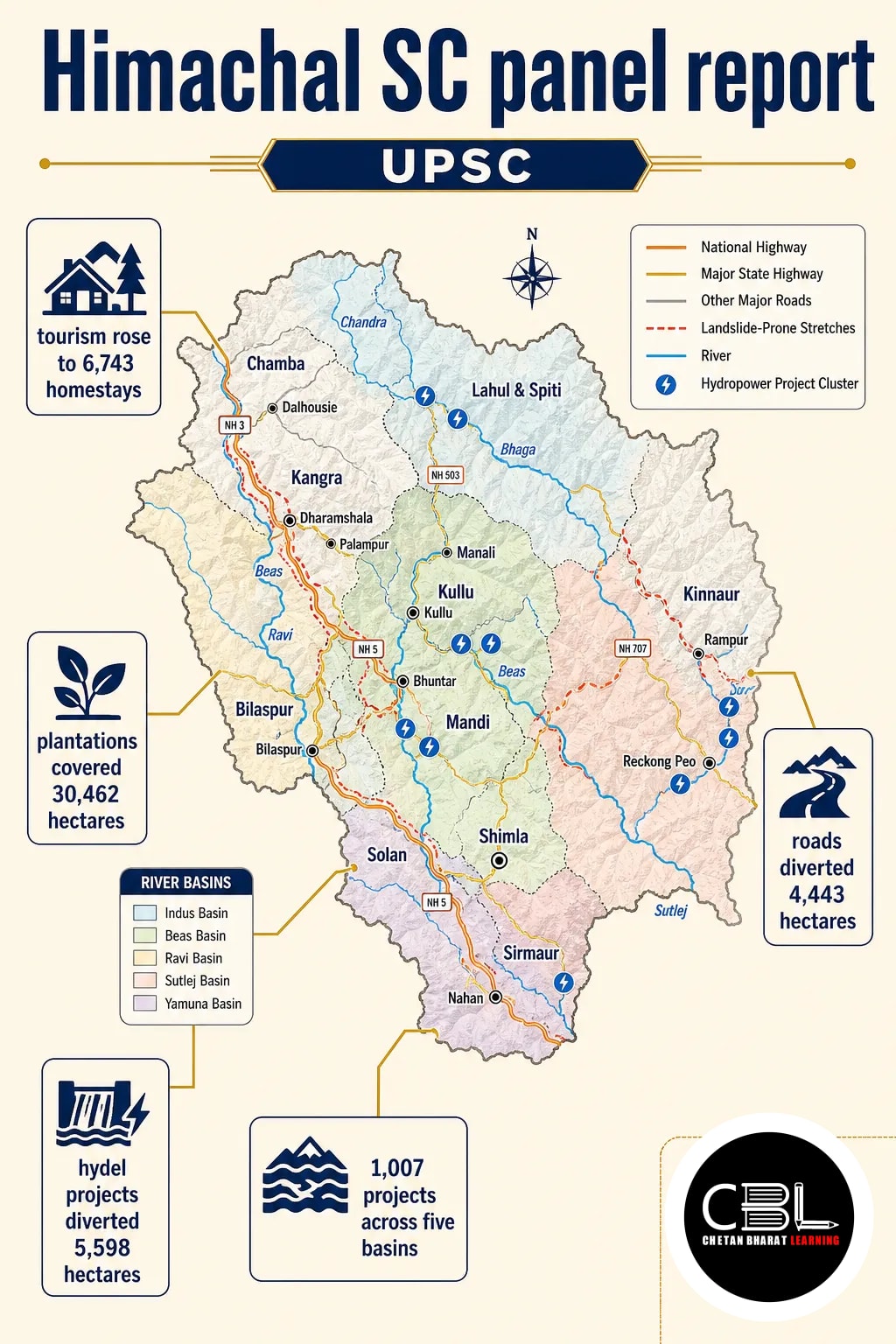

Himachal SC panel report recommends tourism curbs and tighter infrastructure regulation to protect the state’s mountain ecology. The proposals also matter for understanding Himalayan hydropower planning.
Quick answer: The Himachal SC panel report recommends carrying-capacity limits for tourism, stronger hill-road scrutiny and basin-wide hydropower disaster planning. On 27 October 2026, the Supreme Court accepted the Central Empowered Committee’s interim report and gave Himachal Pradesh two weeks to respond. The panel examined four of nine ecological themes.
Why is the Himachal SC panel report in the news?
The Supreme Court accepted the committee’s first report on 27 October 2026 and sought the state’s response. The bench comprised Justices Vikram Nath, Sandeep Mehta and Aparesh Kumar Singh. The recommendations are proposals for consideration; the source does not say the court has imposed them.
The court began proceedings on its own initiative on 28 July 2025, citing ecological degradation beyond isolated incidents. In July 2026, it directed the committee to examine nine themes and submit interim and final reports. The other five themes are zoning, forest and tree cover, climate change, disaster management and mining.
The Central Empowered Committee (CEC) assists the court on forest and environmental matters and monitors compliance with its orders. It originated through a Supreme Court order in 2002 and became a statutory body in 2023. Its examination draws on expert assessment, available site visits and technical assistance from the Forest Survey of India.
What are the key findings?
The committee found growing tourism and infrastructure pressures alongside gaps in forest restoration. The following figures identify the scale of the issues across its four interim themes.
| Theme | Finding |
|---|---|
| Tourism | Registered homestays rose from 876 in 2016 to 6,743 in 2026. |
| Afforestation | Plantations covered approximately 30,462 hectares against a 34,169-hectare target since 1981-82. |
| Roads | Roads accounted for 4,443 hectares, or 25.3%, of diverted forest land. |
| Hydropower | Hydel projects accounted for 5,598 hectares, or 31.9%, of diverted forest land. |
Why does the panel recommend tourism limits?
The panel wants tourism regulated according to each destination’s ecological and geological carrying capacity. This capacity concerns the pressure a location can sustain without unacceptable damage. Therefore, visitor numbers must be considered alongside vehicles, accommodation and local environmental conditions.
Registered hotels increased from 2,784 to 5,311 between 2016 and 2026, a rise of 90.8%. Homestays grew by 669.7% and now outnumber hotels. Meanwhile, the Tourism Department told the CEC it had conducted no carrying-capacity studies for destinations including Shimla, Manali, Kasol, Spiti and the Great Himalayan National Park.
The panel recommends immediate studies and, if necessary, temporary restrictions. It also proposes periodically updated, binding district-wise and destination-wise limits for visitors, vehicles and beds. Such limits would need enforceable planning controls; otherwise, construction could continue to add pressure despite caps on arrivals.
What did the panel find about compensatory afforestation?
The panel found a gap between legally required compensatory afforestation and restoration on the ground. Such afforestation follows the diversion of forest land for non-forestry purposes. However, plantation survival assessments were incomplete or pending.
The planting shortfall was approximately 3,707 hectares, or 10.85% of the target. Moreover, the survival rate for 2020-21 plantations was only 51%. For 2020-21 to 2025-26, spending was ₹592.69 crore against an approved Annual Plan of Operations of ₹1,110.81 crore; ₹865.10 crore was allocated.
Earlier audits found delays, incomplete plantations and unsuitable sites. Therefore, the CEC recommends completing pending work and commissioning independent survival audits. Measuring surviving trees, rather than expenditure alone, would give regulators a clearer picture of outcomes.
How do roads and hydropower increase ecological risks?
Road construction and concentrated hydropower development can compound risks across Himalayan slopes and river basins.
Hill roads and landslides
Hill cutting, excavation debris and unstable slopes can turn road construction into a disaster-risk issue. In 2023, Himachal Pradesh recorded 113 landslides over 55 days during the early monsoon, with 111 deaths. The CEC identified near-vertical cuts, non-compliance with Indian Roads Congress standards and debris dumping towards the Beas.
After 44 critical locations were identified on the Kiratpur–Manali highway, the National Highways Authority of India approved ₹825 crore for restoration. The panel calls for a review of the 2013 environmental-clearance exemption for specified hill-road projects and a clearance mechanism. It also proposes a state-level ombudsman for complaints and compensation grievances concerning the authority’s projects.
Hydropower and cumulative impacts
The basin inventory lists 1,007 projects across the Sutlej, Beas, Chenab, Ravi and Yamuna, with a combined capacity of 22,957 megawatts (MW). Of these, 189 projects totalling 12,588 MW had been commissioned; another 53 totalling 1,528 MW were under construction.
Individual project assessments may miss combined pressures from tunnels, muck, forest diversion and changes to environmental flows. Therefore, the CEC proposes basin-wide disaster preparedness and mitigation plans. These would address glacial lake outburst floods, cascading impacts and multiple hazards.
What is the way forward for Himalayan governance?
Himachal needs development decisions based on measurable ecological limits and enforceable safeguards. The Himachal SC panel report offers a framework that connects tourism, forests, roads and river basins.
- Plan by destination and basin: Publish carrying-capacity limits and assess combined hydropower risks rather than treating each project in isolation.
- Monitor outcomes: Use independent plantation survival audits and track compliance with road-engineering standards.
- Address grievances: Provide accessible complaint and compensation mechanisms for communities affected by highway projects.
- Link planning to disasters: Integrate slope stability, debris disposal and multi-hazard preparedness into infrastructure decisions.
These measures require coordination between tourism, forest, road and disaster-management authorities. They also require the state to translate scientific assessments into decisions that officials can monitor and enforce.
Source: Indian Express Explained, 29 October 2026
- Kishau Multipurpose Project: Six-State Water Pact (18 Sep 2026)
- Cheer Pheasant: Conservation Success & UPSC Analysis (28 Oct 2026)
Asked in UPSC: Previous Year Questions
- UPSC CSE Mains 2021 (GS Paper I): Differentiate the causes of landslides in the Himalayan region and Western Ghats.
- UPSC CSE Mains 2021 (GS Paper III): Describe the causes and effects of landslides and the important components of the National Landslide Risk Management Strategy.
UPSC tests both the physical causes of landslides and the policy response; therefore, connect geography with disaster management.
Punjab PCS and Haryana HCS can test Himalayan river basins, environmental governance and disaster management through this case. In addition, candidates can use it to analyse how neighbouring mountain infrastructure affects shared regional planning.
Prelims Practice Corner
Mains Practice Questions
Frequently Asked Questions
Has the Supreme Court imposed the recommended tourism caps?
No such imposition is stated in the source. The court accepted the interim report and, meanwhile, gave Himachal Pradesh two weeks to respond to its recommendations.
What is tourism carrying capacity?
It is the level of tourism pressure a destination can sustain without unacceptable damage. Therefore, the panel calls for limits based on ecological and geological assessments.
How many hydropower projects did the panel identify?
The inventory identified 1,007 projects at different stages. Together, they had a listed capacity of 22,957 MW across five river basins.
What did the panel recommend for hill roads?
It recommended reviewing the 2013 clearance exemption for specified hill-road projects and establishing a clearance mechanism. In addition, it proposed an ombudsman for highway-related complaints and compensation grievances.
Related Current Affairs
Preparing for UPSC, PCS or HCS?
Talk to a mentor at Chetan Bharat Learning, Chandigarh. Free guidance on choosing the right exam and building a study plan.
Chat on WhatsAppCall 97793 53345UPSC / IAS / PCS coaching in Chandigarh · Trusted by aspirants across Punjab & Haryana
Leave a Reply
You must be logged in to post a comment.