
Punjab drug crisis returned to the spotlight after police took custody of a suspected overdose victim’s body in Mansa. The incident highlights the connection between public health, trafficking and governance; explore more current affairs coverage.
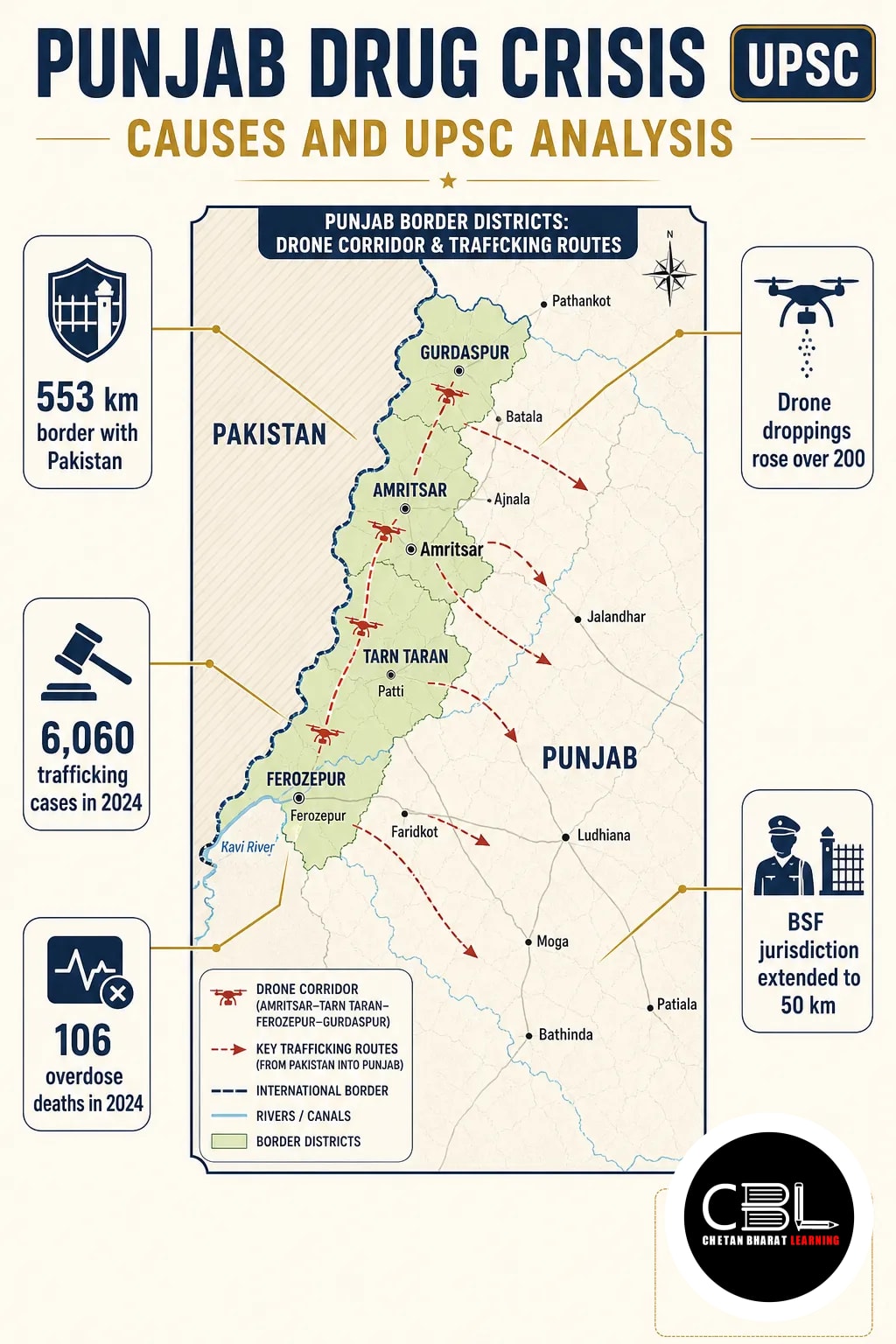
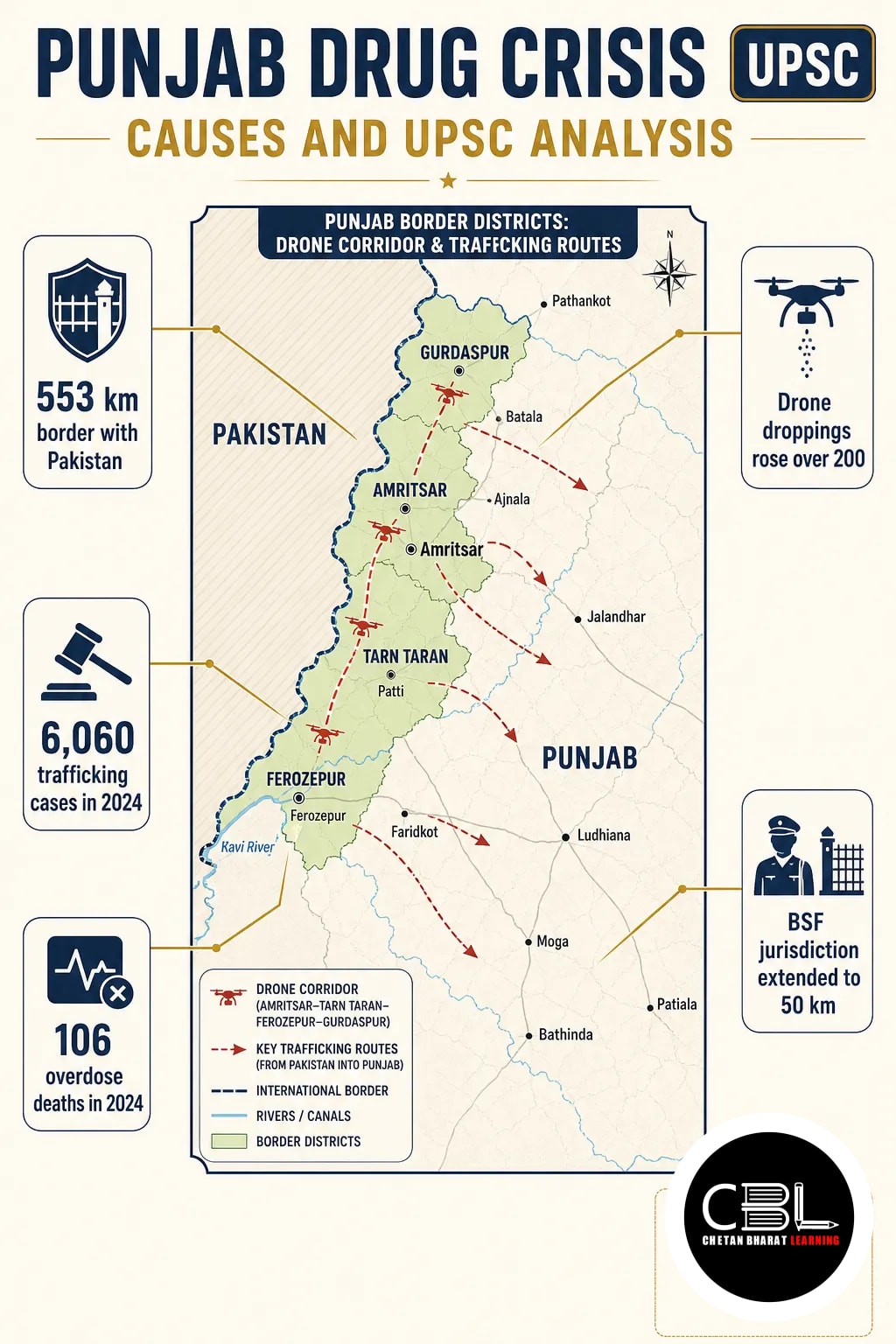
Quick answer: The Punjab drug crisis combines addiction, cross-border trafficking and diversion of pharmaceutical drugs. It drew fresh attention on 28 October 2026 after an incident in Mansa involving a suspected overdose victim. National Crime Records Bureau data for 2024 recorded 6,060 drug trafficking cases and 106 overdose deaths in Punjab.
What is the Punjab drug crisis?
The crisis involves persistent substance use and trafficking through cross-border and domestic supply chains. Heroin, locally called chitta, is one part of the problem; pharmaceutical drugs, opium and poppy husk are also involved.
The National Crime Records Bureau (NCRB) recorded the country’s highest number of drug trafficking cases in Punjab in 2024. Its 106 recorded overdose deaths were second to Tamil Nadu’s 313. However, registered cases measure recorded enforcement activity, not the full prevalence of drug use.
Why is Mansa in the news?
On 28 October 2026, police took custody of Daljit Singh’s body as his family planned a protest in Mansa. The 35-year-old had died of a suspected overdose.
His family was taking the body to a protest site associated with activist Parvinder Singh Jhota’s family. On 13 October, a chemist shot Jhota after the activist confronted him over alleged sales of prohibited drugs. Consequently, both incidents have intensified scrutiny of the state’s response.
What are the main routes and trends?
Punjab’s supply networks span its international border and several Indian states. The following facts distinguish the routes and the policy response.
| Feature | Evidence from the source |
|---|---|
| Golden Crescent | Mountainous areas of Pakistan, Afghanistan and Iran form a major heroin-processing region. |
| Domestic routes | Opium and poppy husk come from Rajasthan and Madhya Pradesh; charas and hashish come from Himachal Pradesh. |
| Pharmaceutical seizures | Punjab accounted for 2.94 crore of 5.13 crore pharmaceutical drug units seized nationally in 2024. |
| Drone corridor | The Amritsar–Tarn Taran–Ferozepur–Gurdaspur belt is the operational core; recorded droppings rose from three in 2021 to over 200 in 2025. |
| Border enforcement | In 2021, the Centre extended the Border Security Force’s jurisdiction from 15 km to 50 km inland. |
Legal cultivation in Rajasthan and Madhya Pradesh serves medical, scientific and export purposes. However, legal production does not authorise diversion into illicit markets. The Golden Triangle is a separate region comprising Myanmar, Thailand and Laos.
Why does the crisis persist?
The Punjab drug crisis persists because supply adapts to enforcement while social and economic pressures sustain demand and recruitment.
History and changing supply
Opium and poppy husk had social acceptance in pre-Independence Punjab. A 1979 study found widespread rural opium use despite the risk of prosecution for smuggling it from neighbouring states. Thus, present-day enforcement operates against a longer history of substance use.
As border enforcement intensified, pharmaceutical drug abuse rose. Around 25% of Punjab Police cases under the Narcotic Drugs and Psychotropic Substances (NDPS) Act in 2022 involved pharmaceutical drugs. Moreover, the source says around 80% of these drugs enter from manufacturing hubs in Himachal Pradesh, Uttar Pradesh, Haryana and Rajasthan.
Profits and institutional challenges
Heroin can sell for ₹1,000–₹5,000 per gram, while a single delivery by a drug courier can earn ₹1 lakh. Consequently, trafficking can attract young people whose job opportunities do not match their aspirations.
Alleged links between traffickers, police personnel and politicians also complicate enforcement. Former Punjab Police officer Jagdish Singh Bhola’s 2013 arrest in a drug racket and 2019 conviction illustrate the need for accountability. Meanwhile, Assembly data showed that women’s arrests under the NDPS Act rose 85% in 2022 compared with 2015; arrests alone do not explain the reasons for that increase.
What has Punjab done, and what should follow?
Punjab has combined enforcement, de-addiction and prevention since the 2014 declaration of a war on drugs. In March 2025, it launched Yudh Nasheyan Virudh, including action against traffickers’ finances and properties identified as built with illicit proceeds.
Its second phase in 2026 placed greater emphasis on community action through over 1.5 lakh village volunteers called Pind De Pehredar. Meanwhile, the Border Security Force established an anti-drone intelligence wing, and Punjab Police procured anti-drone guns.
However, drugs remain available. A balanced response should therefore address both supply and dependence:
- Target networks: Trace illicit finance and investigate organisers, while coordinating border and interstate intelligence.
- Check diversion: Strengthen scrutiny of pharmaceutical distribution without obstructing legitimate medical access.
- Prioritise care: Expand accessible treatment and rehabilitation, alongside prevention in communities.
- Build accountability: Investigate alleged official complicity and ensure lawful, proportionate action against property.
- Reduce vulnerability: Connect prevention with education, employment opportunities and support for affected families.
Finally, measuring treatment access and recovery alongside seizures would give policymakers a broader basis for assessing outcomes.
Source: The Indian Express Explained, 29 October 2026
- MSMER Regulation and NMC Oversight Concerns (28 Oct 2026)
Asked in UPSC: Previous Year Questions
- UPSC CSE Mains 2018 (GS Paper III): How does proximity to two major illicit opium-growing states link drug trafficking with gunrunning, money laundering and human trafficking? What counter-measures are needed?
UPSC connects trafficking routes with other illicit activities and asks for integrated security responses.
Punjab PCS can test the state’s border districts, community initiatives and drug-control strategy. Haryana HCS can also examine interstate coordination and pharmaceutical supply-chain oversight.
Prelims Practice Corner
Mains Practice Questions
Frequently Asked Questions
Why is Punjab vulnerable to drug trafficking?
Punjab is vulnerable partly because it shares a 553-km border with Pakistan. In addition, domestic routes supply substances and pharmaceutical drugs.
What is chitta?
Chitta is the local term for heroin. It is also associated with cross-border smuggling into Punjab.
What is Yudh Nasheyan Virudh?
It is Punjab’s anti-drug campaign, launched in March 2025. Its second phase also emphasised community action through village volunteers.
Related Current Affairs
Preparing for UPSC, PCS or HCS?
Talk to a mentor at Chetan Bharat Learning, Chandigarh. Free guidance on choosing the right exam and building a study plan.
Chat on WhatsAppCall 97793 53345UPSC / IAS / PCS coaching in Chandigarh · Trusted by aspirants across Punjab & Haryana
Leave a Reply
You must be logged in to post a comment.