
UPSC Mapping
| Prelims | Mains |
|---|---|
| GOBARdhan Scheme, CBG, Renewable Energy | GS Paper III – Energy, Environment and Infrastructure |
Quick Facts
| Ministry | Ministry of Petroleum and Natural Gas |
|---|---|
| Outlay | ₹23,731 crore |
| Duration | FY 2026-27 to FY 2035-36 |
| Production Goal | Tenfold increase in domestic CBG production |
Article
What is GOBARdhan Scheme?
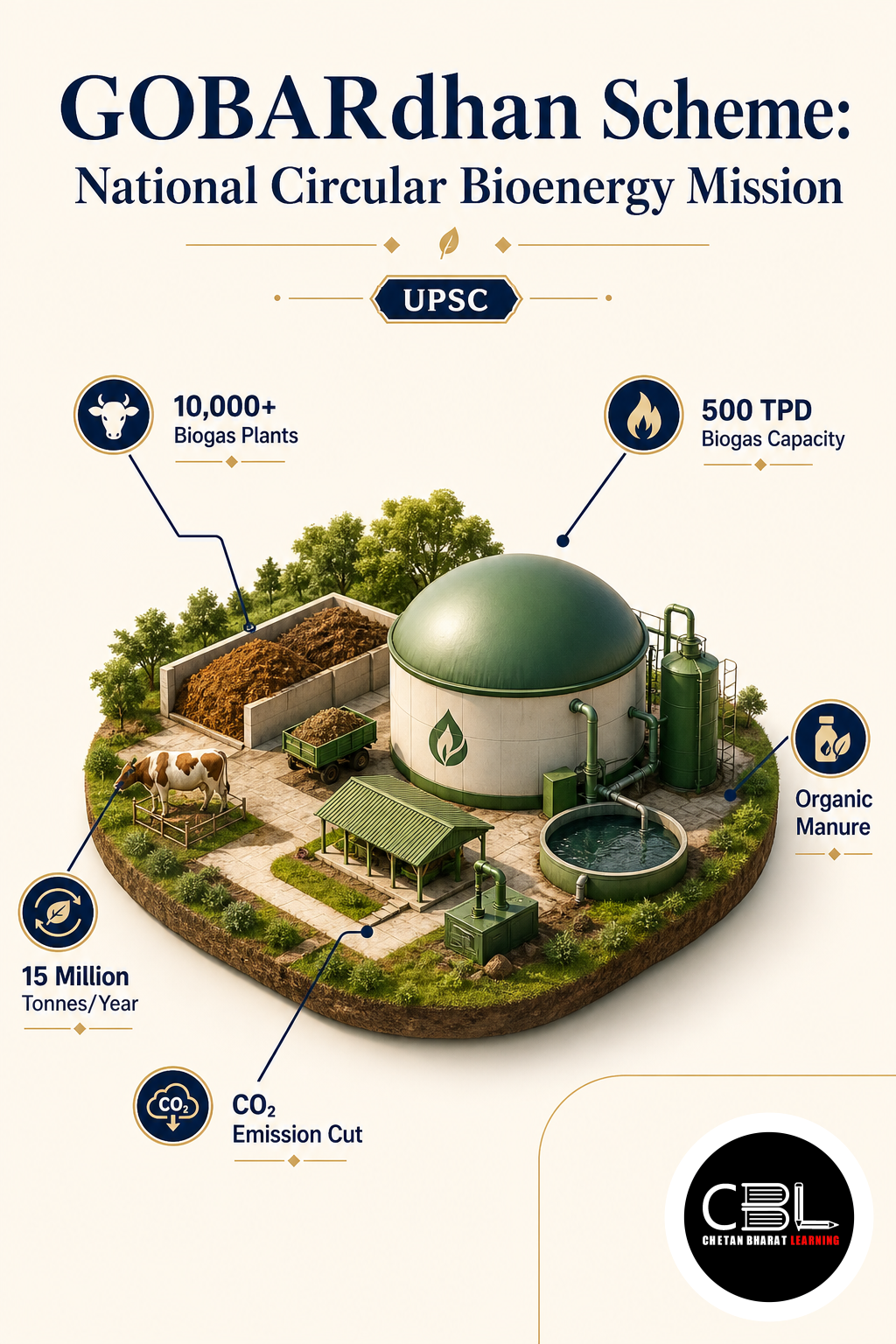
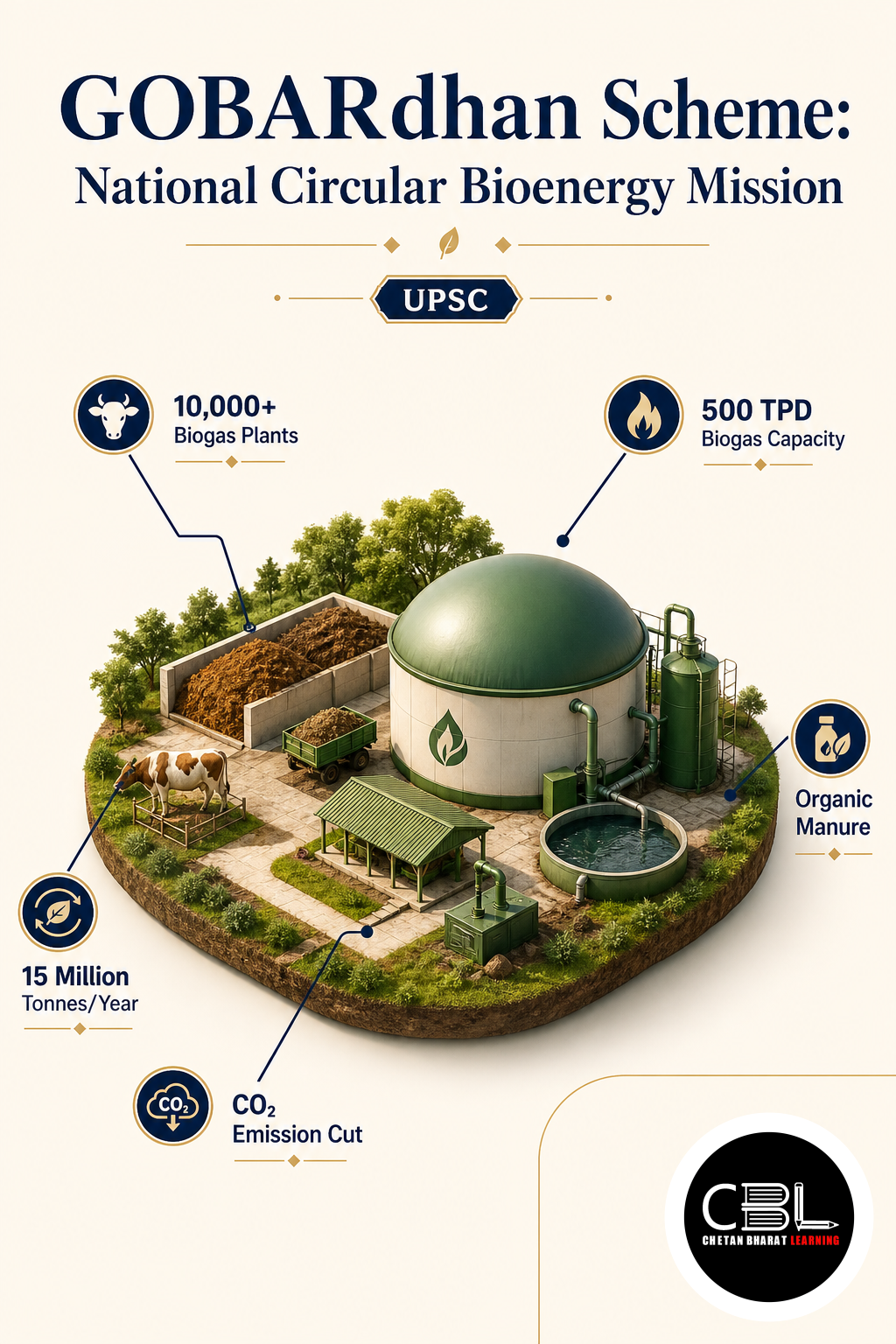
GOBARdhan Scheme, or Galvanizing Organic Bio-Agro Resources Dhan, is presented as the National Circular Bioenergy Scheme under the Ministry of Petroleum and Natural Gas. It seeks to integrate the compressed biogas (CBG) value chain through a national framework.
The scheme focuses on converting organic and agricultural waste into useful energy resources. Its stated objective is a tenfold increase in domestic CBG production, alongside reduced dependence on imported liquefied natural gas and stronger waste-to-wealth outcomes.
Compressed biogas is produced from organic feedstock through processes such as anaerobic digestion, followed by purification and compression. The resulting fuel can support India’s gas-based energy system while giving economic value to waste streams.
The scheme therefore connects several policy objectives at once: waste management, renewable energy, circular economy, rural economic activity and energy security. This integrated approach makes it relevant to both governance and environmental dimensions of the UPSC syllabus.
Why is GOBARdhan Scheme in News?
The Union Cabinet approved the revamped GOBARdhan Scheme with an outlay of ₹23,731 crore for FY 2026-27 to FY 2035-36. The new framework is intended to strengthen the domestic CBG ecosystem by combining demand creation, financial assistance, pricing support and infrastructure development.
The scheme introduces phased CBG blending obligations for city gas distribution entities—3% in FY 2026-27, 4% in FY 2027-28 and 5% from FY 2028-29 onwards—to provide greater investment certainty to producers.
These measures are significant for UPSC aspirants as they link a current government scheme with circular economy principles, energy security, renewable energy and waste management.
Key Features
- Assured offtake: Integration with city gas distribution networks to provide a reliable market for CBG producers.
- Stable pricing: Administered price of ₹2,110 per MMBTU for a minimum ten-year period to improve investment certainty.
- Capital assistance: Financial support of up to ₹2 crore per tonne per day of installed capacity for eligible greenfield projects.
- Pipeline infrastructure: Dedicated support for connecting CBG plants with city gas distribution pipeline networks.
- Credit guarantee: Up to 85% credit guarantee for MSME-based CBG projects.
- Challenge fund: Ecosystem Challenge Fund supports technology development, feedstock mapping and district-level planning.
- Mandatory blending: Phased blending obligations of 3%, 4% and 5% across successive implementation stages.
Challenges
Successful implementation will require coordination across producers, local governments, financial institutions and gas distribution networks.
- Feedstock availability: Regular collection, segregation and aggregation of agricultural and organic waste can create logistical difficulties.
- Infrastructure gaps: Pipeline connectivity, storage facilities and related transport systems require adequate development.
- High initial investment: CBG plants require substantial capital expenditure despite government assistance.
- Technology adoption: Modern biodigestion and purification systems require skilled personnel and maintenance.
- Market coordination: Effective collaboration among producers, CGD entities, lenders, farmers and local bodies.
Way Forward
The GOBARdhan Scheme can strengthen India’s circular economy by converting organic waste into a usable energy resource. Achieving this potential will require timely infrastructure development, reliable feedstock systems and sustained stakeholder participation.
States can improve implementation by strengthening waste collection and segregation systems and conducting district-level feedstock mapping. Financial mechanisms should be combined with technical assistance to ensure dependable technology and skilled manpower.
Greater integration with the city gas distribution network and phased blending obligations provide a predictable policy signal, while infrastructure support can improve the physical connection between producers and consumers.
For UPSC aspirants, the scheme should be connected with India’s renewable-energy transition, circular economy, waste-to-wealth approach, rural livelihoods and energy-import dependence.
Prelims Practice Corner
Q1. GOBARdhan Scheme is associated with which ministry in the uploaded material?
- a) Ministry of Rural Development
- b) Ministry of Petroleum and Natural Gas
- c) Ministry of Agriculture
- d) Ministry of Environment
Answer: b) Ministry of Petroleum and Natural Gas
Q2. Which gas is the principal component of purified Compressed Biogas?
- a) Nitrogen
- b) Hydrogen
- c) Methane
- d) Carbon monoxide
Answer: c) Methane
Q3. What is the first-year CBG blending obligation mentioned in the uploaded material?
- a) 2%
- b) 3%
- c) 4%
- d) 5%
Answer: b) 3%
Q4. CBG is primarily produced from organic feedstock through which process?
- a) Electrolysis
- b) Anaerobic digestion
- c) Thermal cracking
- d) Coal gasification
Answer: b) Anaerobic digestion
Q5. Which of the following is a stated feature of the revamped scheme?
- a) Elimination of gas-network integration
- b) Credit guarantee support for eligible MSME-based CBG projects
- c) Ban on private participation
- d) Exclusive support for coal-based energy
Answer: b) Credit guarantee support for eligible MSME-based CBG projects
Mains Practice Questions
Q1. Discuss the significance of the GOBARdhan Scheme in promoting India’s circular economy and energy security. (10 Marks)
Intro: Define GOBARdhan as a national framework for converting organic waste into bioenergy and supporting CBG production.
Body: Cover circular economy, waste-to-wealth, domestic energy production, reduced import dependence, rural economic opportunities and clean-energy transition.
Conclusion: Effective implementation can align waste management with India’s broader energy-security and sustainability goals.
Q2. Evaluate the policy measures introduced under the revamped GOBARdhan Scheme to accelerate India’s compressed biogas ecosystem. (15 Marks)
Intro: Mention the Cabinet-approved framework, its financial outlay and objective of expanding domestic CBG production.
Body: Explain assured offtake, pricing support, capital assistance, pipeline connectivity, credit guarantees, challenge funding and mandatory blending, followed by implementation constraints.
Conclusion: Coordinated implementation across government, industry, local bodies and farmers is necessary for durable CBG-sector growth.
FAQs on GOBARdhan Scheme
What is the main objective of the GOBARdhan Scheme?
The uploaded material identifies a tenfold increase in domestic CBG production as the primary objective, along with reducing dependence on imported LNG and promoting waste-to-wealth and circular bioenergy outcomes.
What is Compressed Biogas?
Compressed Biogas is purified and compressed biogas produced from organic feedstock, containing over 90% methane and generated through anaerobic digestion.
What are the CBG blending targets under the scheme?
The material specifies blending obligations of 3% in FY 2026-27, 4% in FY 2027-28 and 5% from FY 2028-29 onwards for city gas distribution entities.
Related Current Affairs
Preparing for UPSC, PCS or HCS?
Talk to a mentor at Chetan Bharat Learning, Chandigarh. Free guidance on choosing the right exam and building a study plan.
Chat on WhatsAppCall 97793 53345UPSC / IAS / PCS coaching in Chandigarh · Trusted by aspirants across Punjab & Haryana
Leave a Reply
You must be logged in to post a comment.