

UPSC Mapping
| Prelims | Mains |
|---|---|
| PMAY-G, CSIR-CBRI and Construction Technology | GS Paper III – Science, Technology and Infrastructure |
Quick Facts
| Pilot Announced | 4 October 2026 |
|---|---|
| Location | Guntur District, Andhra Pradesh |
| Houses | 177 |
| Pilot Cost | ₹14 Crore |
| Housing Programme | PMAY-G 2.0 |
What is 3D Concrete Printing?
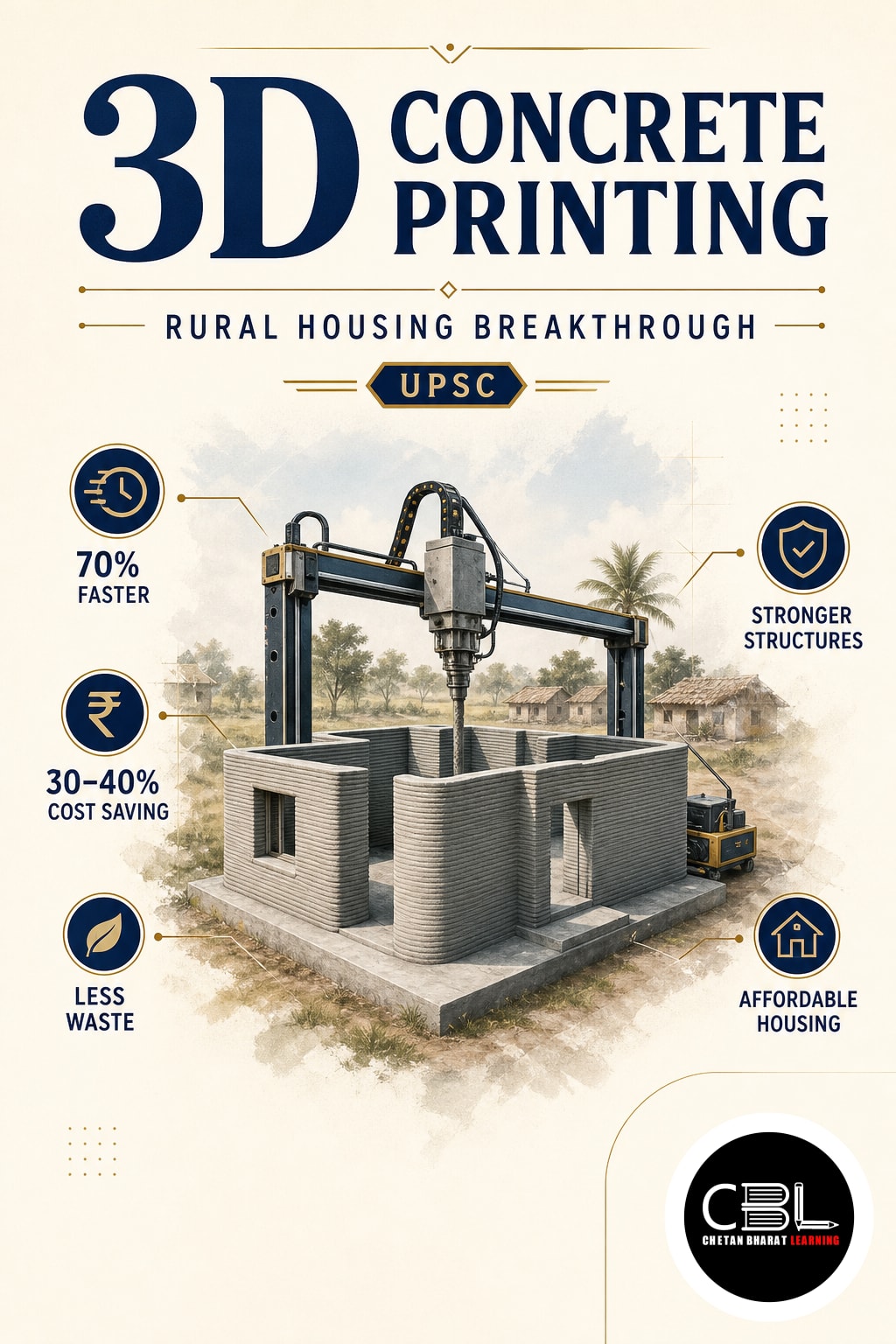
3D Concrete Printing is an automated construction process in which a digitally controlled machine deposits concrete in successive layers. A computer converts an architectural model into instructions that guide a robotic nozzle or gantry-based printing system.
The method follows the principle of additive manufacturing, where material is added only where the design requires it. It can construct walls and selected structural components without the extensive formwork used in conventional concrete construction.
The printing material must balance several properties during construction. It should flow smoothly through the nozzle, retain its deposited shape and develop enough early strength to support additional layers.
Engineers first prepare a digital building model containing the dimensions and geometry of the proposed house. Software then divides the design into printable layers and controls the machine’s movement along predetermined paths.
Workers usually complete foundations, reinforcement, roofing, doors, windows and utility connections through separate processes where required. The technology should therefore be understood as a construction system rather than a machine that automatically finishes every component.
Why is 3D Concrete Printing in News?
India launched its first pilot project for 3D Concrete Printing in rural housing at Burripalem and Obulnayudupalem in Andhra Pradesh. The foundation stone was laid on 4 October 2026 during a Pradhan Mantri Awaas Yojana–Gramin programme in Guntur district.
The ₹14 crore pilot plans to construct 177 rural houses within six months. The official PIB release presented the initiative as a step towards faster, durable and technology-driven rural housing.
The announcement accompanied the release of the first instalment for three lakh PMAY-G 2.0 houses in Andhra Pradesh. This connection places the experiment within India’s wider effort to provide pucca rural housing to eligible households.
The pilot will test whether automated construction can operate economically outside laboratories and urban demonstration projects. It will also generate practical evidence on logistics, material supply, machine deployment, quality control and beneficiary acceptance.
India has previously demonstrated printed buildings and prototypes at research institutions and urban sites. The Andhra Pradesh initiative is distinct because it applies the technology to a multi-house rural housing project under a public welfare programme.
Key Features
- Layer-by-layer construction: A robotic nozzle deposits printable concrete along digitally specified paths to form walls and other components.
- Limited formwork: The printed layers retain their shape, reducing the need for temporary moulds used in conventional construction.
- Digital customisation: Designers can modify layouts for household needs, climatic conditions and available land without rebuilding physical moulds.
- Material optimisation: Software can place material precisely and create hollow or cellular sections where the approved design permits.
- Faster repetitive work: Automated printing can reproduce standard housing components consistently across a clustered construction site.
The process begins with site investigation and a structurally validated house design. Engineers must account for soil conditions, local hazards, wall loads, reinforcement requirements and the integration of plumbing and electrical systems.
A batching system prepares the printable mixture according to controlled specifications. Pumps deliver the mixture to the nozzle, while the robotic system follows the toolpath produced from the digital model.
The absence of conventional wall formwork can save timber, steel or plastic moulding materials. Precise deposition may also reduce cutting waste and unnecessary material use when compared with poorly controlled manual construction.
Automation can improve consistency because the machine follows predetermined dimensions and movement speeds. Digital records can document material batches, printing intervals and machine parameters for later quality audits.
Design flexibility offers another advantage for rural housing. Authorities can develop region-specific layouts reflecting climate, household activities, sanitation needs and disaster risks while retaining standardised engineering principles.
The technology can potentially reduce strenuous manual tasks while creating new roles for machine operators, technicians and quality inspectors. Training local workers for these roles can connect housing delivery with rural skill development.
CSIR-Central Building Research Institute has already developed a 32-square-metre printed PMAY-G rural house at Roorkee. The prototype demonstrates how indigenous robotic systems and alternative construction materials can support affordable housing research.
Challenges
- High initial investment: Printers, pumps, control systems and specialised mixing equipment require substantial capital and trained maintenance teams.
- Material standardisation: Printable mixtures must satisfy flow, shape retention, bonding, strength, durability and local climatic requirements.
- Quality assurance: Weak bonding between layers or uncontrolled printing intervals can affect the long-term performance of walls.
- Rural logistics: Narrow roads, unreliable electricity and widely separated construction sites can reduce the efficiency of large printing systems.
- Regulatory readiness: Building codes, procurement rules and approval procedures must recognise validated printed designs and testing methods.
The technology becomes more economical when several houses are constructed within a compact cluster. Transporting and recalibrating heavy machinery for scattered individual houses may offset savings in time and labour.
Concrete printing also requires dependable supplies of carefully graded materials and chemical additives. Variations in sand, water, temperature or humidity can change pumpability, setting time and interlayer adhesion.
Printed layers create directional interfaces that differ from monolithic cast concrete. Engineers must test their behaviour under vertical loads, earthquakes, cyclones, moisture exposure and repeated temperature changes.
Automation may reduce demand for some conventional tasks, raising concerns among masons and other workers. Governments should support reskilling so that technological adoption produces safer occupations instead of sudden livelihood displacement.
Rural housing must remain responsive to household preferences and local cultural practices. A technically efficient standard design may receive limited acceptance if it ignores cooking patterns, livestock, storage, ventilation or opportunities for future expansion.
Environmental gains also require lifecycle assessment rather than assumptions based only on reduced waste. Cement production remains carbon-intensive, while printer transport, electricity consumption and specialised additives can add environmental costs.
Public agencies should disclose verified data on cost per house, construction duration, material consumption and maintenance. Readers can track associated housing and infrastructure policies through science and technology updates.
Way Forward
The Andhra Pradesh pilot should function as a transparent demonstration project with independent technical evaluation. Authorities should compare printed houses with conventional PMAY-G houses using common indicators for cost, speed, quality and durability.
India needs performance-based standards for printable materials, equipment calibration, reinforcement and interlayer bonding. National standards should still permit adjustments for different climatic, seismic and soil conditions.
Research institutions should conduct long-term tests covering weathering, fire resistance, water penetration and structural behaviour. The CSIR rural housing research shows why scientific validation must accompany rapid construction.
Governments should initially prioritise clustered projects where printer mobilisation and material supply remain economical. Careful site selection can provide reliable cost evidence before any wider national expansion.
Housing designs should incorporate local participation from the planning stage. Beneficiaries, engineers and village institutions can identify requirements involving room use, ventilation, sanitation, accessibility and future extensions.
Training programmes can prepare rural youth as printer operators, material technicians, electricians and maintenance workers. Existing masons should receive bridge courses that combine their construction knowledge with digital and automated methods.
Researchers should develop mixtures using suitable local materials and lower-carbon binders without compromising structural performance. Lifecycle assessments can verify whether each proposed mixture offers genuine environmental benefits.
A digital record should accompany every printed house and document its design, material batch, weather conditions and printing sequence. Such traceability would improve inspections, maintenance and accountability when defects emerge.
3D Concrete Printing can complement India’s rural housing programme, but evidence must guide its expansion. Safety standards, transparent evaluation and community-responsive designs can turn a promising pilot into a reliable public construction option.
Prelims Practice Corner
-
Q1. Additive manufacturing in construction primarily involves:
- (a) Removing material from a solid block
- (b) Depositing material layer by layer
- (c) Assembling only prefabricated steel frames
- (d) Compacting soil without binders
Answer: (b) Additive manufacturing creates an object by depositing material in successive layers.
-
Q2. India’s first rural pilot of printed concrete houses was launched in which state?
- (a) Andhra Pradesh
- (b) Uttarakhand
- (c) Gujarat
- (d) Odisha
Answer: (a) The pilot was launched at two locations in Guntur district, Andhra Pradesh.
-
Q3. The rural housing pilot is associated with which programme?
- (a) PMAY-U 2.0
- (b) PMAY-G 2.0
- (c) AMRUT 2.0
- (d) Smart Cities Mission
Answer: (b) The pilot forms part of the rural housing context under PMAY-G 2.0.
-
Q4. Which institution developed a 32-square-metre printed PMAY-G rural house at Roorkee?
- (a) CSIR-CBRI
- (b) CSIR-NEERI
- (c) ISRO
- (d) National Housing Bank
Answer: (a) CSIR-Central Building Research Institute developed the rural housing prototype at Roorkee.
-
Q5. Which property allows freshly deposited concrete to support subsequent printed layers?
- (a) Electrical conductivity
- (b) Buildability
- (c) Optical transparency
- (d) Magnetic permeability
Answer: (b) Buildability enables printed material to retain shape and bear additional layers.
Mains Practice Questions
-
Q1. Examine the potential of automated construction technologies to improve affordable rural housing in India. (250 words, 15 marks)
Answer Structure:
- Intro: Connect affordable rural housing with the need for faster and reliable construction methods.
- Body: Discuss speed, material efficiency, customisation, skill creation, costs, standards, logistics and beneficiary acceptance.
- Conclusion: Recommend evidence-based expansion supported by safety testing and local participation.
-
Q2. Technological innovation in public housing must remain sensitive to employment, sustainability and regional diversity. Discuss. (150 words, 10 marks)
Answer Structure:
- Intro: Present technology as a tool for inclusive development rather than an end in itself.
- Body: Cover reskilling, local materials, climate-responsive designs, lifecycle emissions and community preferences.
- Conclusion: Advocate a balanced model combining innovation with social and environmental safeguards.
FAQs on 3D Concrete Printing
- Does a concrete printer construct an entire finished house?
- The printer primarily constructs walls and selected components by depositing material in layers. Foundations, reinforcement, roofs, utilities, doors and finishes may still require separate work.
- Why is the Andhra Pradesh project significant?
- It is India’s first pilot to apply printed concrete technology to a multi-house rural housing project. The initiative will test 177 houses under real implementation conditions.
- Can the technology automatically make rural housing cheaper?
- Cost savings depend on project scale, printer utilisation, material availability and local logistics. Independent comparison with conventional construction is necessary before wider adoption.
Related Current Affairs
Preparing for UPSC, PCS or HCS?
Talk to a mentor at Chetan Bharat Learning, Chandigarh. Free guidance on choosing the right exam and building a study plan.
Chat on WhatsAppCall 97793 53345UPSC / IAS / PCS coaching in Chandigarh · Trusted by aspirants across Punjab & Haryana
Leave a Reply
You must be logged in to post a comment.