
UPSC Mapping
- Prelims: Environment and Economy
- Mains: GS Paper III – Infrastructure, Economy and Environment
Quick Facts
| Launch | Lead Institution | Umbrella | Core Method |
|---|---|---|---|
| 7 September 2026 | NITI Aayog | e-FAST India | Corridor demand aggregation |
What is PACT Platform?
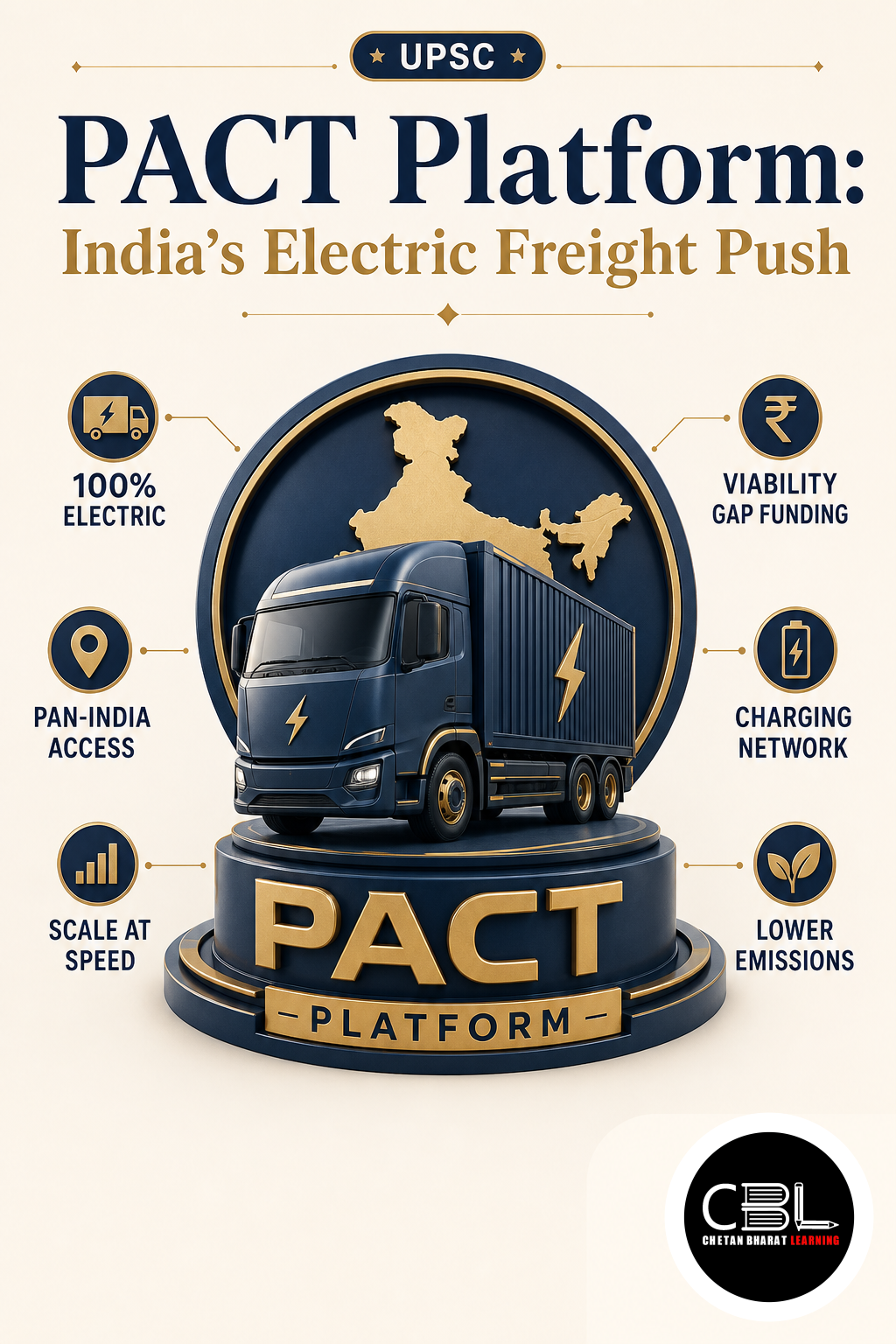
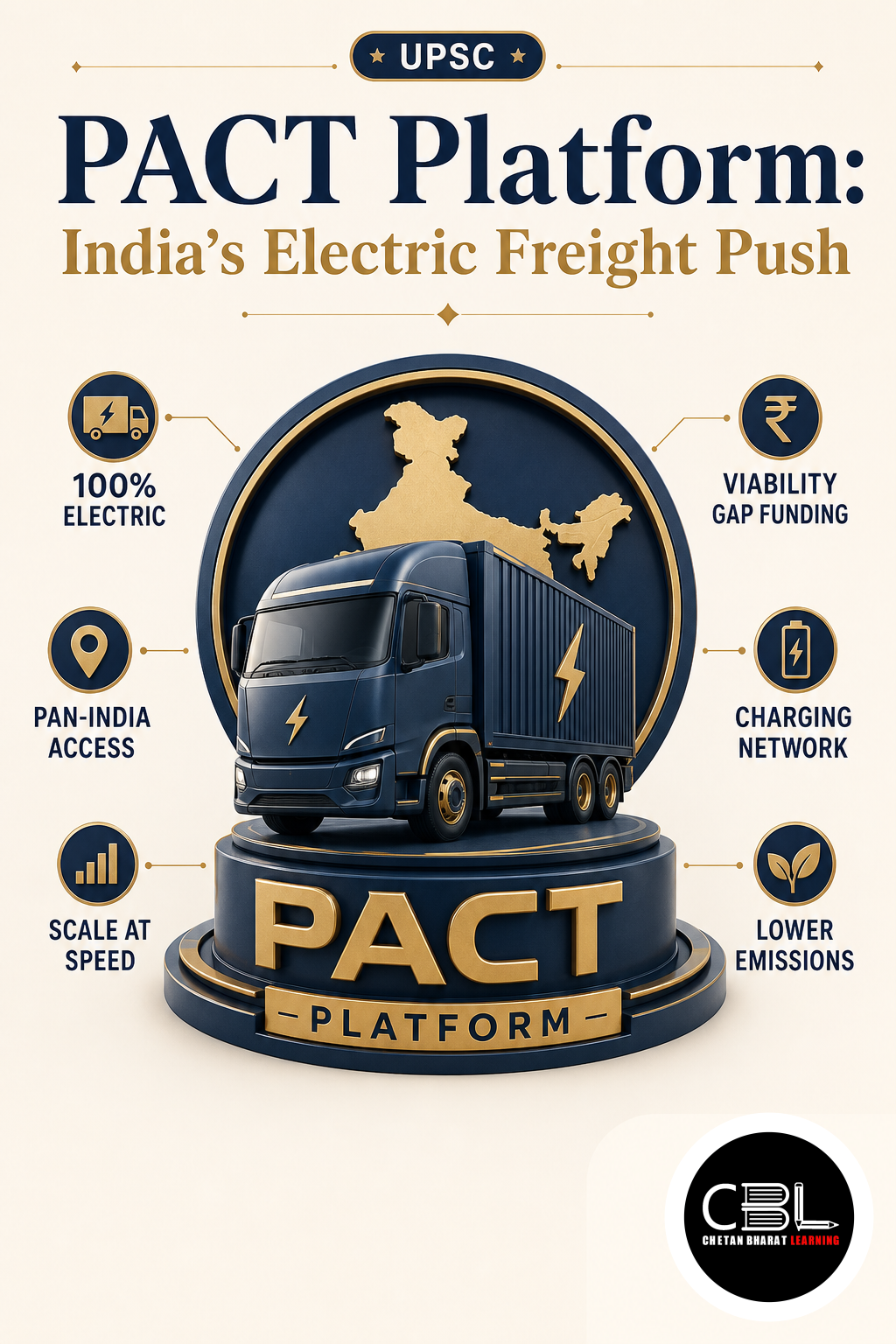
The PACT Platform, or Platform for Aggregating Clean Transport, is a NITI Aayog initiative under e-FAST India. It aggregates freight requirements from shippers and logistics service providers along similar routes. The resulting demand signal can help firms plan electric medium- and heavy-duty trucks at a commercially meaningful scale, while giving infrastructure providers clearer evidence about likely traffic and charging requirements.
PACT functions as a coordinating mechanism rather than a vehicle subsidy or procurement programme; participating organisations share information about routes, freight needs and deployment readiness, after which project teams assess corridor alignment and identify potential project clusters. Teams can connect suitable participants with manufacturers, charging providers, financiers and technology partners that serve a common operational geography. This model links vehicle demand with infrastructure, finance, technology and recurring cargo commitments needed for dependable freight operations.
Why is PACT Platform in News?
NITI Aayog launched the PACT Platform at the fifth e-FAST India Summit on 7 September 2026. The summit also introduced a Zero Emission Truck Marketplace to support business discovery, financing options, charging partnerships and wider engagement across the emerging clean-trucking value chain. The official NITI Aayog announcement describes PACT as a flagship mechanism for turning aggregated demand into deployment opportunities.
The launch shifts the policy discussion from general interest towards project-ready freight corridors. Electric trucks require coordinated decisions because vehicles, chargers, routes, power supply and finance must develop together, while individual fleet operators may hesitate when any one component remains uncertain. Demand aggregation can reveal predictable utilisation, helping stakeholders compare vehicle economics, charger locations and financing needs against actual operating requirements rather than broad national estimates.
Key Features
The initiative combines demand visibility, corridor planning and structured engagement across the electric-freight ecosystem.
- Freight aggregation: PACT combines similar corridor requirements into a credible demand signal for suppliers, lenders and infrastructure planners.
- Corridor projectisation: The platform converts registered interest into location-specific projects coordinating trucks, chargers, power connections and freight operations.
- Multi-stakeholder participation: Cargo owners, fleet operators, manufacturers, charging providers, financiers, technology firms and public agencies can register interest.
- Facilitated partnerships: Project teams connect suitable participants for corridor-level commercial, financial, technical and operational discussions before investment decisions.
- Deployment assessment: Submitted information supports reviews of freight patterns, organisational readiness, charging needs and alignment with promising routes.
Challenges
Successful deployment will depend on overcoming commercial, infrastructure and coordination risks beyond initial registration.
- High upfront costs: Electric heavy trucks and fast-charging systems require substantial early capital before operators can realise potential savings.
- Financing constraints: Limited operating histories, battery evidence and resale benchmarks complicate loan pricing for newer heavy-vehicle technologies and smaller borrowers.
- Charging coordination: Corridor chargers need suitable land, reliable power, safe access, compatible standards and predictable traffic for viable utilisation.
- Fragmented logistics: Small operators, diverse duty cycles, seasonal flows and changing contracts complicate stable demand commitments across freight corridors.
- Data governance: Participants need safeguards, access controls and clear retention rules for commercially sensitive route, customer, cargo and operational information.
Way Forward
NITI Aayog and participating firms can prioritise corridors with regular traffic, committed cargo owners, feasible charging sites and distribution networks capable of meeting heavy-vehicle power demand. Transparent selection criteria and standard methods for measuring utilisation, energy use, reliability and emissions can build a comparable evidence base for public agencies, businesses and lenders, while helping future projects distinguish local constraints from technology-wide barriers. The official electric freight portal sets out registration, aggregation and partnership stages that can support this phased approach.
Public agencies can advance common charging standards, grid planning and interoperable payment systems, while lenders develop leasing, risk-sharing and cash-flow products using verified corridor data. State governments and distribution companies should join early because permits, land, safety rules and electricity connections shape implementation timelines; strong data protection and voluntary participation will sustain trust among competing businesses that must collaborate on infrastructure while protecting customer relationships and commercially sensitive operating strategies. The PACT Platform should measure success through operational trucks, reliable corridors, lower project uncertainty and repeatable financing models, using pilot evidence to improve designs while preserving competition among vehicle, charging and finance providers.
Prelims Practice Corner
-
Q1. PACT operates under which wider initiative?
- (a) PM Gati Shakti
- (b) e-FAST India
- (c) National Logistics Portal
- (d) SATAT
Answer: (b) PACT is a flagship initiative under the NITI Aayog-led e-FAST India platform.
-
Q2. What is the central operating method of PACT?
- (a) Fuel price regulation
- (b) Freight demand aggregation
- (c) Railway privatisation
- (d) Port tariff control
Answer: (b) It aggregates freight demand along corridors to support electric-truck deployment.
-
Q3. Which institution leads the PACT initiative?
- (a) NITI Aayog
- (b) Reserve Bank of India
- (c) Finance Commission
- (d) Central Electricity Authority
Answer: (a) NITI Aayog leads PACT through the e-FAST India platform.
-
Q4. PACT primarily targets which vehicle segment?
- (a) Private two-wheelers
- (b) Passenger aircraft
- (c) Medium- and heavy-duty freight trucks
- (d) Inland fishing vessels
Answer: (c) The initiative supports electric medium- and heavy-duty freight deployment.
-
Q5. Which participant is directly relevant to corridor charging deployment?
- (a) Charge point operator
- (b) Census registrar
- (c) District judge
- (d) Crop insurer
Answer: (a) Charge point operators plan and provide the charging infrastructure required by electric trucks.
Mains Practice Questions
-
Q1. Explain how demand aggregation can accelerate the transition to zero-emission freight in India. (150 words, 10 marks)
Answer Structure:
- Intro: Define demand aggregation in the context of freight electrification.
- Body: Cover demand visibility, charging utilisation, vehicle economics, financing confidence and corridor coordination.
- Conclusion: Link credible demand signals with scalable and competitive clean-logistics projects.
-
Q2. Discuss the institutional and operational challenges in electrifying India’s medium- and heavy-duty freight corridors. (250 words, 15 marks)
Answer Structure:
- Intro: Frame freight electrification as an infrastructure, finance and coordination challenge.
- Body: Examine vehicle costs, fragmented operators, charging networks, grid readiness, standards, data and financing.
- Conclusion: Recommend phased corridor projects supported by evidence, competition and inter-agency coordination.
FAQs on PACT Platform
- What does PACT stand for?
- PACT stands for Platform for Aggregating Clean Transport. It brings freight demand and supporting stakeholders together for corridor-based zero-emission truck projects.
- Does PACT provide a direct vehicle subsidy?
- PACT is presented as a coordination and demand-aggregation platform, not a direct subsidy scheme. It facilitates project assessment and partnerships among relevant organisations.
- Who can participate in PACT?
- Eligible participants include shippers, logistics and fleet operators, manufacturers, charging providers, financiers, technology providers and public-sector undertakings. Registration records interest but does not guarantee participation.
Related Current Affairs
Preparing for UPSC, PCS or HCS?
Talk to a mentor at Chetan Bharat Learning, Chandigarh. Free guidance on choosing the right exam and building a study plan.
Chat on WhatsAppCall 97793 53345UPSC / IAS / PCS coaching in Chandigarh · Trusted by aspirants across Punjab & Haryana
Leave a Reply
You must be logged in to post a comment.