
UPSC Mapping
- Prelims: Economy & Banking
- Mains: GS Paper 3 (Economic Development & Banking)
Article
What is UPI Free Funding?
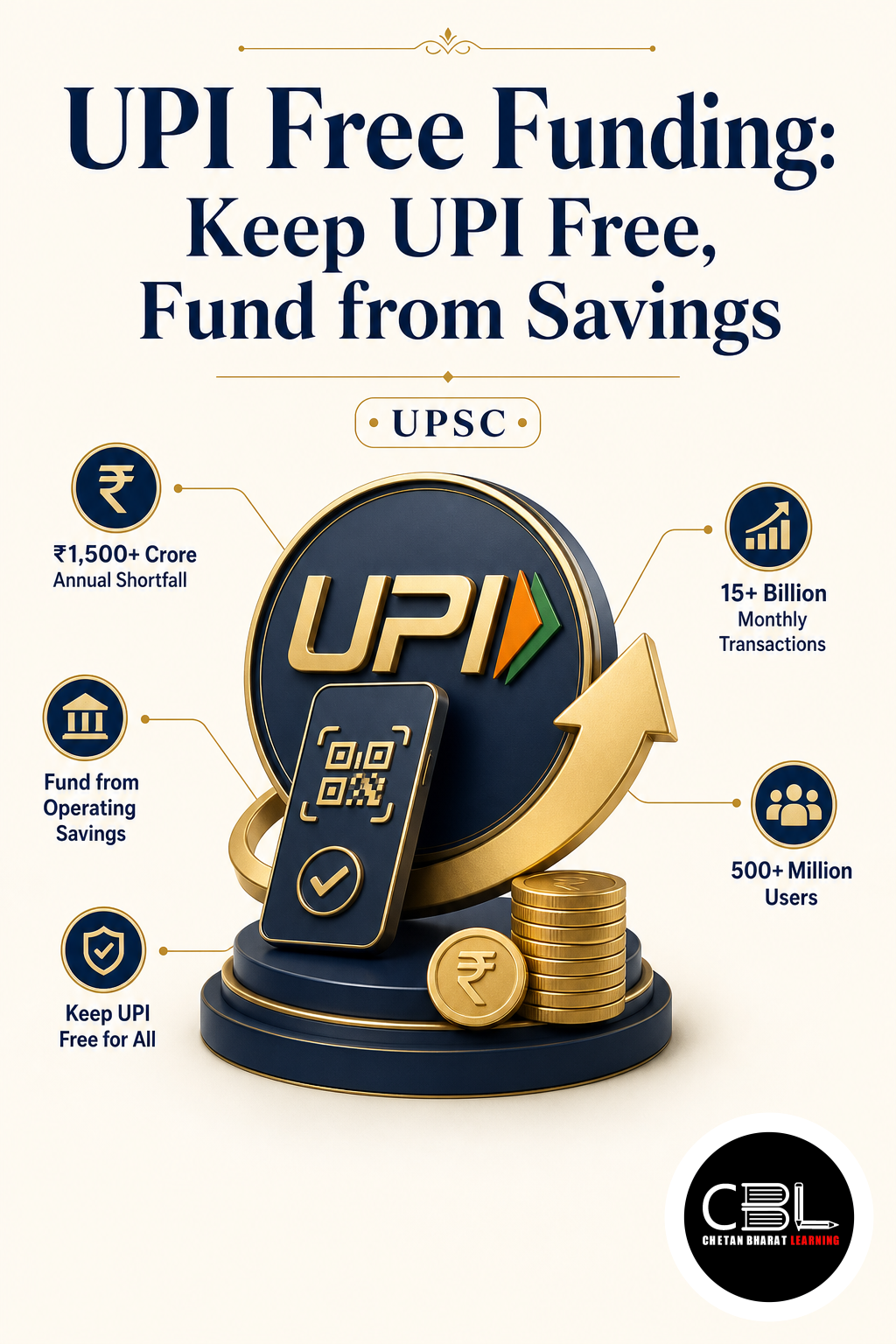
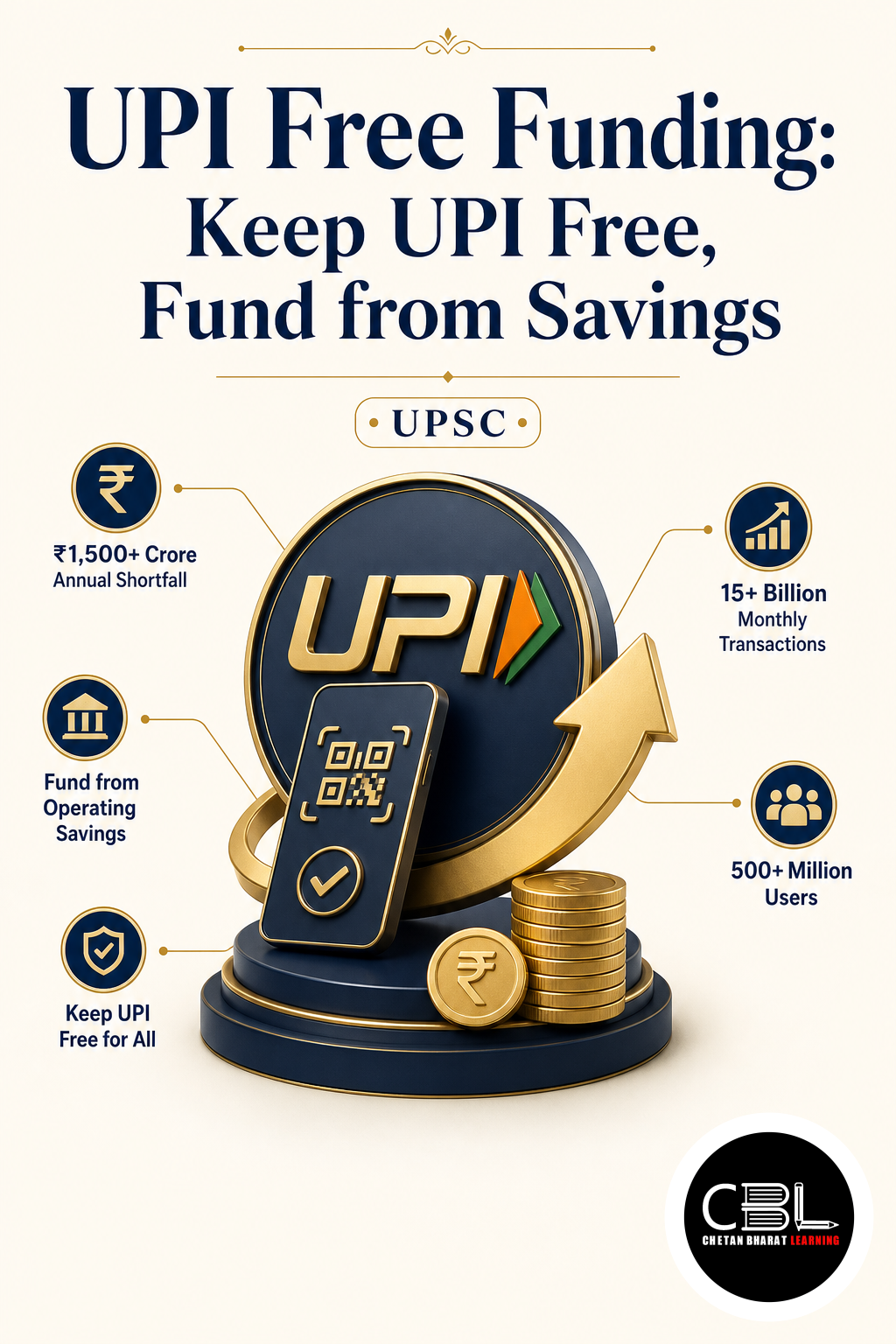
UPI Free Funding refers to the policy of zero Merchant Discount Rate (MDR) on UPI transactions, in place since January 2020 to accelerate digital payment adoption. Following the amendment to the Payment and Settlement Systems Act, the government can now notify which modes can carry charges, though no charge has been imposed yet.
Why is UPI Free Funding in News?
Parliament passed the Taxation and Other Laws (Amendment) Bill, 2026, rewriting Section 10A of the Payment and Settlement Systems Act. The amendment replaces the absolute bar on charges with an enabling provision, allowing future levies on UPI transactions. The debate balances free access for small merchants and consumers against sustainable funding of infrastructure.
Key Features of UPI Free Funding
- Zero MDR: No charges for consumers or merchants on UPI transactions.
- Scale: 24,000 crore transactions in 2025–26, accounting for 85% of India’s digital retail payments.
- Small Transactions: Average transaction ~Rs 1,300; 86% of merchant payments below Rs 500.
- Cost Comparison: UPI is far cheaper than cash handling or card payments.
- Enabling Amendment: The 2026 Act allows charges in the future.
Challenges in UPI Free Funding
- Sustainability: Infrastructure costs must be borne by someone.
- Merchant Resistance: Small merchants may resist charges, potentially shifting back to cash.
- Consumer Impact: Merchants might pass on any new costs to consumers.
- Revenue Model: Banks and processors need a viable funding mechanism.
- Regulatory Clarity: The enabling provision creates uncertainty about future charges.
Way Forward for UPI Free Funding
To sustain UPI Free Funding, the government can utilise savings from reduced currency printing, lower bank operational costs, and enhanced tax compliance. A tiered MDR structure exempting small merchants and low-value transactions can protect the most vulnerable. Transparency on costs and a clear timeline for any charges will build stakeholder confidence.
Quick Facts
| Transactions (2025–26) | 24,000 crore+ |
|---|---|
| Average Transaction | ~Rs 1,300 |
| RBI Currency Cost | Rs 5,000–6,400 crore/year |
Prelims Practice Corner
-
Q1. How many UPI transactions were processed in 2025–26? (a) 10,000 crore (b) 15,000 crore (c) 24,000 crore (d) 30,000 crore
Answer: (c) Over 24,000 crore transactions were processed.
-
Q2. What is the average UPI transaction value? (a) ~Rs 500 (b) ~Rs 1,300 (c) ~Rs 2,000 (d) ~Rs 5,000
Answer: (b) The average transaction is about Rs 1,300.
-
Q3. How much does the RBI spend annually on currency printing? (a) Rs 1,000–2,000 crore (b) Rs 3,000–4,000 crore (c) Rs 5,000–6,400 crore (d) Rs 10,000 crore
Answer: (c) The RBI spends Rs 5,000–6,400 crore annually on currency printing.
-
Q4. What percentage of India’s digital retail payments are on UPI? (a) 65% (b) 75% (c) 85% (d) 95%
Answer: (c) UPI accounts for 85% of digital retail payments by volume.
-
Q5. What does the 2026 amendment to the Payment and Settlement Systems Act allow? (a) Immediate charges on UPI (b) Enabling provision for future charges (c) Abolition of UPI (d) Reduction of MDR
Answer: (b) The amendment allows the government to notify charges in the future.
Mains Practice Questions
-
Q1. Discuss the policy debate around charging for UPI transactions and its implications for financial inclusion in India. (250 words, 15 marks)
Answer Structure:
- Intro: Introduce UPI’s success and the free vs funded debate.
- Body: Analyse cost savings from UPI (currency printing, bank costs). Discuss pros and cons of MDR charges. Suggest tiered approach protecting small merchants.
- Conclusion: Emphasise the balance between sustainability and inclusion.
-
Q2. What is Merchant Discount Rate (MDR) and why is it important for digital payment ecosystems? (150 words, 10 marks)
Answer Structure:
- Intro: Define MDR as a merchant fee.
- Body: Explain MDR funds payment infrastructure. Zero MDR boosted UPI adoption but raises sustainability concerns.
- Conclusion: A balanced MDR policy is needed.
FAQs on UPI Free Funding
Is UPI free?
Yes, UPI remains free for consumers and merchants, but the amendment allows future charges.
Why is funding UPI a concern?
The infrastructure cost of UPI must be borne, and currently there is no revenue from transactions.
What is the cost of keeping UPI free?
The government and banks bear the infrastructure cost, offset by savings from reduced cash handling.
Related Current Affairs
Preparing for UPSC, PCS or HCS?
Talk to a mentor at Chetan Bharat Learning, Chandigarh. Free guidance on choosing the right exam and building a study plan.
Chat on WhatsAppCall 97793 53345UPSC / IAS / PCS coaching in Chandigarh · Trusted by aspirants across Punjab & Haryana
Leave a Reply
You must be logged in to post a comment.