
Why Is This News Important?
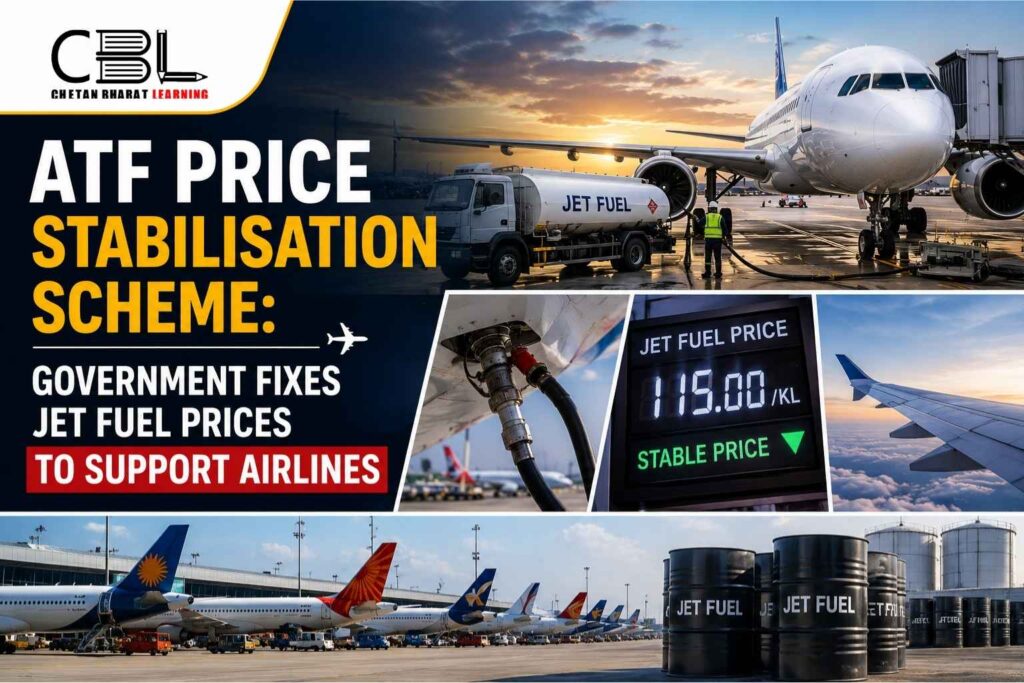
The Union Government has introduced a price stabilisation scheme for Aviation Turbine Fuel (ATF) to protect Indian airlines from sharp fluctuations in global fuel prices.
Under the scheme, ATF prices have been fixed at levels slightly above current market rates. The move aims to reduce financial pressure on airlines and ensure stability in the aviation sector.
For UPSC aspirants, the development is important from the perspective of economic policy, energy security, and civil aviation.
What Happened?
The government approved a ₹10,000 crore ATF Price Stabilisation Scheme.
Under this mechanism:
- ATF prices will be fixed for participating airlines.
- Indian airlines will receive fuel at predetermined rates.
- Oil Marketing Companies (OMCs) will be compensated when losses occur.
- The scheme is expected to remain in force for up to three years.
The objective is to shield airlines from extreme volatility in international fuel markets.
What Is Aviation Turbine Fuel (ATF)?
ATF is a specialized fuel used to power aircraft.
It is one of the largest operational expenses for airlines and can account for a significant share of total operating costs.
Changes in ATF prices directly affect:
- Airline profitability
- Airfares
- Aviation sector growth
- Passenger travel costs
Therefore, fuel price stability is critical for the aviation industry.
Why Was the Scheme Introduced?
Global fuel prices have remained volatile due to geopolitical tensions and disruptions in energy markets.
The government introduced the scheme to:
- Reduce uncertainty for airlines
- Stabilize operational costs
- Support the aviation sector
- Prevent sharp increases in airfares
As a result, airlines can plan operations more effectively.
Key Features of the Scheme
Fixed Fuel Pricing
Participating airlines will purchase ATF at predetermined prices regardless of international market fluctuations.
Support for Indian Airlines
The facility is available only to Indian carriers and not foreign airlines.
Compensation Mechanism
OMCs will receive compensation when they incur losses due to fixed pricing.
Long-Term Stability
The scheme may continue for up to three years, subject to periodic review.
Benefits of the Scheme
The initiative offers several advantages.
Reduced Cost Uncertainty
Airlines can better predict operational expenses.
Stable Airfares
Fuel price stability may help control ticket prices.
Stronger Aviation Sector
The policy provides financial relief to airlines.
Improved Economic Connectivity
A healthier aviation sector supports tourism, trade, and economic growth.
Challenges and Concerns
Despite its benefits, the scheme faces certain challenges.
Fiscal Burden
Compensating OMCs may increase government expenditure.
Market Distortions
Fixed pricing can reduce the impact of market signals.
Long-Term Sustainability
The scheme’s success depends on future global fuel price trends.
Limited Coverage
The facility is currently focused on Indian airlines only.
Impact on India’s Aviation Sector
The aviation sector has faced rising fuel costs in recent years.
The scheme is expected to:
- Improve airline financial health
- Encourage route expansion
- Support passenger demand
- Reduce fare volatility
Overall, it aims to strengthen India’s rapidly growing aviation market.
Way Forward
To maximize benefits, the government should focus on:
- Regular review of pricing mechanisms
- Strengthening energy security
- Improving aviation infrastructure
- Promoting sustainable aviation fuels
- Maintaining fiscal discipline
A balanced approach will help ensure long-term sectoral growth.
Prelims Pointers
| Topic | Key Fact |
|---|---|
| Fuel | Aviation Turbine Fuel (ATF) |
| Sector | Civil Aviation |
| Scheme Size | ₹10,000 Crore |
| Beneficiaries | Indian Airlines |
| Objective | Price Stabilisation |
Mains Perspective
Possible UPSC Question
“Discuss the significance of the ATF Price Stabilisation Scheme for India’s aviation sector. Examine its potential benefits and challenges.”
Key Dimensions
- Aviation sector growth
- Fuel price volatility
- Economic policy
- Energy security
- Airline profitability
- Government intervention
Frequently Asked Questions (FAQ)
What is ATF?
ATF stands for Aviation Turbine Fuel, which is used by aircraft.
Why was the stabilisation scheme introduced?
To protect airlines from sharp fluctuations in global fuel prices.
Who benefits from the scheme?
Indian airlines participating in the programme.
Why is ATF important?
Fuel costs form a major portion of airline operating expenses.
Conclusion
The ATF Price Stabilisation Scheme represents a significant policy intervention aimed at supporting India’s aviation sector during a period of global energy uncertainty.
By reducing fuel price volatility and improving cost predictability, the scheme can strengthen airline operations while contributing to broader economic growth.
For More UPSC Current Affairs
Stay updated with the latest developments in economy, governance, and international affairs through UPSC Coaching in Chandigarh and IAS Coaching in Chandigarh at Chetan Bharat Learning.
Related Current Affairs
Preparing for UPSC, PCS or HCS?
Talk to a mentor at Chetan Bharat Learning, Chandigarh. Free guidance on choosing the right exam and building a study plan.
Chat on WhatsAppCall 97793 53345UPSC / IAS / PCS coaching in Chandigarh · Trusted by aspirants across Punjab & Haryana
Leave a Reply
You must be logged in to post a comment.