
| Important for | |
|---|---|
PrelimsPolity & Judiciary |
MainsGS Paper 2 (Polity & Judiciary) |
What is Justice Reddy Committee?
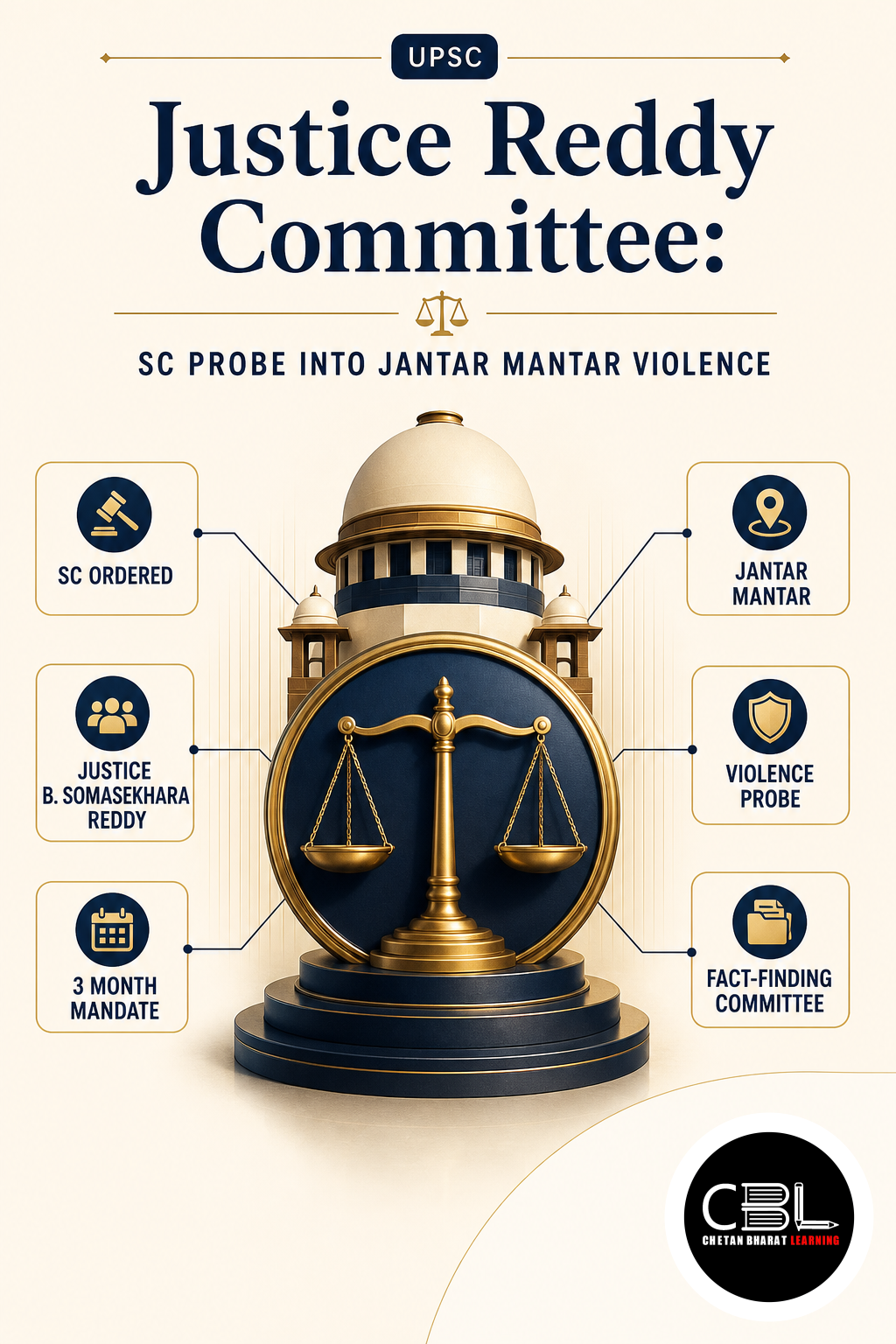
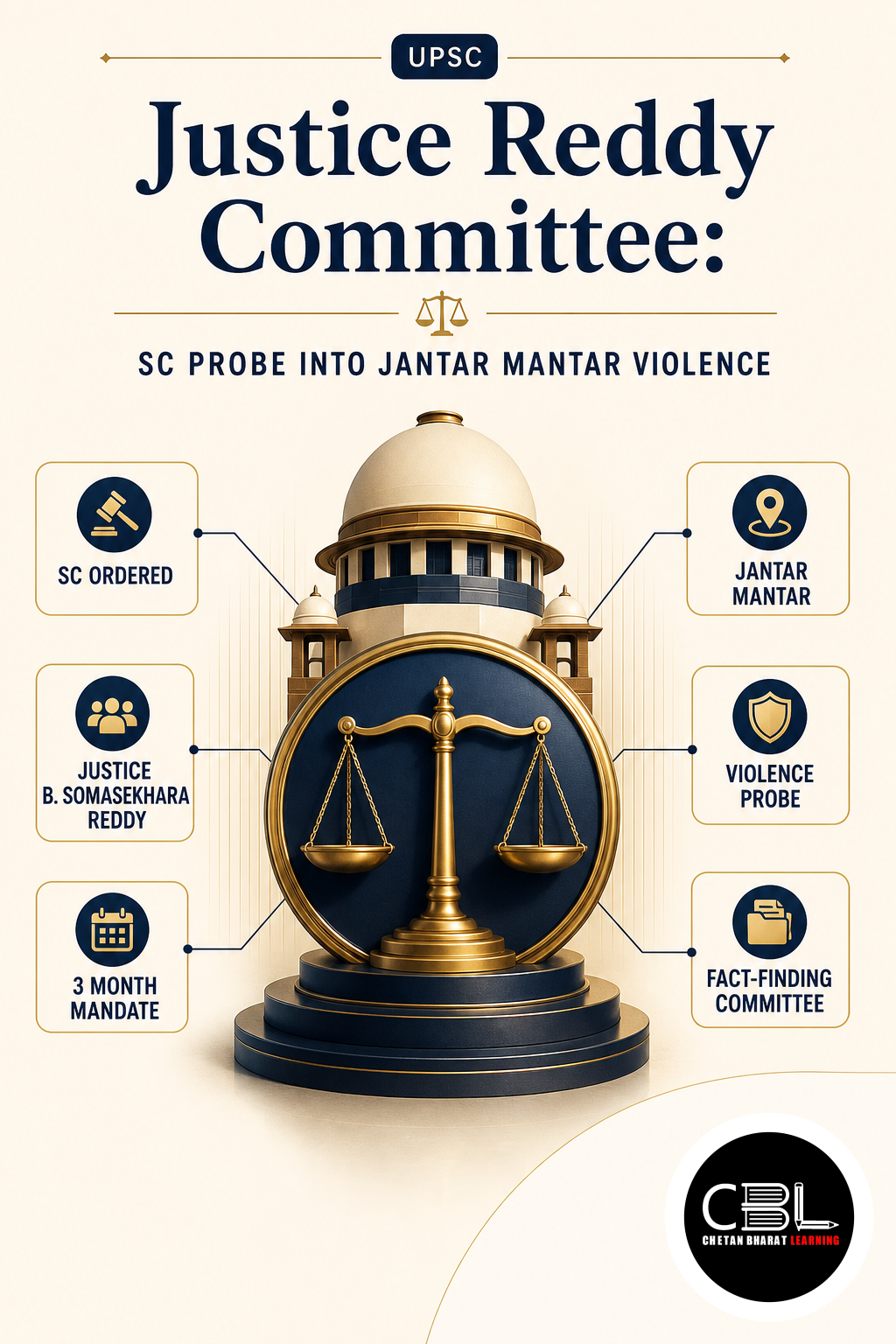
Justice Reddy Committee is a High-Powered Enquiry Committee constituted by the Supreme Court to independently examine allegations of violence during student demonstrations at Jantar Mantar in New Delhi. The committee is headed by former Justice R Subhash Reddy and comprises five members. It was formed following petitions alleging excessive use of force and violence against protesters.
The committee’s mandate is to examine the sequence of events, the nature of force used, and compliance with legal procedures. Its findings will guide the Supreme Court in determining whether constitutional rights were violated and what corrective measures are needed.
Why is Justice Reddy Committee in News?
Justice Reddy Committee is in the news following its constitution by the Supreme Court to probe the Jantar Mantar violence. The committee is tasked with an independent inquiry into the allegations of police excess and the treatment of students during the protests. The Supreme Court’s intervention highlights the importance of judicial oversight in ensuring accountability.
The committee’s findings are expected to have significant implications for police conduct and the protection of the right to protest.
Key Features of Justice Reddy Committee
Justice Reddy Committee has several distinctive features:
- High-Powered: Headed by a former Supreme Court judge.
- Independent Inquiry: Tasked with examining allegations of violence.
- Scope: Sequence of events, use of force, compliance with procedures.
- Judicial Oversight: Constituted by the Supreme Court.
- Implications: Findings will guide the Court’s decision.
Challenges in Justice Reddy Committee
Justice Reddy Committee faces several challenges:
- Conflicting Versions: Reconciling different accounts of the events.
- Evidence Collection: Gathering and verifying evidence.
- Witness Cooperation: Ensuring witnesses come forward.
- Timelines: Completing the inquiry within a reasonable time.
- Public Trust: Maintaining credibility and impartiality.
Way Forward for Justice Reddy Committee
To ensure a credible inquiry, Justice Reddy Committee should adopt transparent procedures, including public hearings and evidence disclosure where appropriate. The committee’s report should be made public to uphold accountability.
The inquiry’s findings can inform police training and protocols for handling protests, balancing the right to protest with public order.
Prelims Practice Corner
Q1. Who heads the Justice Reddy Committee?
- (a) Justice R Subhash Reddy
- (b) Justice Surya Kant
- (c) Justice D.Y. Chandrachud
- (d) Justice K.M. Joseph
Answer: (a) The committee is headed by former Justice R Subhash Reddy.
Q2. Which court constituted the committee?
- (a) Delhi High Court
- (b) Supreme Court
- (c) Allahabad High Court
- (d) Madras High Court
Answer: (b) The Supreme Court constituted the committee.
Q3. What is the purpose of the committee?
- (a) To frame new laws
- (b) To examine allegations of violence during protests
- (c) To conduct elections
- (d) To review judicial appointments
Answer: (b) It is probing the Jantar Mantar violence allegations.
Q4. How many members does the committee have?
- (a) 3
- (b) 4
- (c) 5
- (d) 7
Answer: (c) It is a five-member committee.
Q5. Where did the student demonstrations occur?
- (a) India Gate
- (b) Jantar Mantar
- (c) Rajpath
- (d) Red Fort
Answer: (b) The demonstrations were at Jantar Mantar in New Delhi.
Mains Practice Questions
Q1. Discuss the significance of judicial inquiry committees like the Justice Reddy Committee in ensuring accountability and upholding constitutional rights. (250 words, 15 marks)
Answer Structure
- Intro: Introduce the Justice Reddy Committee and its mandate.
- Body: Discuss the role of judicial inquiries in investigating state action, the importance of independence, and the need for transparent procedures. Analyse the implications for the right to protest and police accountability.
- Conclusion: Emphasise the need for swift and credible inquiries to maintain public trust.
Q2. What is the constitutional framework governing the right to protest in India? (150 words, 10 marks)
Answer Structure
- Intro: Note that the right to protest emerges from Articles 19(1)(a) and (b).
- Body: Explain that it is subject to reasonable restrictions under Article 19(2) and (3) for public order, etc. The state must balance dissent with public order.
- Conclusion: Conclude that judicial oversight ensures this balance.
FAQs on Justice Reddy Committee
What is the Justice Reddy Committee?
A Supreme Court-constituted committee to probe Jantar Mantar violence allegations.
Who heads the committee?
Former Justice R Subhash Reddy heads the five-member committee.
Why was it constituted?
To independently examine allegations of violence during student protests at Jantar Mantar in New Delhi.
Related Current Affairs
Preparing for UPSC, PCS or HCS?
Talk to a mentor at Chetan Bharat Learning, Chandigarh. Free guidance on choosing the right exam and building a study plan.
Chat on WhatsAppCall 97793 53345UPSC / IAS / PCS coaching in Chandigarh · Trusted by aspirants across Punjab & Haryana
Leave a Reply
You must be logged in to post a comment.