
UPSC Mapping
| Prelims | Agriculture & Statistics |
|---|---|
| Mains | GS Paper 3 (Agriculture & Economy) |
Quick Facts
| Launch Year | 1973-74 |
|---|---|
| CCE Lapses | ~28% |
| Outdated Village Maps | 63% |
What is the Crop Statistics Scheme?
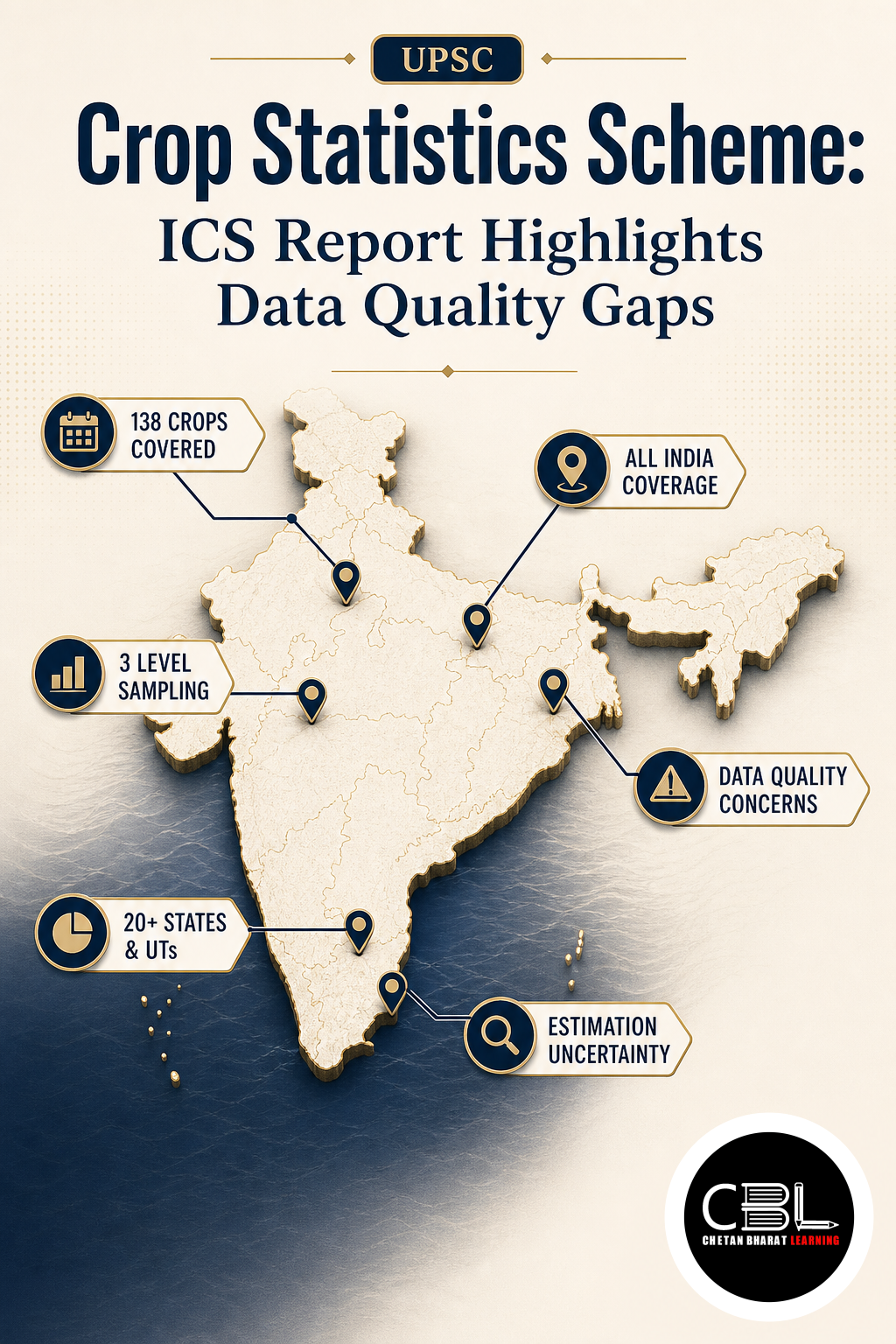
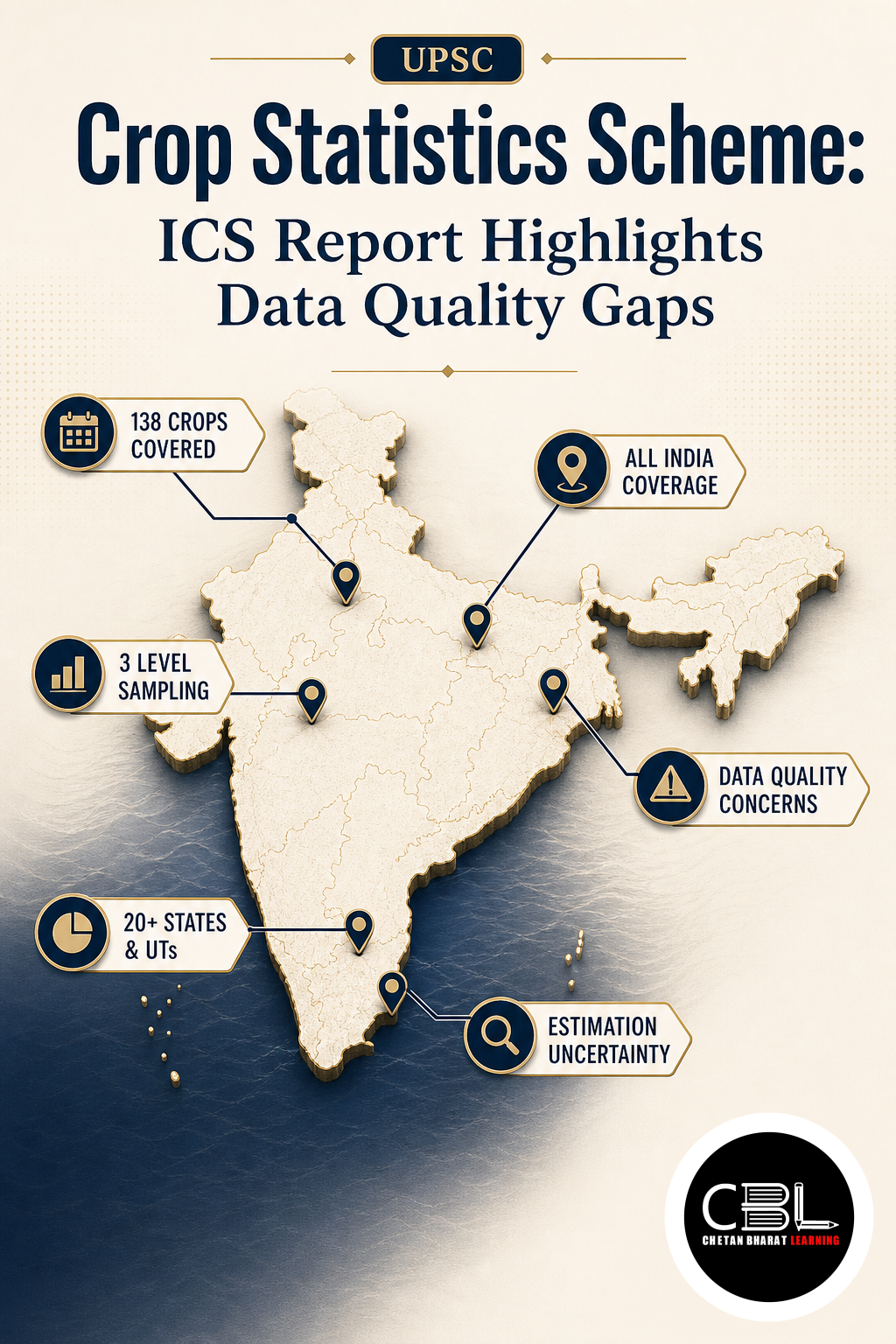
Crop Statistics Scheme (ICS) is a centrally sponsored quality-control mechanism under the National Statistical Office (NSO), launched in 1973-74 to audit, verify, and improve the accuracy of state-generated agricultural statistics. The scheme focuses on two key areas: Area Enumeration (total land planted with a crop in a season) and Crop Cutting Experiments (average production per unit area).
The implementing agencies include Patwari (Village Accountant) for village-level crop enumeration (Girdawari), State Agricultural Statistics Authorities (SASA) for data collection and CCE execution, and NSO’s Field Operations Division for guidance and supervision. The digital shift includes the Agrisoft Android app and geotagged DGEs App for real-time harvest data.
Why is Crop Statistics Scheme in News?
Crop Statistics Scheme is in the news following the release of the Annual Report for 2023-24, which identified significant gaps in data quality. The report found about 28% of CCEs showed procedural lapses, rule violations, or errors. Heavy reliance on untrained field staff undermined reliability (e.g., 41% in Jharkhand, 40% in Uttar Pradesh).
Crop or area discrepancies were found in 20-25% of inspected fields. Additionally, 63% of village maps used by field workers were over 20 years old, reducing their utility for identifying altered land-use boundaries.
Key Features of Crop Statistics Scheme
- Quality Control: Audits and verifies state crop statistics.
- Area Enumeration: Total land planted with a crop in a season.
- Crop Cutting Experiments: Average production per unit area.
- Implementing Agencies: Patwari, SASA, NSO Field Operations Division.
- Digital Shift: Agrisoft Android app and geotagged DGEs App.
Challenges in Crop Statistics Scheme
- Procedural Lapses: 28% of CCEs showed rule violations or errors.
- Untrained Staff: Heavy reliance on untrained field staff (41% in Jharkhand, 40% in Uttar Pradesh).
- Recording Errors: 20-25% of fields had crop or area discrepancies.
- Outdated Maps: 63% of village maps were over 20 years old.
- Infrastructure: Lack of modern equipment and technology.
Way Forward for Crop Statistics Scheme
To improve the Crop Statistics Scheme, the government should invest in training field staff and modernising data collection methods. Updating village maps with digital and geospatial tools is essential. Strengthening supervision and regular audits can reduce procedural lapses.
Leveraging technology, such as satellite-based area estimation and remote sensing, can complement ground-based CCEs. Inter-departmental coordination and increased budget allocation for the scheme can enhance data quality.
Prelims Practice Corner
Q1. In which year was the ICS Scheme launched?
- (a) 1950
- (b) 1965
- (c) 1973-74
- (d) 1980
Answer: (c) The ICS Scheme was launched in 1973-74.
Q2. What percentage of CCEs showed procedural lapses?
- (a) 15%
- (b) 20%
- (c) 28%
- (d) 35%
Answer: (c) About 28% of CCEs showed procedural lapses.
Q3. What is a Crop Cutting Experiment?
- (a) A survey of farmers
- (b) Measuring average production per unit area
- (c) A soil test
- (d) A market survey
Answer: (b) CCE measures average production per unit area.
Q4. What percentage of village maps used by field workers were over 20 years old?
- (a) 40%
- (b) 50%
- (c) 63%
- (d) 75%
Answer: (c) 63% of village maps were over 20 years old.
Q5. Which body oversees the ICS Scheme?
- (a) Ministry of Agriculture
- (b) National Statistical Office
- (c) NITI Aayog
- (d) Planning Commission
Answer: (b) The NSO oversees the ICS Scheme.
Mains Practice Questions
Q1. Discuss the importance of reliable crop statistics for agricultural policy in India and the challenges faced by the Crop Statistics Scheme. (250 words, 15 marks)
Answer Structure:
- Intro: Introduce the ICS Scheme and its importance.
- Body: Discuss the key findings of the report (lapses, untrained staff, outdated maps). Analyse the implications for agricultural policy. Suggest improvements: training, technology, modernisation.
- Conclusion: Emphasise the need for accurate data for food security and farmer welfare.
Q2. What is Girdawari and what is its role in crop statistics? (150 words, 10 marks)
Answer Structure:
- Intro: Define Girdawari as village-level crop enumeration.
- Body: Explain that Patwaris conduct Girdawari to record crop area, which is the basis for agricultural statistics. Its accuracy is crucial for policy.
- Conclusion: Conclude that Girdawari is the foundation of crop data collection.
FAQs on Crop Statistics Scheme
What is the ICS Scheme?
It is a quality-control mechanism to audit and improve state crop statistics.
What are the main issues with crop statistics?
Procedural lapses, untrained staff, recording errors, and outdated maps.
How can crop statistics be improved?
Through training, modern technology (GIS, satellite), and regular audits.
Related Current Affairs
Preparing for UPSC, PCS or HCS?
Talk to a mentor at Chetan Bharat Learning, Chandigarh. Free guidance on choosing the right exam and building a study plan.
Chat on WhatsAppCall 97793 53345UPSC / IAS / PCS coaching in Chandigarh · Trusted by aspirants across Punjab & Haryana
Leave a Reply
You must be logged in to post a comment.