
UPSC Mapping
| Prelims | Polity & Federalism |
|---|---|
| Mains | GS Paper 2 (Polity & Federalism) |
| Southern Zonal Council Headquarters | Chennai |
|---|---|
| Chairperson | Union Home Minister |
Article
Zonal Councils have been in focus with the 31st meeting of the Southern Zonal Council concluding in Tamil Nadu. Zonal Councils are statutory bodies established under Part III of the States Reorganization Act, 1956, serving as deliberative and advisory bodies with non-binding recommendations. For more such polity updates, explore the polity and governance archive.
What are Zonal Councils?
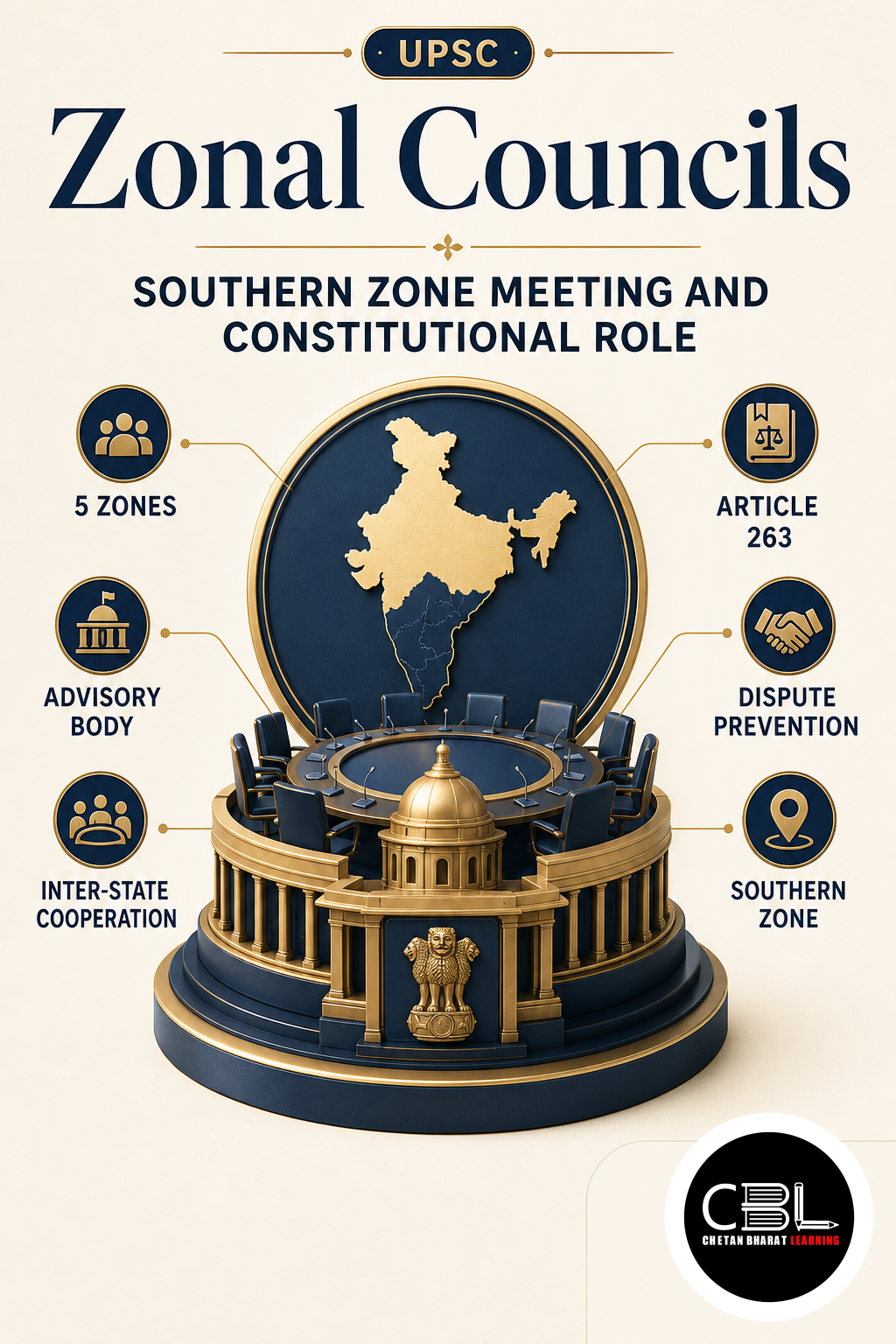
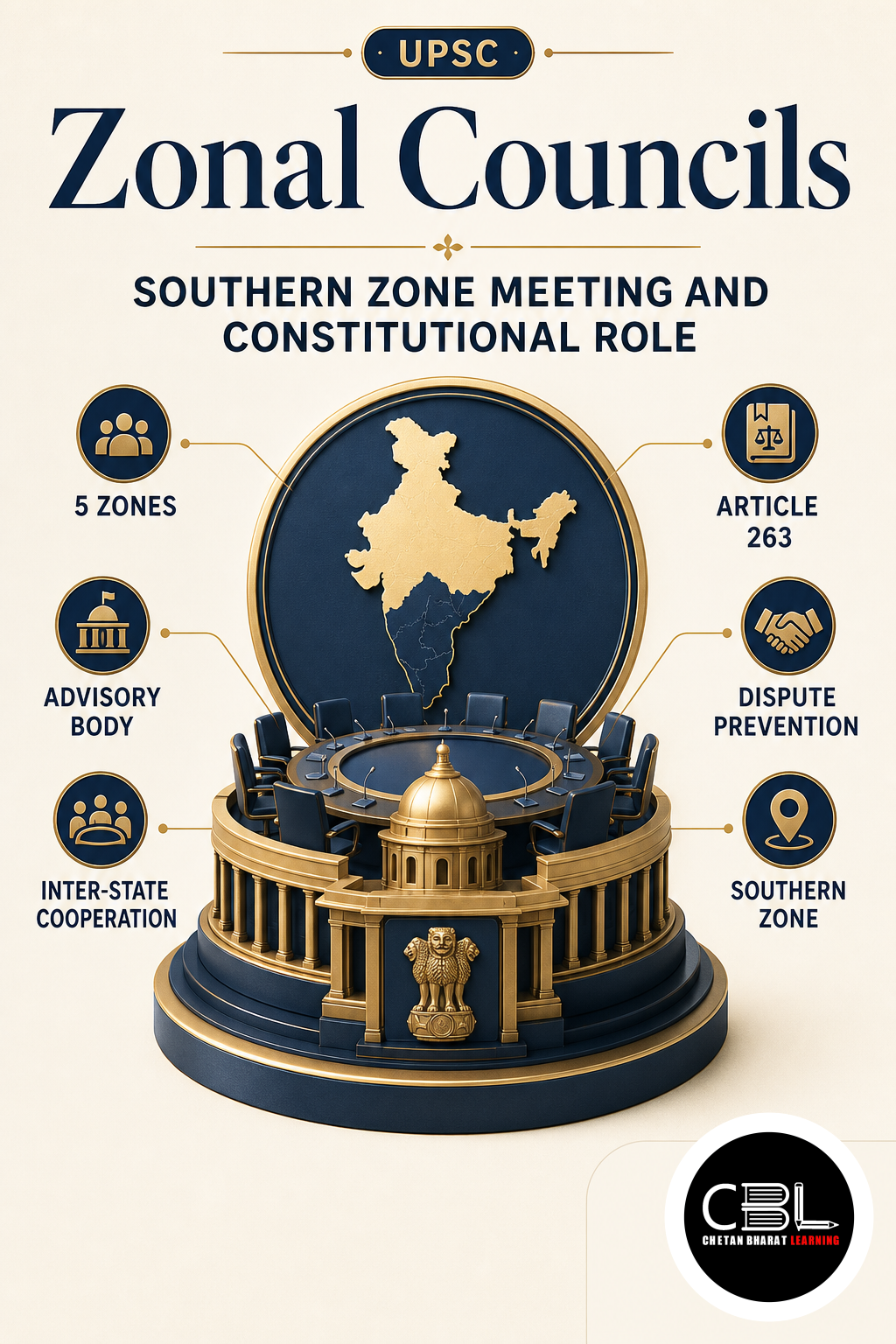
Zonal Councils are statutory bodies established under Part III of the States Reorganization Act, 1956, to promote Centre-state cooperation, socio-economic planning, and linguistic minority protection. They were proposed by Prime Minister Jawaharlal Nehru in 1956 during debates on the linguistic reorganisation of states. The Act established five zonal councils—Northern, Central, Eastern, Western, and Southern. A sixth was later created under the North-Eastern Council Act, 1971, for the Northeast.
The Southern Zonal Council comprises Andhra Pradesh, Karnataka, Kerala, Tamil Nadu, Telangana, and Puducherry, with its headquarters in Chennai. The councils are deliberative and advisory bodies with non-binding recommendations. The Union Home Minister chairs all five zonal councils, with member-state CMs serving as Vice-Chairman on an annual rotating basis.
Why are Zonal Councils in News?
Zonal Councils are in the news following the 31st meeting of the Southern Zonal Council, which concluded in Tamil Nadu. The meeting discussed issues of centre-state cooperation, development projects, and inter-state disputes. The council’s role in fostering cooperative federalism and addressing regional concerns has been highlighted.
The meeting also provided a platform for states to raise issues related to water sharing, infrastructure, and security. For more details, refer to this PIB release.
Key Features of Zonal Councils
- Statutory Bodies: Established under the States Reorganization Act, 1956.
- Advisory Role: Non-binding recommendations to the government.
- Composition: Chief Ministers and nominated ministers from member states, Administrators/Lt. Governors of UTs.
- Chairperson: Union Home Minister chairs all five councils.
- Vice-Chairman: Member-state CMs on an annual rotating basis.
Challenges in Zonal Councils
- Non-Binding Nature: Recommendations are not mandatory, limiting their effectiveness.
- Political Dynamics: Centre-state relations can affect the council’s functioning.
- Resource Constraints: Limited secretariat and staff support.
- Infrequent Meetings: Irregular meetings reduce their impact.
- Lack of Awareness: Many citizens are unaware of the councils’ role. For more on federalism, visit the polity section.
Way Forward for Zonal Councils
To strengthen Zonal Councils, the government should ensure regular meetings and follow-up on recommendations. Strengthening the secretariat and providing more resources can enhance their effectiveness. The councils can serve as a platform for resolving inter-state disputes and promoting cooperative federalism.
Including more issues of regional importance and involving civil society can make the councils more relevant. For international best practices, refer to the OECD.
Prelims Practice Corner
-
Who chairs the Zonal Councils?
- (a) Prime Minister
- (b) Home Minister
- (c) Finance Minister
- (d) President
Answer: (b) The Union Home Minister chairs all Zonal Councils.
-
Which Act established the Zonal Councils?
- (a) Government of India Act, 1935
- (b) States Reorganization Act, 1956
- (c) Constitution of India
- (d) North-Eastern Council Act, 1971
Answer: (b) The States Reorganization Act, 1956, established the Zonal Councils.
-
Which states are part of the Southern Zonal Council?
- (a) Andhra Pradesh, Karnataka, Kerala, Tamil Nadu, Telangana, Puducherry
- (b) Maharashtra, Gujarat, Goa
- (c) West Bengal, Odisha, Jharkhand
- (d) Uttar Pradesh, Bihar, MP
Answer: (a) The Southern Zonal Council includes these states and UT.
-
Who is the Vice-Chairman of a Zonal Council?
- (a) Chief Minister of the host state
- (b) Chief Minister of a member state on rotation
- (c) Governor of a member state
- (d) Union Home Minister
Answer: (b) CM of a member state serves as Vice-Chairman on an annual rotating basis.
-
Where is the Southern Zonal Council headquarters?
- (a) Bengaluru
- (b) Hyderabad
- (c) Chennai
- (d) Thiruvananthapuram
Answer: (c) The headquarters is in Chennai.
Mains Practice Questions
Q1. Discuss the role of Zonal Councils in promoting cooperative federalism in India. (250 words, 15 marks)
Answer Structure:
Intro: Introduce Zonal Councils and their objectives.
Body: Discuss their composition, advisory role, and significance for centre-state cooperation. Analyse the challenges and suggest improvements.
Conclusion: Emphasise the need to strengthen these institutions for effective federalism.
Q2. What is the significance of the Southern Zonal Council meeting for regional cooperation? (150 words, 10 marks)
Answer Structure:
Intro: Mention the 31st Southern Zonal Council meeting.
Body: Explain its role in addressing inter-state issues, promoting development, and strengthening centre-state relations in the southern region.
Conclusion: Conclude that such meetings are vital for regional harmony.
FAQs on Zonal Councils
What are Zonal Councils?
They are statutory advisory bodies for centre-state cooperation and regional development.
How many Zonal Councils are there?
There are six zonal councils, including the North-Eastern Council.
Who proposed the Zonal Councils?
Prime Minister Jawaharlal Nehru proposed them in 1956.
Related Current Affairs
Preparing for UPSC, PCS or HCS?
Talk to a mentor at Chetan Bharat Learning, Chandigarh. Free guidance on choosing the right exam and building a study plan.
Chat on WhatsAppCall 97793 53345UPSC / IAS / PCS coaching in Chandigarh · Trusted by aspirants across Punjab & Haryana
Leave a Reply
You must be logged in to post a comment.