
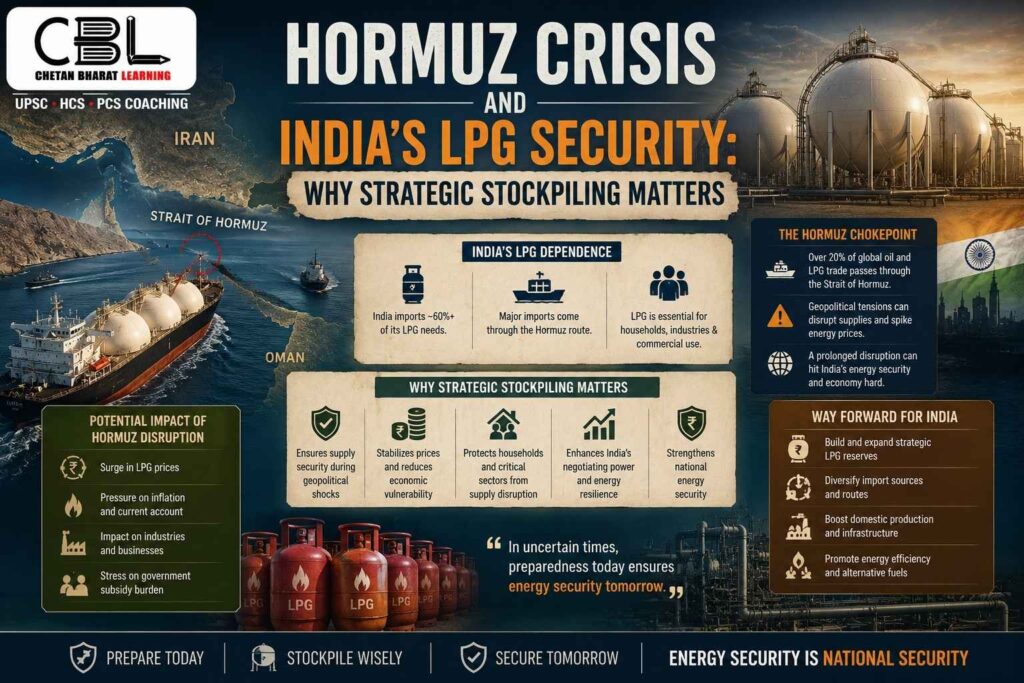
Why the Hormuz Crisis Has Global Significance
The Strait of Hormuz is one of the most strategically important maritime chokepoints in the world. A significant share of global oil and liquefied petroleum gas (LPG) trade passes through this narrow waterway connecting the Persian Gulf to global markets.
Amid rising geopolitical tensions in West Asia, the Government of India has reportedly directed Oil Marketing Companies (OMCs) to maintain LPG stocks capable of meeting at least 30 days of domestic demand.
The decision highlights growing concerns about supply disruptions and reinforces the importance of energy security in an uncertain geopolitical environment.
Students preparing through UPSC Coaching in Chandigarh and IAS Coaching in Chandigarh should closely follow topics like energy security, strategic reserves, maritime chokepoints, and geopolitical risks because these themes are highly important for GS Paper 2, GS Paper 3, Essay, and UPSC Interview preparation.
What Is the Strait of Hormuz?
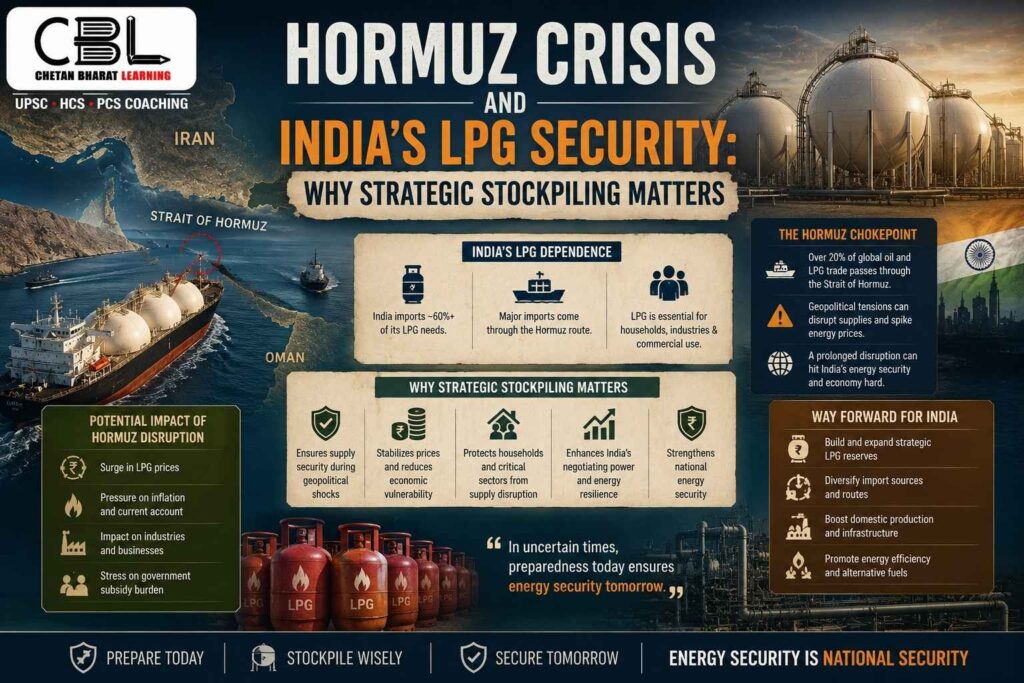
The Strait of Hormuz is a narrow maritime passage located between:
- Iran
- Oman
It serves as the primary gateway connecting the Persian Gulf with the Gulf of Oman and the Arabian Sea.
The strait is critical because:
✔ A large share of global crude oil exports passes through it
✔ Significant LPG shipments move through this route
✔ Several Gulf energy producers depend on it for exports
Any disruption in the region can have immediate consequences for global energy markets.
Why Is India Concerned?
India is among the world’s largest importers of:
- Crude oil
- Natural gas
- LPG
A substantial portion of these imports originates from Gulf countries.
As a result, disruptions in the Strait of Hormuz could:
- Increase import costs
- Affect domestic fuel availability
- Create inflationary pressures
- Impact energy-intensive industries
This makes uninterrupted access to energy supplies a national priority.
What Are Strategic LPG Stocks?
Strategic LPG stocks are emergency reserves maintained to ensure uninterrupted supply during:
- Geopolitical crises
- Supply chain disruptions
- Shipping interruptions
- Natural disasters
Maintaining sufficient reserves helps governments respond effectively to temporary supply shocks.
The recent directive to maintain stocks equivalent to at least 30 days of demand aims to improve resilience against potential disruptions.
The Role of Oil Marketing Companies (OMCs)
India’s major Oil Marketing Companies include:
- Indian Oil Corporation (IOC)
- Bharat Petroleum Corporation Limited (BPCL)
- Hindustan Petroleum Corporation Limited (HPCL)
These companies are responsible for:
✔ LPG procurement
✔ Storage and distribution
✔ Supply chain management
✔ Domestic fuel availability
Their preparedness plays a critical role in maintaining energy security.
Energy Security: A Strategic Priority
Energy security refers to the uninterrupted availability of energy sources at affordable prices.
It involves:
- Reliable supply chains
- Diversified import sources
- Strategic reserves
- Infrastructure resilience
For a growing economy like India, energy security directly affects:
- Economic growth
- Industrial production
- Transportation
- Household welfare
Geopolitical Risks in West Asia
West Asia remains one of the most geopolitically sensitive regions in the world.
The region faces:
- Military tensions
- Regional rivalries
- Maritime security challenges
- Supply chain vulnerabilities
Because global energy flows are concentrated in this region, even localized tensions can affect international energy markets.
Lessons from Previous Energy Crises
Past geopolitical disruptions have demonstrated how vulnerable global energy markets can be.
Major consequences often include:
- Rising crude oil prices
- Increased shipping costs
- Supply shortages
- Inflationary pressures
Countries therefore increasingly invest in:
✔ Strategic reserves
✔ Supply diversification
✔ Alternative energy sources
to reduce vulnerability.
India’s Long-Term Energy Strategy
India is pursuing multiple approaches to strengthen energy security.
These include:
- Expanding strategic petroleum reserves
- Diversifying energy imports
- Increasing renewable energy capacity
- Promoting domestic energy production
- Strengthening storage infrastructure
Such measures help reduce dependence on any single supply route or region.
Prelims Pointers
Important Location
- Strait of Hormuz
Key Concept
Energy Security
Important Institutions
- IOC
- BPCL
- HPCL
Mains Perspective
Possible Question
“Energy security has become an important dimension of national security in an increasingly uncertain geopolitical environment.” Discuss.
Key Dimensions to Include
- Strategic reserves
- Import dependence
- Maritime chokepoints
- Supply chain resilience
- Geopolitical risks
- Renewable energy transition
Frequently Asked Questions (FAQ)
Why is the Strait of Hormuz important?
It is one of the world’s most critical energy trade routes, carrying a significant share of global oil and LPG exports.
Why is India building larger LPG stocks?
To ensure uninterrupted supply during potential disruptions caused by geopolitical tensions or shipping interruptions.
What are strategic energy reserves?
Strategic reserves are emergency stocks maintained to safeguard against supply disruptions and market volatility.
How does the Hormuz crisis affect India?
Since India imports large quantities of energy from the Gulf region, disruptions can affect fuel availability, prices, and economic stability.
Conclusion: Energy Security Is National Security
The Hormuz crisis highlights how deeply interconnected geopolitics and energy markets have become.
For India, maintaining adequate LPG reserves is not merely a logistical measure—it is a strategic necessity. As global supply chains face increasing uncertainty, resilience through stockpiling, diversification, and infrastructure development becomes essential.
The episode reinforces a broader lesson:
“In a world of geopolitical uncertainty, energy security is no longer just an economic concern—it is a cornerstone of national security.”
Related Current Affairs
Preparing for UPSC, PCS or HCS?
Talk to a mentor at Chetan Bharat Learning, Chandigarh. Free guidance on choosing the right exam and building a study plan.
Chat on WhatsAppCall 97793 53345UPSC / IAS / PCS coaching in Chandigarh · Trusted by aspirants across Punjab & Haryana
Leave a Reply
You must be logged in to post a comment.