

UPSC Mapping
Important for Prelims: rooftop solar, net metering and energy storage. Important for Mains: GS Paper III: Energy and infrastructure.
Article
Rooftop solar battery storage could become mandatory for some consumers under amendments proposed by the Union Power Ministry. The proposals also address grid charges and electricity tariffs; see CBL’s economy current affairs for related policy coverage.
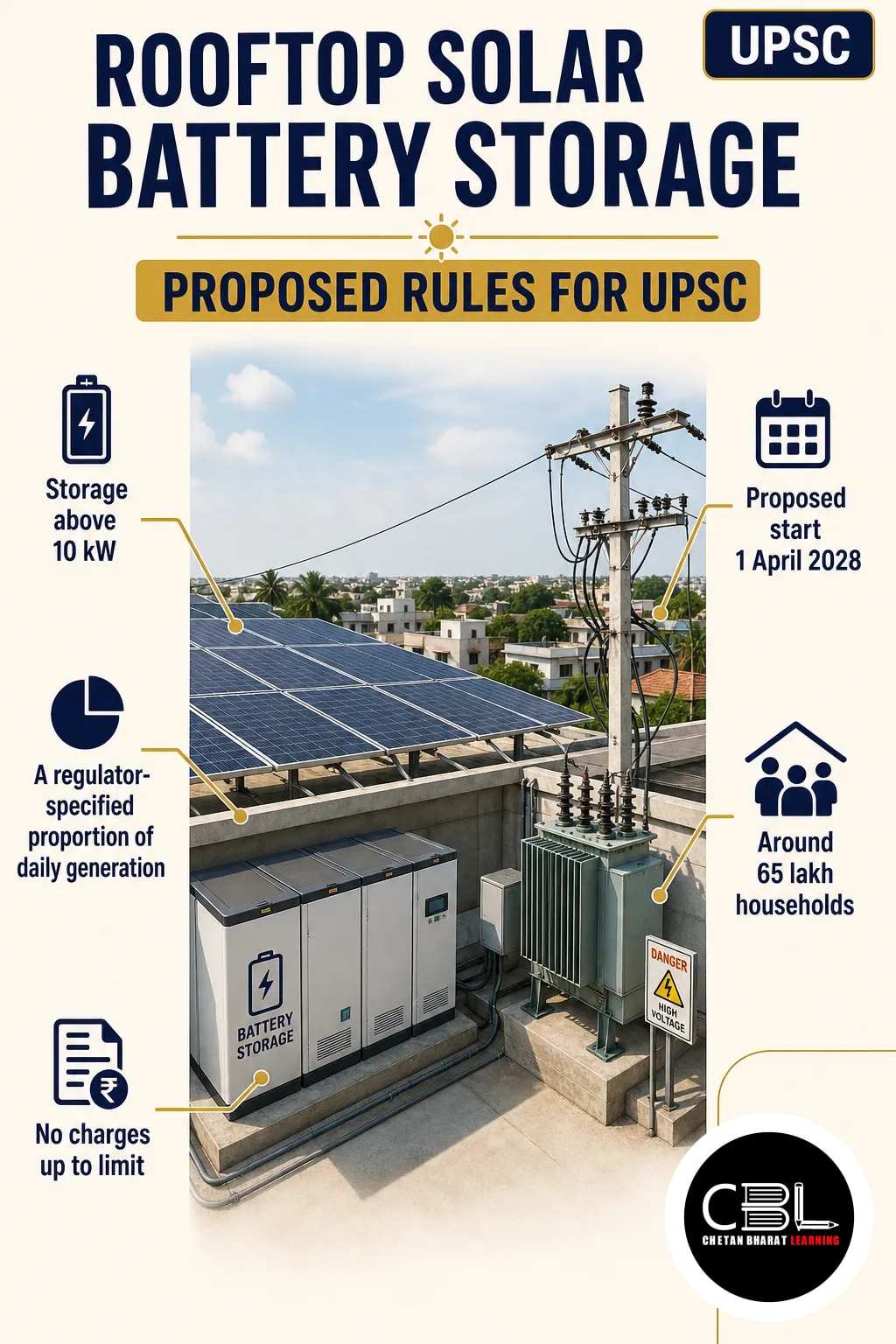
Quick answer: On 23 November 2026, the ministry proposed rooftop solar battery storage requirements and grid-related charges under amendments to consumer electricity rules. From 1 April 2028, storage could be required above 10 kilowatts unless state regulators set another threshold. Regulators could also set charge-free net-metering limits, reflecting local grid conditions.
What are the proposed rooftop solar rules?
The ministry proposed changes to the Electricity (Rights of Consumers) Rules, 2020, not a blanket storage mandate. State Electricity Regulatory Commissions can set thresholds and charges according to local conditions. The table summarises the proposals and related facts.
| Feature | Key fact |
|---|---|
| Storage threshold | Above 10 kilowatts (kW), unless the state regulator specifies another threshold |
| Storage requirement | A regulator-specified proportion of daily generation, or 20% |
| Storage start date | Proposed from 1 April 2028 |
| Typical household system | 3–5 kW |
| Distributed solar capacity | 33.41 gigawatts (GW) |
| PM Surya Ghar adoption | Around 65 lakh households as of November 2026 |
Under PM Surya Ghar: Muft Bijli Yojana, the government records more than 13,000 rooftop installations daily. For background, read CBL’s explainer on the household solar scheme.
How do net metering and proposed charges work?
Net metering offsets electricity drawn from the grid against surplus solar power fed into it. Consumers therefore pay for net consumption.
State regulators could set a net-metering limit. Above it, they could impose charges for the imputed cost of using the grid to manage surplus power and for network losses. However, no such charges could apply up to the limit.
Consumers could also install capacity above their sanctioned load, subject to regulatory limits. Grid injection would remain capped at the sanctioned load unless the distribution utility authorises more. Unauthorised excess injection would receive no compensation and could attract a regulator-specified penalty.
What other consumer changes are proposed?
The draft also revises the timetable for time-of-day tariffs, under which electricity rates vary with consumption time. For consumers above 10 kW, the proposed deadline is 1 April 2028; for others, it is 1 April 2029. Agricultural consumers are excluded.
Moreover, state regulators could define solar and peak hours locally. Distribution licensees would review and resolve unusual bills within 30 days when billed consumption exceeds five times, or falls below one-fifth of, the previous six-cycle average. Regulators could revise these thresholds.
Why does rooftop solar battery storage matter?
Storage can shift solar electricity from daylight to non-solar hours and help manage surplus generation. The government also cites the finances of distribution companies, commonly called discoms. Their fixed costs include generator capacity payments, transmission, salaries and maintenance.
Under net metering, lower billed consumption can reduce recovery of those costs. In addition, high-use households may enter cheaper tariff slabs because their net consumption is lower. For the wider challenge, see CBL’s analysis of solar grid integration.
Source: Indian Express Explained, 26 November 2026
- PM Surya Ghar: Transforming India’s Rooftop Solar Sector (10 Sep 2026)
- Solar Grid Integration: Challenges for India’s Energy Future (27 Aug 2026)
- Canal-Top Photovoltaics: India’s Solar Opportunity (24 Sep 2026)
Asked in UPSC: Previous Year Questions
- UPSC CSE Prelims 2024 (GS Paper I): How many of these are distributed energy resources: battery storage, biomass generators, fuel cells and rooftop solar photovoltaic units?
UPSC connects distributed generation with storage and other energy technologies, so revise the broader resource category.
Punjab PCS and Haryana HCS may test net metering, state electricity regulators and proposed storage thresholds in General Studies. Also distinguish central proposals from the rules state regulators may subsequently specify.
Prelims Practice Corner
Mains Practice Questions
Frequently Asked Questions
Is battery storage compulsory for every rooftop solar user?
No, because the proposal uses a capacity threshold rather than a universal mandate. The default is above 10 kW unless the state regulator specifies another threshold.
When could the proposed storage requirement begin?
1 April 2028 is the proposed start date. The amendments remain proposals, so implementation depends on the final rules.
What is net metering in rooftop solar?
Net metering offsets electricity drawn from the grid against surplus solar electricity fed into it. Therefore, a consumer pays for net electricity consumption.
Related Current Affairs
Preparing for UPSC, PCS or HCS?
Talk to a mentor at Chetan Bharat Learning, Chandigarh. Free guidance on choosing the right exam and building a study plan.
Chat on WhatsAppCall 97793 53345UPSC / IAS / PCS coaching in Chandigarh · Trusted by aspirants across Punjab & Haryana






Leave a Reply
You must be logged in to post a comment.