

UPSC Mapping
| Exam | Topics |
|---|---|
| Prelims | Solar Energy, MNRE and Renewable Technologies |
| Mains | GS Paper III – Energy, Environment and Infrastructure |
Quick Facts
| Parameter | Details |
|---|---|
| Technology | Elevated Solar Panels |
| First Indian Project | 2012 |
| Pioneer Site | Mehsana, Gujarat |
| Assessed Potential | Around 131 GW Combined |
What is Canal-Top Photovoltaics?
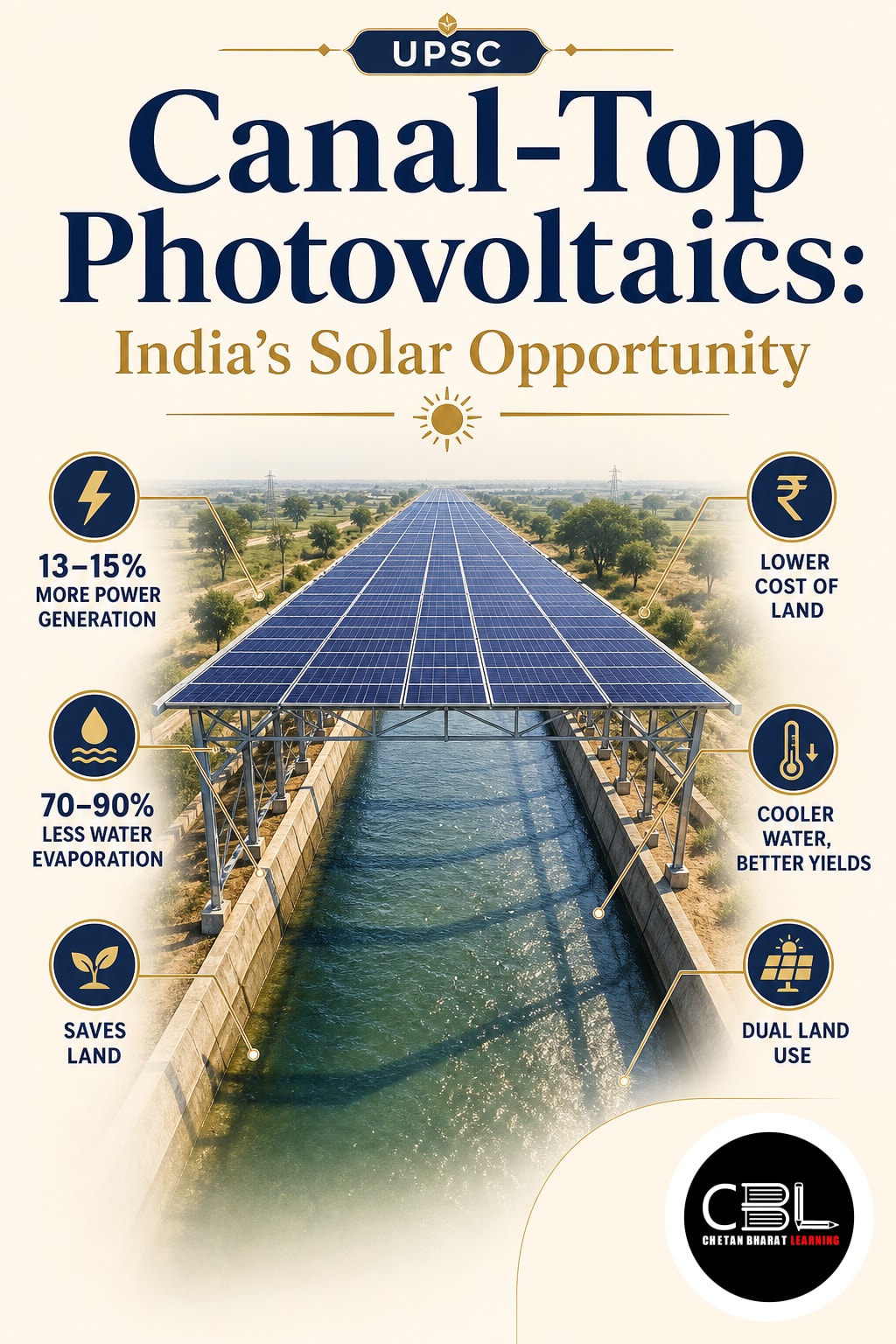
Canal-Top Photovoltaics refers to solar panels mounted on elevated structures above canals. Engineers design these structures to maintain unobstructed water flow and preserve access for canal operations. The installation uses the canal corridor as a shared infrastructure space rather than occupying agricultural or residential land.
The technology differs from floating solar systems, where panels rest on buoyant platforms placed directly on reservoirs or other water bodies. Canal systems generally use steel structures spanning the channel or installations positioned along its banks. The final design depends on canal width, orientation, terrain, water operations and nearby grid infrastructure.
Why is Canal-Top Photovoltaics in News?
Canal-Top Photovoltaics has regained attention as India searches for solar solutions that do not intensify competition for land. Large ground-mounted projects need extensive sites, transmission connections and careful management of agricultural concerns. India’s vast irrigation canal network offers an alternative space for distributed renewable capacity.
The approval of the PM Surya Sarovar Yojana, targeting 5,000 MW of floating solar capacity, has renewed policy interest in land-neutral solar technologies. Punjab has also explored additional installations across its canal network, while Haryana has examined suitable irrigation channels. The Ministry of New and Renewable Energy provides official information on India’s solar programmes and policies.
Key Features
- Minimal additional land: Canal-Top Photovoltaics uses existing canal corridors, reducing the need to purchase or convert agricultural land for utility-scale solar installations.
- Lower evaporation losses: Panels shade portions of the water surface and can reduce direct exposure to sunlight, supporting water conservation in dry and water-stressed regions.
- Potential efficiency gains: The cooler microclimate above flowing water can moderate panel temperatures because excessive heat generally lowers the operating efficiency of photovoltaic modules.
- Compatibility with irrigation assets: Properly engineered structures allow canals to continue carrying water while the same corridor supports electricity generation, transmission equipment and maintenance access.
- Distributed power opportunity: Projects located near farms, pumping stations, settlements or substations can serve local demand and potentially reduce the need for lengthy transmission connections.
Challenges
- Expensive support structures: Projects require steel frames, foundations and safety systems capable of spanning canals and resisting wind loads, making them costlier than conventional ground-mounted installations.
- Difficult maintenance access: Technicians must inspect, clean and replace equipment above an operating water channel, requiring specialised platforms, safety procedures and coordination with irrigation authorities.
- Irregular canal geometry: Changes in width, direction and elevation can disrupt standard panel layouts, limit economies of scale and increase the cost of project-specific engineering.
- Multiple institutional approvals: Developers may need clearances from renewable-energy agencies, irrigation departments, electricity utilities and local authorities, which can extend project preparation and execution timelines.
- Grid and site limitations: A technically suitable canal may remain commercially unviable if substations, electricity demand or maintenance roads are distant.
Way Forward
Canal-Top Photovoltaics requires careful site selection based on land scarcity, canal orientation, structural conditions, local electricity demand and grid proximity. Governments should prepare a national inventory of suitable stretches and publish standard engineering specifications. Pilot results should inform realistic benchmarks for generation, evaporation reduction, maintenance costs and project life.
Viability-gap funding, concessional debt and competitive procurement can support early projects while developers build technical experience. State nodal agencies and irrigation departments also need dedicated capacity for planning and coordinated approvals. Policy updates available through the Press Information Bureau can guide stakeholders as India develops land-efficient renewable energy at scale.
Prelims Practice Corner
Q1. How do canal-top solar systems primarily differ from floating solar systems?
- (a) They generate only thermal energy
- (b) Their panels stand on elevated structures above canals
- (c) They cannot connect with the electricity grid
- (d) They operate only during irrigation releases
Answer: (b) Their panels stand on elevated structures above canals.
Q2. India’s first canal-top solar installation was commissioned in which state?
- (a) Punjab
- (b) Haryana
- (c) Gujarat
- (d) Rajasthan
Answer: (c) Gujarat.
Q3. Which ministry launched the pilot-cum-demonstration scheme for grid-connected canal-top and canal-bank solar projects?
- (a) Ministry of Jal Shakti
- (b) Ministry of New and Renewable Energy
- (c) Ministry of Agriculture and Farmers Welfare
- (d) Ministry of Power
Answer: (b) Ministry of New and Renewable Energy.
Q4. Which of the following is not a likely advantage of canal-top solar installations?
- (a) Reduced additional land requirement
- (b) Lower evaporation from covered stretches
- (c) Easier maintenance than all ground-mounted systems
- (d) Potential cooling benefit for panels
Answer: (c) Maintenance above operating canals is generally more difficult and expensive.
Q5. Consider the following factors for selecting canal-top solar sites: 1. Canal orientation 2. Proximity to substations 3. Local electricity demand 4. Structural suitability Which factors are relevant?
- (a) 1 and 2 only
- (b) 2 and 3 only
- (c) 1, 3 and 4 only
- (d) 1, 2, 3 and 4
Answer: (d) 1, 2, 3 and 4.
Mains Practice Questions
Q1. Canal-based solar projects can address India’s renewable-energy and resource-management challenges simultaneously. Discuss. (250 words, 15 marks)
Answer Structure
- Intro: Explain the use of existing canal corridors for solar generation.
- Body: Discuss land savings, water conservation, panel efficiency, distributed power and structural or financial constraints.
- Conclusion: Present canal-based solar as a complementary component of India’s clean-energy transition.
Q2. Why has canal-top solar capacity remained limited despite India’s early adoption of the technology? Suggest measures for expansion. (150 words, 10 marks)
Answer Structure
- Intro: Mention India’s pioneering installation and limited subsequent deployment.
- Body: Cover high costs, complex designs, maintenance, approval delays, grid access, standardisation and financing.
- Conclusion: Recommend targeted projects supported by evidence-based standards and coordinated institutions.
FAQs on Canal-Top Photovoltaics
How do solar panels installed above canals save land and water?
They use existing canal corridors instead of separate land parcels. Their shade can also reduce direct sunlight on covered water and lower evaporation losses.
Why are canal-based solar projects more expensive?
They require specialised elevated structures, strong foundations and safe maintenance systems above operating canals. Irregular canal layouts can further increase engineering and construction costs.
Can this technology replace conventional solar parks?
It cannot replace every ground-mounted or rooftop project because suitable canal stretches remain limited by engineering and grid conditions. It can nevertheless provide valuable additional capacity where land is scarce or costly.
Related Current Affairs
Preparing for UPSC, PCS or HCS?
Talk to a mentor at Chetan Bharat Learning, Chandigarh. Free guidance on choosing the right exam and building a study plan.
Chat on WhatsAppCall 97793 53345UPSC / IAS / PCS coaching in Chandigarh · Trusted by aspirants across Punjab & Haryana
Leave a Reply
You must be logged in to post a comment.