
Battery black mass exports face an immediate prohibition under India’s revised foreign trade policy. The decision also links trade policy and critical mineral security.
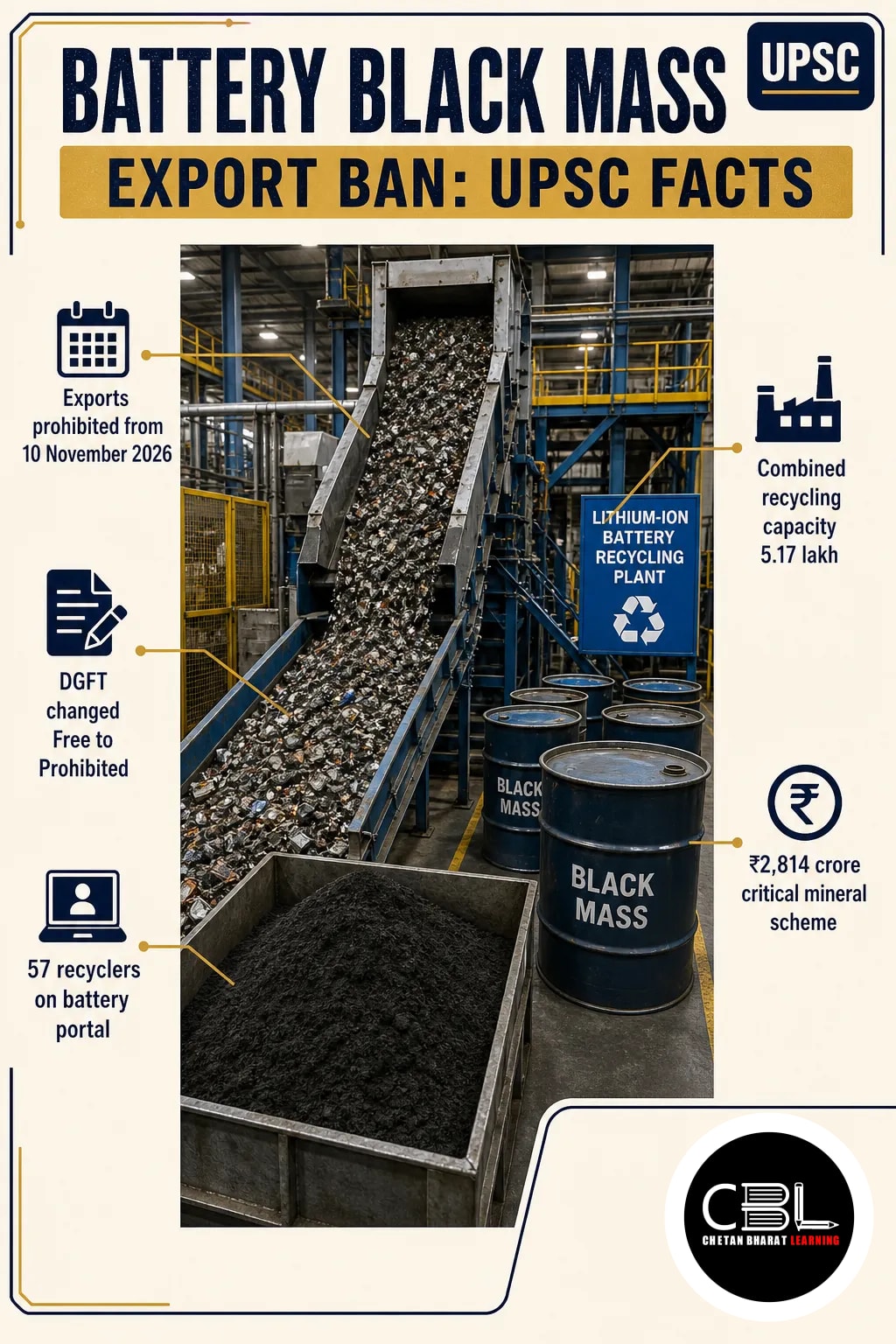
Quick answer: On 10 November 2026, India’s Directorate General of Foreign Trade prohibited exports of specified lithium-ion battery black mass and related waste. The measure aims to retain mineral-rich material for domestic recycling. It follows approval of a ₹2,814 crore scheme supporting critical mineral processing, particularly lithium and nickel.
What is battery black mass?
Battery black mass is a powder-like material obtained by breaking down waste lithium-ion batteries and consumer electronics. It contains lithium, cobalt, manganese, nickel and graphite, among other materials. Recycling can recover these materials for reuse in batteries.
Black mass also illustrates the circular economy approach, which treats waste as a potential resource.
What did the export notification change?
The notification changed the export policy for the specified waste category from Free to Prohibited. The Directorate General of Foreign Trade (DGFT), under the Commerce Ministry, issued it on 10 November.
The specified category covers unsorted battery waste and scrap not containing lead, cadmium or mercury, including lithium-ion battery black mass. The prohibition took effect immediately. However, transitional arrangements under paragraph 1.05 of the Foreign Trade Policy, 2023 apply.
| Fact | Detail |
|---|---|
| Policy change | Free to Prohibited |
| Lithium-ion recyclers | 57 registered on the battery waste portal |
| Combined recycling capacity | 5.17 lakh metric tonnes per year |
| Estimated black mass input capacity | 75,500 metric tonnes per year |
How does the processing scheme relate to the ban?
The ₹2,814 crore scheme supports capital expenditure for critical mineral processing, with a focus on lithium and nickel. The Union Cabinet approved it days before the export decision.
Meanwhile, the Central Pollution Control Board (CPCB) records recyclers on its Battery Waste Extended Producer Responsibility (EPR) portal. EPR makes producers responsible for managing waste arising from their products.
The two capacity figures measure different activities: overall lithium-ion battery recycling and black mass processing. Therefore, aspirants should not treat them as interchangeable.
Why does the decision matter?
The ban seeks to retain feedstock for domestic recyclers and recover minerals used in batteries. It could also support supply chains for electric mobility, energy storage and electronics.
India depends heavily on imports for critical minerals; its current lithium demand is entirely import-fed, according to the ministry’s parliamentary submission cited in the source. However, domestic refining capacity and the expertise needed to recover battery-grade materials remain important constraints.
Source: Indian Express Business, 12 November 2026
- Circular Economy (9 Feb 2023)
Asked in UPSC: Previous Year Questions
- UPSC CSE Prelims 2025 (GS Paper I): Which statements are correct: India joined the Minerals Security Partnership; is resource-rich in all 30 identified critical minerals; and empowered the Centre to exclusively auction specified mineral leases through a 2023 amendment?
UPSC also tests critical mineral partnerships, resource availability and mining legislation together.
State PCS General Studies may test battery waste recycling, critical minerals and the roles of pollution control institutions. Also revise how extended producer responsibility connects producers with waste management.
Prelims Practice Corner
Mains Practice Questions
Frequently Asked Questions
What is battery black mass?
It is a powder-like material from broken-down batteries and consumer electronics. It can also contain recoverable lithium, cobalt and nickel.
When did India prohibit the specified black mass exports?
The prohibition took effect immediately on 10 November 2026. However, the notification also applies the specified transitional arrangements under the Foreign Trade Policy, 2023.
How many lithium-ion battery recyclers are registered in India?
Government data lists 57 recyclers on the CPCB battery waste EPR portal. Their combined annual processing capacity is 5.17 lakh metric tonnes.
Related Current Affairs
Preparing for UPSC, PCS or HCS?
Talk to a mentor at Chetan Bharat Learning, Chandigarh. Free guidance on choosing the right exam and building a study plan.
Chat on WhatsAppCall 97793 53345UPSC / IAS / PCS coaching in Chandigarh · Trusted by aspirants across Punjab & Haryana









Leave a Reply
You must be logged in to post a comment.