
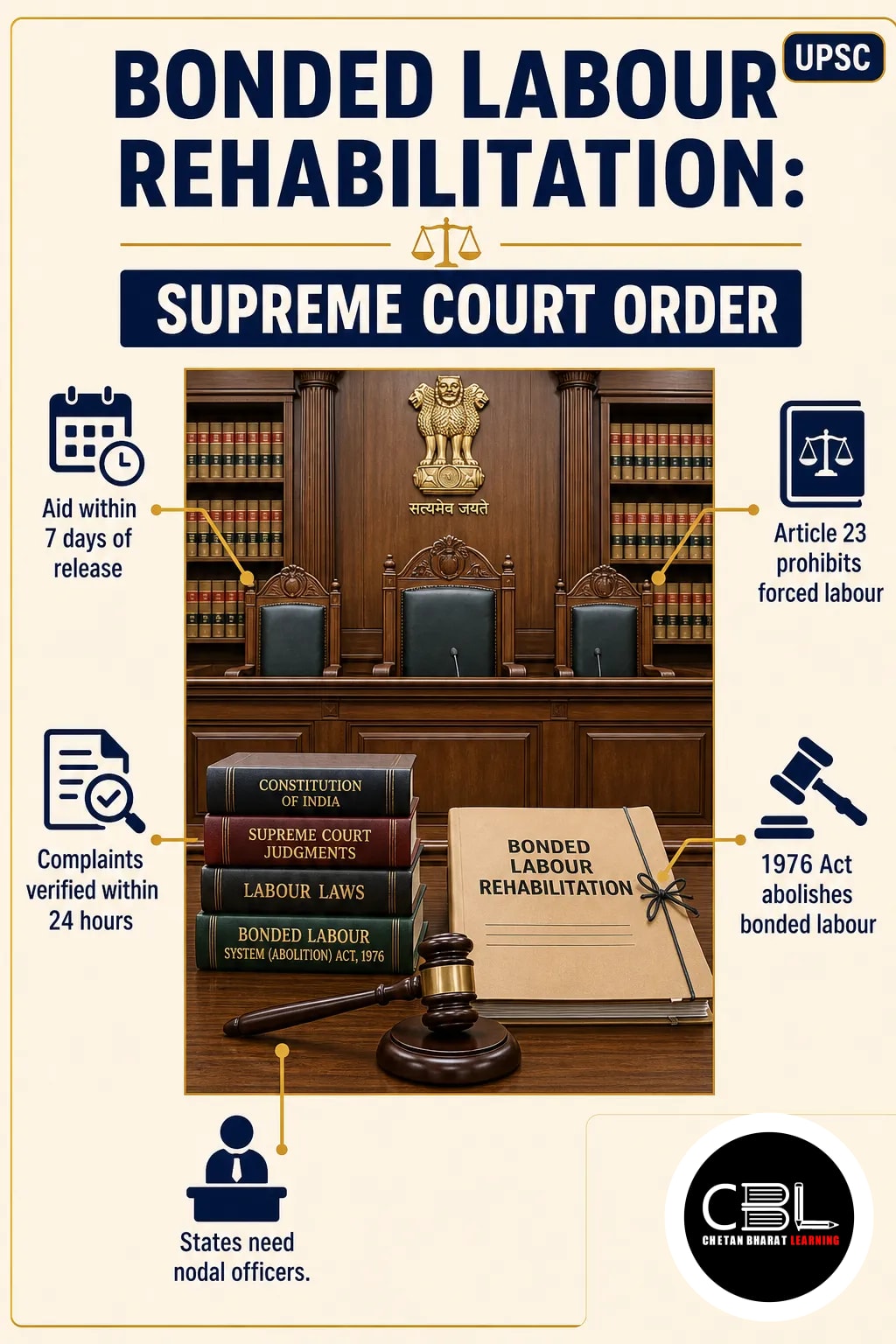

Bonded labour rehabilitation must continue beyond rescue, the Supreme Court held on 2 November 2026. The ruling adds an enforcement dimension to constitutional rights and governance.
Quick answer: On 2 November 2026, the Supreme Court asked the Centre to establish a uniform procedure for financial aid within seven days of release. For bonded labour rehabilitation across India, it also directed faster verification, stronger inter-State coordination and livelihood support because freedom from bondage requires more than physical rescue.
What did the Supreme Court hold?
The Court held that the State’s responsibility continues through identification, release and meaningful rehabilitation. Therefore, rescue alone does not fulfil the constitutional obligation if a freed person lacks conditions for a dignified life.
Justices Vikram Nath and Aparesh Kumar Singh heard two petitions, including one from a bonded labour survivor. The petitions highlighted delayed assistance and institutional shortcomings in identification and rehabilitation.
The Bench asked the Centre to establish a uniform procedure requiring aid within seven days of release. It also asked the Centre to consider revising the existing rehabilitation scheme within three months, including higher aid and subsistence support when payments are delayed. This is a direction to consider revision, not an immediate increase in the benefit amount.
What timelines and duties did the Court set?
The Court prescribed time-bound steps for complaints, release, coordination and compliance. The following distinctions matter: some operational deadlines apply ordinarily, while others concern institutional implementation.
| Action | Direction or timeline |
|---|---|
| Complaint verification | Ordinarily within 24 hours; prompt rescue where required |
| Release certificate | After identification and necessary inquiry, ordinarily within 24 hours |
| Financial assistance | Centre to lay down a uniform procedure for payment within seven days of release |
| Supplementary guidelines | Centre to issue them within three months, in consultation with the National Human Rights Commission |
| Revised standard operating procedure | States and Union Territories to implement it within six months |
| Inter-State coordination | States to designate a nodal officer and establish a mechanism within six months |
| Compliance affidavits | Centre within four months; States and Union Territories after six months for compliance, with a further two weeks to file |
The Union government told the Court that the revised standard operating procedure (SOP) was formulated on 14 May. Meanwhile, the Court kept the petitions pending and scheduled further consideration after seven months.
Which constitutional and legal provisions apply?
Article 23 and the Bonded Labour System (Abolition) Act, 1976 provide the central legal framework. Moreover, the Court linked enforcement of this framework to a life of dignity.
| Provision | Relevance |
|---|---|
| Article 23 | Prohibits trafficking, begar and other similar forms of forced labour; contravention is punishable by law. |
| Article 21 | Protects life and personal liberty; the Court has interpreted the right to life to include dignity. |
| Bonded Labour System (Abolition) Act, 1976 | Abolishes the bonded labour system and provides for district and sub-divisional vigilance committees. |
Unlike a mere welfare target, the prohibition in Article 23 is a fundamental right. Thus, legal enforcement and access to rehabilitation must work together.
Why does the ruling matter for governance?
The ruling makes the transition from release to sustainable freedom an administrative responsibility. It connects a constitutional prohibition with specific duties across the Centre, States and district authorities.
- Economic security: Delayed aid can leave a rescued person without immediate support; therefore, the proposed payment procedure addresses a critical post-release gap.
- Livelihood: District magistrates must facilitate access to employment and livelihood opportunities under existing welfare schemes. This can reduce vulnerability to renewed exploitation.
- Inter-State mobility: A nodal officer and coordination mechanism can connect the authorities in the State of rescue and the State of origin.
- Accessible administration: Officials must communicate release, entitlements and rehabilitation in a language the rescued person understands. They must also record statements with appropriate safeguards.
For a broader labour-welfare context, see CBL’s coverage of social security boards and welfare boards for gig workers. These are distinct mechanisms, but they illustrate the importance of institutional access to worker protections.
What implementation challenges remain?
Effective bonded labour rehabilitation depends on coordination and follow-through at each stage. The Court identified delays in assistance and shortcomings in identification as central concerns.
- Identification and certification: A delayed inquiry or certificate can obstruct access to entitlements; hence, the Court set ordinary 24-hour targets.
- Cross-border administration: When rescue occurs outside the State of origin, weak coordination can delay release and benefits.
- Language barriers: Unfamiliar procedures or languages can prevent a person from understanding available remedies and assistance.
- Accountability: The Court called for supervisory scrutiny of unjustified failures to perform statutory duties or meet timelines.
In addition, the Bench directed States to ensure vigilance committees at district and sub-divisional levels. It also called for regular training and sensitisation of police and other implementing authorities.
What is the way forward?
Implementation should treat financial assistance, livelihood access and follow-up as connected stages. First, authorities should operationalise the Court’s timelines and communicate entitlements in accessible languages.
Second, nodal officers and vigilance committees should coordinate across jurisdictions and track unresolved cases. Finally, compliance affidavits and supervisory review can help the Court assess whether directions translate into actual benefits, rather than paperwork alone.
Source: The Hindu, 2 November 2026
Punjab PCS and Haryana HCS may test Article 23, the 1976 Act and district-level vigilance committees in General Studies. In addition, candidates should connect inter-State coordination and accessible service delivery with state governance.
Prelims Practice Corner
Mains Practice Questions
Frequently Asked Questions
What did the Supreme Court order on financial aid?
The Centre must lay down a uniform procedure for assistance within seven days of release. It must also consider revising the scheme within three months.
Which constitutional provision prohibits bonded labour?
Article 23 prohibits begar and other similar forms of forced labour. In addition, the 1976 Act abolishes the bonded labour system.
When should a release certificate ordinarily be issued?
Ordinarily within 24 hours after identification and the necessary inquiry. The Court also directed prompt rescue where required.
Why is inter-State coordination important for rescued workers?
It helps prevent delays when rescue takes place outside a worker’s State of origin. Therefore, the Court directed States to designate nodal officers and establish coordination mechanisms within six months.
Related Current Affairs
Preparing for UPSC, PCS or HCS?
Talk to a mentor at Chetan Bharat Learning, Chandigarh. Free guidance on choosing the right exam and building a study plan.
Chat on WhatsAppCall 97793 53345UPSC / IAS / PCS coaching in Chandigarh · Trusted by aspirants across Punjab & Haryana

 Ananya RanaIAS · AIR 60
 Aditya SharmaIAS · AIR 70
 Ria Kaur SethiIPS · AIR 89
 Aman AloonIRS · AIR 295
 Sumer Singh VirkIRS · AIR 335
 Shivani PanchalIAS

Leave a Reply
You must be logged in to post a comment.