
UPSC Mapping
| Prelims | Modern History |
|---|---|
| Mains | GS Paper 1 (Modern History) |
Who was Madan Lal Dhingra?
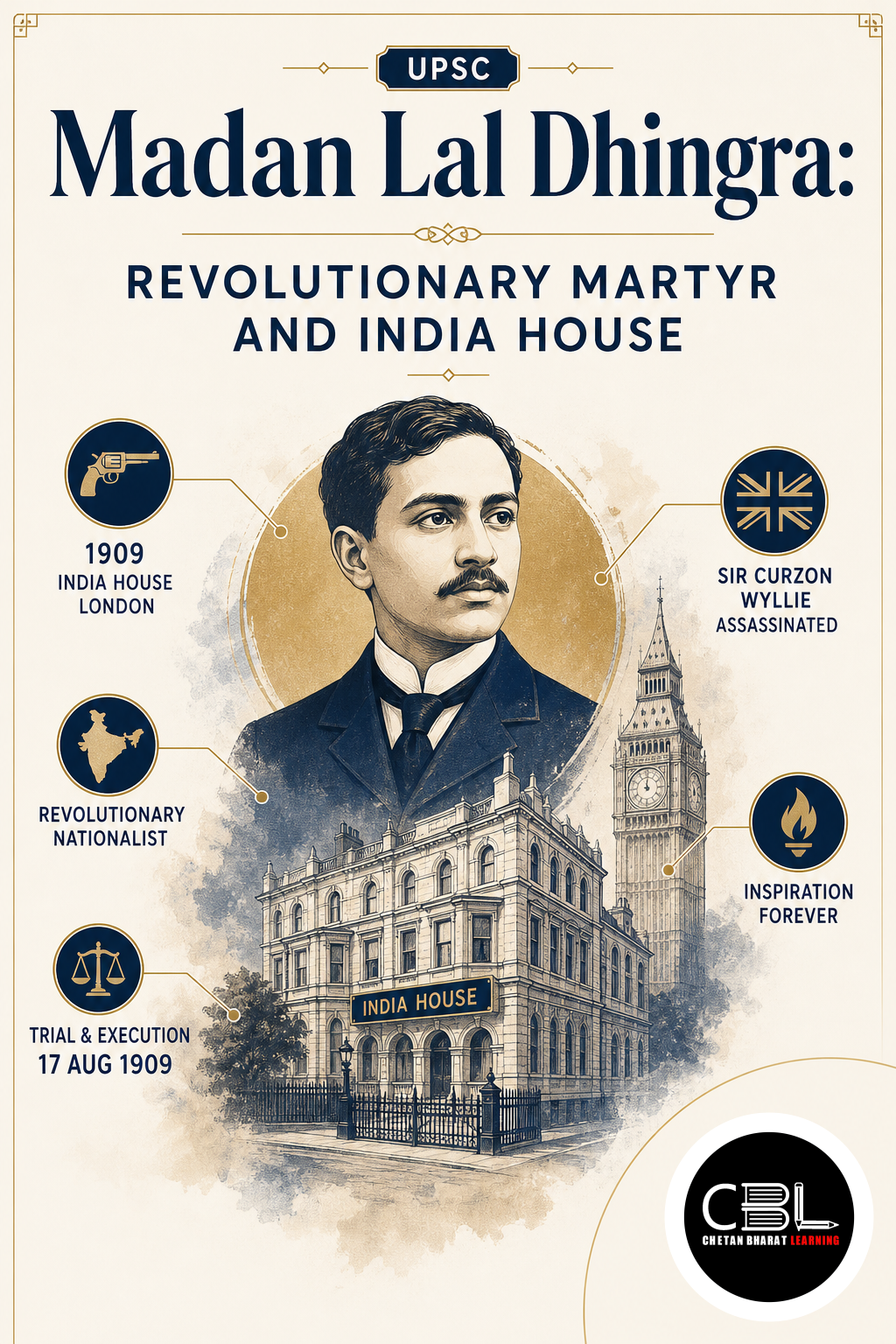
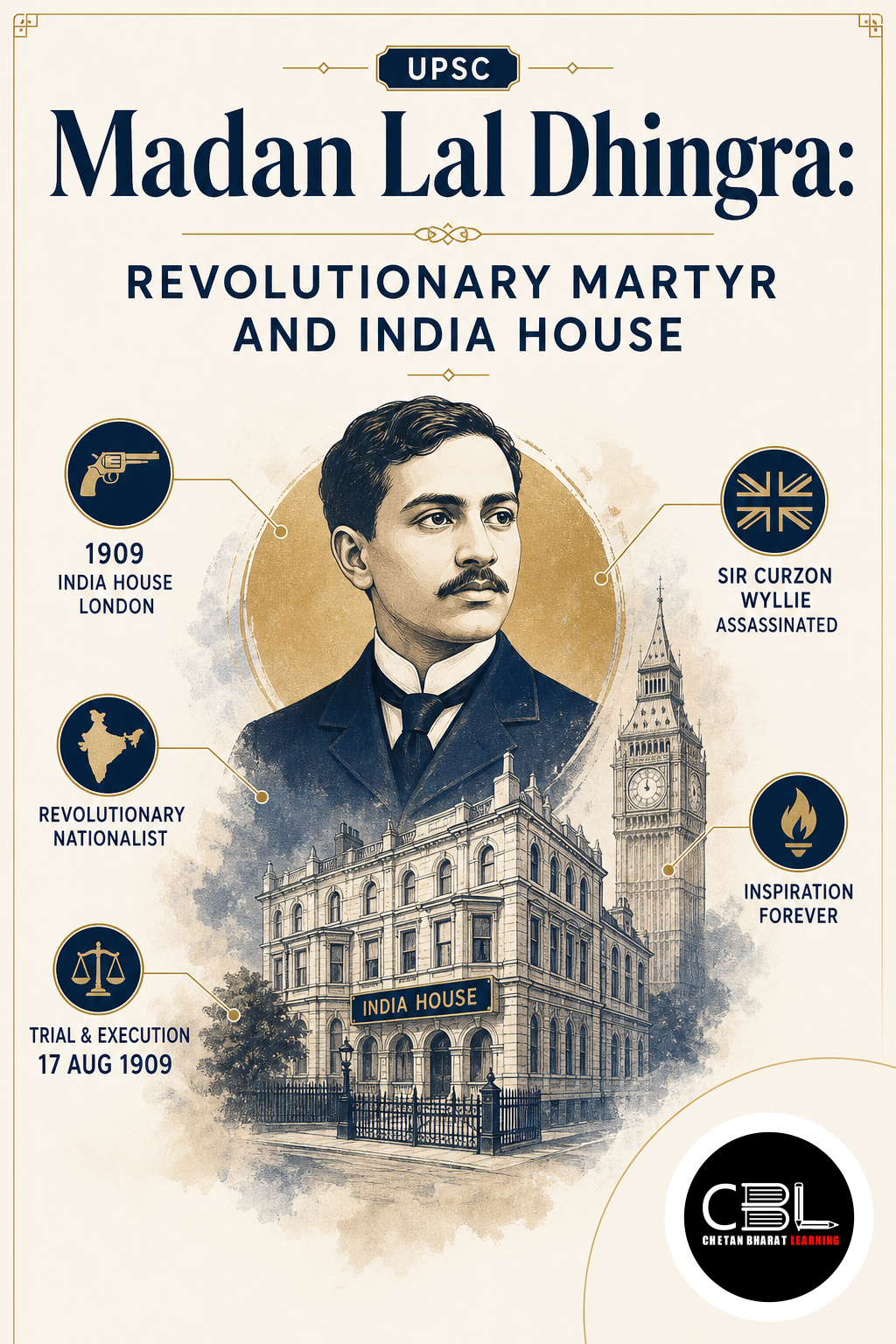
Madan Lal Dhingra (1883–1909) was a revolutionary nationalist who aligned with the radical wing of the Indian independence movement. Born in Amritsar, Punjab, into an affluent, pro-British family, he moved to England in 1906 to study engineering at University College London. He joined India House, founded by Shyamji Krishna Varma, and worked with V.D. Savarkar, being associated with the Abhinav Bharat Society in London.
On 1 July 1909, Dhingra assassinated Sir William Hutt Curzon Wyllie, a political aide to the Secretary of State for India, at the Imperial Institute in London. He was subsequently arrested, tried, and hanged at Pentonville Prison on 17 August 1909, aged 25.
Why is Madan Lal Dhingra in News?
Madan Lal Dhingra is in the news because India observed his martyrdom anniversary on August 17. His actions and martyrdom are remembered as a symbol of revolutionary nationalism that sought to overthrow British rule through direct action.
Dhingra’s assassination of Curzon Wyllie was a significant event in the revolutionary movement, drawing attention to the activities of India House and inspiring other revolutionaries. For more details, refer to this PIB release.
Key Features of Madan Lal Dhingra’s Life
- Revolutionary Nationalist: He was part of the radical stream that advocated armed resistance.
- India House Connection: He was associated with the Indian revolutionary centre in London.
- Assassination of Curzon Wyllie: He shot Wyllie on 1 July 1909, an act that shocked the British establishment.
- Trial and Execution: He was tried and hanged on 17 August 1909.
- Martyrdom: His sacrifice inspired later revolutionaries and is commemorated in India.
Challenges in Madan Lal Dhingra’s Era
- Colonial Repression: Revolutionary activities were brutally suppressed by the British.
- Lack of Mass Support: Revolutionary nationalism was a minority trend compared to the moderate and Gandhian streams.
- Infiltration: British intelligence infiltrated revolutionary groups, leading to arrests.
- Exile: Many revolutionaries were exiled or executed.
- Legacy: His actions remain debated—whether they were terrorism or heroism. For more on the freedom struggle, visit the art and culture section.
Way Forward for Madan Lal Dhingra’s Legacy
To honour Madan Lal Dhingra’s legacy, his story should be included in school history curricula to highlight the revolutionary stream of the freedom movement. Memorials and annual observances can keep his memory alive. Research into the activities of India House and Abhinav Bharat can provide a fuller understanding of the revolutionary movement.
Balanced historical interpretation that acknowledges both the methods and the ideals of revolutionaries can help students understand the complexity of the freedom struggle. For international best practices, refer to the UK National Archives.
Prelims Practice Corner
Q1. Who founded India House in London?
- (a) V.D. Savarkar
- (b) Shyamji Krishna Varma
- (c) Madan Lal Dhingra
- (d) Lala Har Dayal
Answer: (b) Shyamji Krishna Varma founded India House.
Q2. Whom did Madan Lal Dhingra assassinate?
- (a) Lord Curzon
- (b) Sir William Curzon Wyllie
- (c) Lord Minto
- (d) Lord Hardinge
Answer: (b) He assassinated Curzon Wyllie.
Q3. When was Dhingra executed?
- (a) 1908
- (b) 1909
- (c) 1910
- (d) 1911
Answer: (b) He was executed on 17 August 1909.
Q4. Which organisation was Dhingra associated with?
- (a) Gadar Party
- (b) Abhinav Bharat
- (c) Hindustan Socialist Republican Association
- (d) Anushilan Samiti
Answer: (b) He was associated with the Abhinav Bharat Society.
Q5. In which year did Dhingra assassinate Curzon Wyllie?
- (a) 1907
- (b) 1908
- (c) 1909
- (d) 1910
Answer: (c) The assassination occurred on 1 July 1909.
Mains Practice Questions
Q1. Discuss the role of revolutionary nationalism in India’s freedom struggle, with reference to Madan Lal Dhingra and the activities of India House. (250 words, 15 marks)
Answer Structure
- Intro: Introduce revolutionary nationalism and Dhingra.
- Body: Discuss the methods and motivations of revolutionaries, the role of India House, the assassination of Curzon Wyllie, and its impact. Analyse the legacy and debates around revolutionary methods.
- Conclusion: Emphasise the need for a nuanced understanding of the freedom movement.
Q2. What was the significance of India House in the Indian freedom struggle? (150 words, 10 marks)
Answer Structure
- Intro: Define India House as a revolutionary centre in London.
- Body: Explain its role in nurturing revolutionaries like Savarkar and Dhingra, publishing revolutionary literature, and coordinating anti-colonial activities.
- Conclusion: Conclude that India House was a key node in the global revolutionary network.
FAQs on Madan Lal Dhingra
Who was Madan Lal Dhingra?
He was a revolutionary nationalist who assassinated Sir William Curzon Wyllie in 1909 and was later hanged.
What was India House?
It was a revolutionary centre in London founded by Shyamji Krishna Varma, where Indian revolutionaries gathered.
Why is Dhingra remembered?
For his act of revolutionary violence against a British official, which inspired other revolutionaries and is commemorated as martyrdom.
Related Current Affairs
Preparing for UPSC, PCS or HCS?
Talk to a mentor at Chetan Bharat Learning, Chandigarh. Free guidance on choosing the right exam and building a study plan.
Chat on WhatsAppCall 97793 53345UPSC / IAS / PCS coaching in Chandigarh · Trusted by aspirants across Punjab & Haryana
Leave a Reply
You must be logged in to post a comment.