
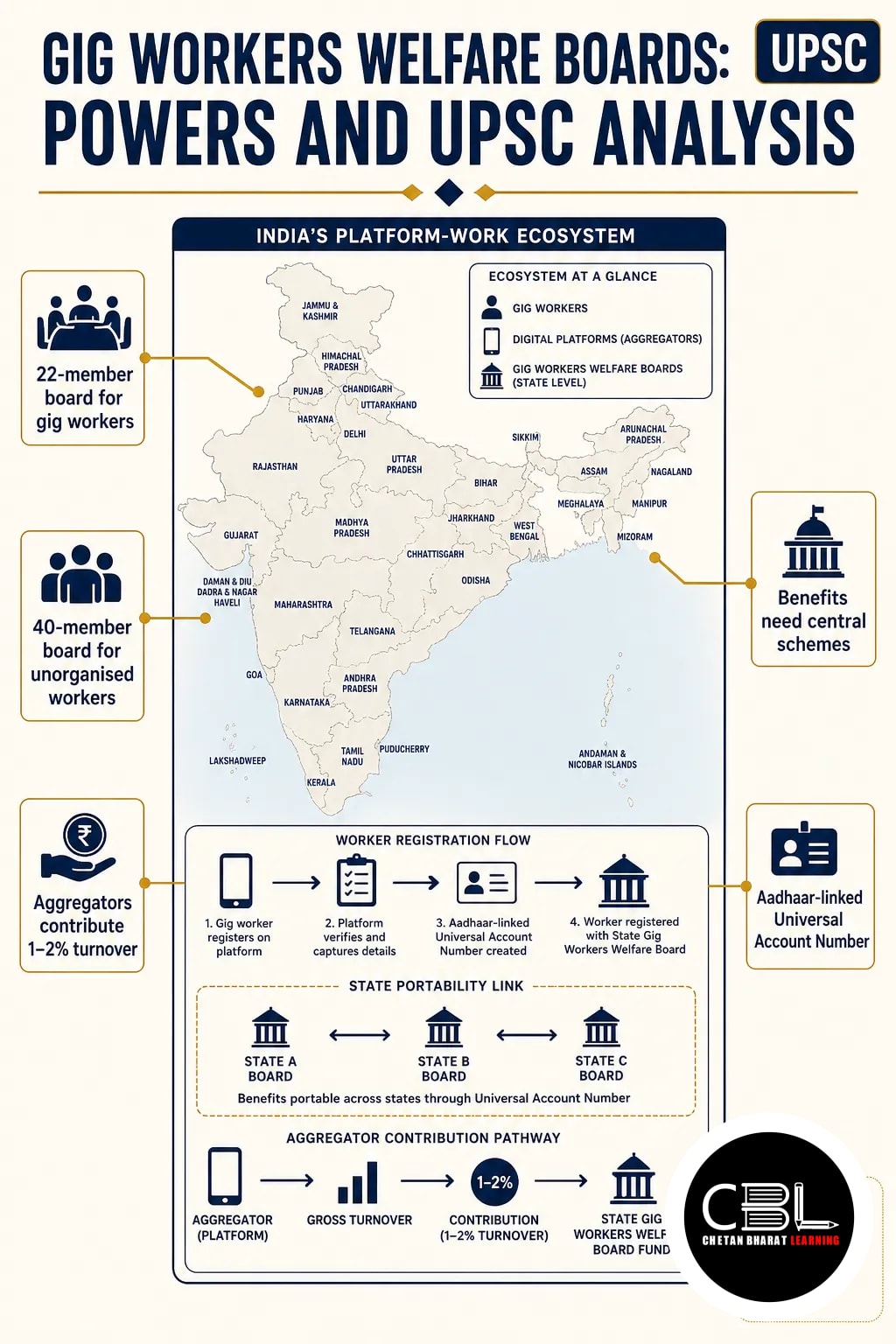

Gig workers welfare boards are in focus after the Centre notified two national social security boards on 30 October 2026. The decision adds an institutional mechanism to India’s labour and social security framework.
Quick answer: On 30 October 2026, the Union Labour Ministry notified a 22-member national board for gig and platform workers and a 40-member board for unorganised workers. The boards will recommend and monitor welfare schemes. For gig workers, aggregator contributions and portable registration are central to the proposed social security framework.
What are gig workers welfare boards?
The term gig workers welfare boards refers here to national bodies that advise on social security for gig, platform and unorganised workers. The Code on Social Security provides the framework for their functions, registration and funding.
Gig work broadly involves earning outside a traditional employer–employee relationship. Platform work, meanwhile, uses an online platform to connect workers with customers or service users. The Code legally defined both categories for the first time.
The Code merged nine social security laws covering organised and unorganised sectors. For the broader context, see CBL’s analysis of India’s social security coverage.
Why were the boards in the news?
The Ministry of Labour and Employment notified the constitution of both boards on 30 October 2026. Their membership brings government, worker and business representatives into the welfare process.
| Feature | Details |
|---|---|
| Gig and platform board | 22 members, including platform and worker representatives |
| Unorganised workers’ board | 40 members, including seven employee and seven employer representatives |
| Leadership | Union Labour Minister chairs; Labour Secretary serves as vice-chairperson |
| Meeting frequency | At least three times a year |
The gig board includes representatives associated with Eternal, Zepto, Swiggy and Urban Company. Worker-side members include the Bharatiya Mazdoor Sangh, the Indian Federation of App-Based Transport Workers and the National Front of Indian Trade Unions.
On the unorganised workers’ board, the Bharatiya Mazdoor Sangh holds three trade union seats. Meanwhile, Laghu Udyog Bharati holds three of the seven employer seats. For more on their composition, read the earlier CBL account of social security boards for workers.
What powers and duties do the boards have?
The boards recommend welfare schemes to the Centre and monitor their implementation. They also review expenditure from the relevant fund and account.
- Scheme advice: The boards recommend suitable measures for different categories of workers.
- Oversight: They monitor schemes and review fund expenditure; moreover, the Centre may assign other functions.
- State records: The gig board reviews state-level record-keeping linked to gig workers’ welfare schemes.
- Administration: The board also advises the Centre on matters referred to it under the Code.
This distinction matters: a board’s recommendation does not itself create a payable benefit. The Centre must frame schemes, and their terms determine eligibility and delivery.
How will funding and benefits work?
The Code envisages a Social Security Fund for gig and platform workers, supported by several sources. These include contributions from governments, corporate social responsibility contributions and fines collected through compounding.
Aggregators must contribute 1–2% of annual turnover, subject to a ceiling of 5% of the amount payable by them to workers. Therefore, the turnover rate and the worker-payment ceiling must be read together.
The Centre may frame schemes for life and disability cover, accident insurance, health and maternity benefits, old-age protection and crèche facilities. However, the notification of boards alone does not establish that every benefit is immediately available to every worker.
Registration and portability
Platforms will work with government to register gig and platform workers using an Aadhaar-linked Universal Account Number. This arrangement aims to make benefits portable across states, an advantage for workers who move for employment.
In addition, the Code extends the Employees’ Provident Fund Organisation framework to establishments with at least 20 employees, regardless of industry type. However, this establishment rule should not be confused with automatic provident fund enrolment for every gig worker.
Why does the framework matter?
The framework connects a growing workforce to a route for social security beyond conventional employment. NITI Aayog projects that the gig sector will employ 2.35 crore workers by 2029–30; this is a projection, not a current worker count.
Moreover, portability can reduce disruption when workers move between states. Aggregator contributions also distribute part of the financing responsibility to businesses that use platform labour.
In constitutional terms, Article 41 directs the state to make effective provision for public assistance in specified cases, within its economic capacity. Article 42, meanwhile, concerns just and humane conditions of work and maternity relief. Both are Directive Principles, not directly enforceable individual claims.
What are the implementation challenges and way forward?
The main challenge is translating board oversight into accessible, adequately funded benefits. Therefore, policy design must address registration, financing and delivery together.
- Representation: Worker participation must be meaningful when platforms and government also sit on the board. Published recommendations and meeting records can improve accountability.
- Registration: Workers using multiple platforms need a clear registration process. Moreover, assisted enrolment can help those facing digital or documentation difficulties.
- Portability: States need compatible records and clear processes for handling claims. Otherwise, a portable account may not translate into portable access.
- Funding: Authorities should disclose contribution collection and fund expenditure. In addition, transparent scheme rules can clarify who receives which benefit.
- Delivery: Simple claims procedures and accessible grievance channels can help workers use schemes. Regular board reviews should track whether registered workers actually receive benefits.
Overall, gig workers welfare boards provide a forum for coordination, but outcomes depend on scheme design and state-level execution. Thus, measuring access and benefit delivery matters as much as creating the institutions.
Source: Indian Express Explained, 1 November 2026
- India Social Security Coverage: UPSC Analysis (31 Oct 2026)
- Social Security Boards for Workers: UPSC Analysis (30 Oct 2026)
Punjab PCS and Haryana HCS candidates can connect this topic to state administration of worker registration and social security. In addition, revise Centre–state coordination and benefit portability for General Studies.
Prelims Practice Corner
Mains Practice Questions
Frequently Asked Questions
How many members are on the gig and platform workers’ board?
The board has 22 members. Its membership also includes worker and platform representatives.
How much must aggregators contribute to the social security fund?
Aggregators must contribute 1–2% of annual turnover. However, the contribution is capped at 5% of the amount payable to workers.
Do the boards automatically give every gig worker all listed benefits?
No, because the boards recommend and monitor schemes rather than automatically grant every benefit. The Centre must frame schemes, and their terms determine eligibility and delivery.
How can gig workers’ benefits move across states?
An Aadhaar-linked Universal Account Number is intended to support portability. Therefore, registration and coordination across states are important for access.
Related Current Affairs
Preparing for UPSC, PCS or HCS?
Talk to a mentor at Chetan Bharat Learning, Chandigarh. Free guidance on choosing the right exam and building a study plan.
Chat on WhatsAppCall 97793 53345UPSC / IAS / PCS coaching in Chandigarh · Trusted by aspirants across Punjab & Haryana

 Ananya RanaIAS · AIR 60
 Aditya SharmaIAS · AIR 70
 Ria Kaur SethiIPS · AIR 89
 Aman AloonIRS · AIR 295
 Sumer Singh VirkIRS · AIR 335
 Shivani PanchalIAS

Leave a Reply
You must be logged in to post a comment.