
Social security boards for unorganised and gig workers have been constituted by the Centre, bringing their membership and mandate into focus. The decision raises questions about worker representation and welfare delivery, both central to economy and labour policy.
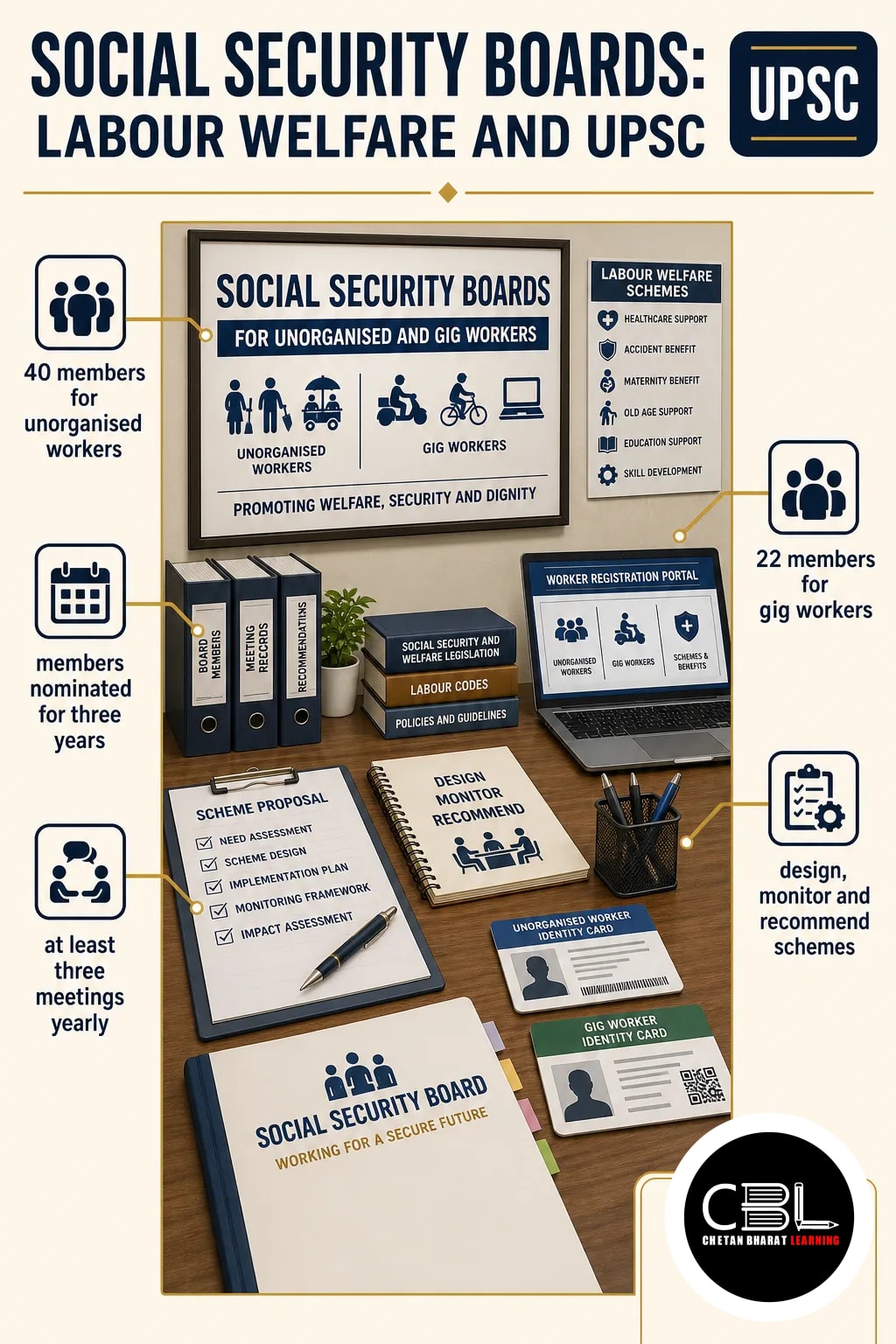
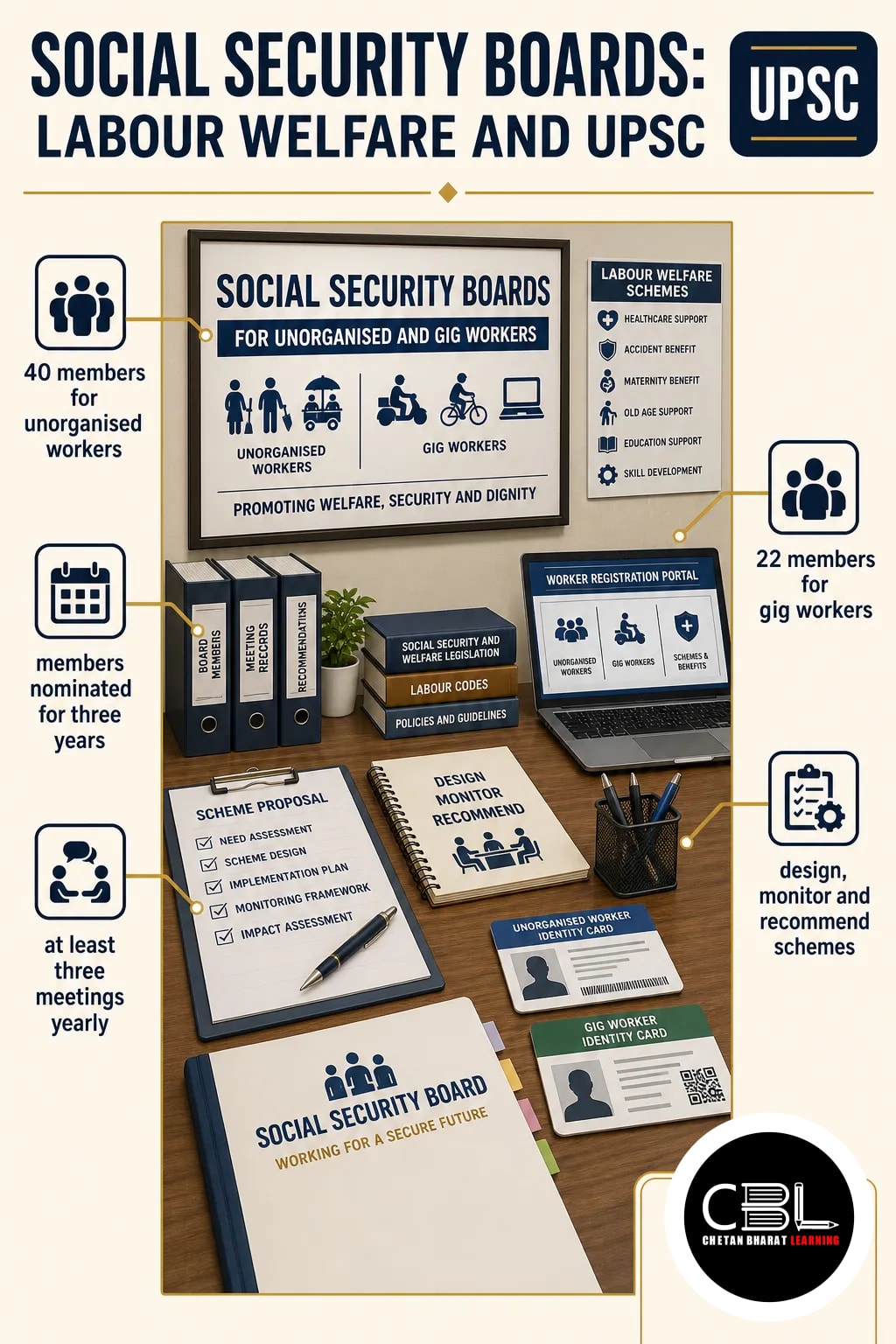
Quick answer: The Labour Ministry has constituted two national social security boards: a 40-member board for unorganised workers and a 22-member board for gig and platform workers. Nominated for three years, they will design, monitor and recommend welfare schemes. However, union nominations have prompted criticism over representation.
What are the social security boards?
The boards are national bodies constituted under the statutory framework of the Code on Social Security, 2020. Their remit covers welfare schemes for unorganised workers and, separately, gig and platform workers.
They must design, monitor and recommend targeted schemes to address gaps in coverage. However, constituting a board is distinct from creating a funded scheme or delivering benefits to an individual worker.
A gig worker generally earns through work outside a traditional employer-employee arrangement. Platform work, meanwhile, involves access to work through an online platform. For institutional context, see CBL’s analysis of gig worker welfare boards.
Why are the boards in the news?
The Ministry of Labour and Employment has notified the constitution of both boards for a three-year term. Their formation places informal and platform work within a common discussion of social security coverage.
The National Institution for Transforming India (NITI) Aayog projects that the gig and platform sector will employ 2.35 crore workers by 2029–30. This is a projection, not a current employment count. Consequently, the capacity to design and deliver suitable benefits will matter as the workforce expands.
The source describes a gap in providing social security benefits to gig and platform workers. The ministry, however, identifies the Code on Social Security as the statutory framework for the boards; the existence of that framework should not be confused with universal benefit delivery.
Key features and membership
The two boards differ in size and membership, but share leadership, tenure and welfare functions.
| Feature | Details |
|---|---|
| Unorganised workers | 40 members, including seven union and seven employer representatives |
| Gig and platform workers | 22 members, including worker and aggregator representatives |
| Leadership | Union Labour Minister as chairperson and Labour Secretary as vice-chairperson |
| Tenure and meetings | Members nominated for three years; at least three meetings each year |
| Functions | Design, monitor and recommend targeted welfare schemes |
On the unorganised workers’ board, the Bharatiya Mazdoor Sangh (BMS) has three of seven union seats. Laghu Udyog Bharati, which works for micro, small and medium enterprises, has three of seven employer seats. The report identifies both as linked to the Rashtriya Swayamsevak Sangh (RSS).
The gig and platform board includes company representatives from Eternal, Zepto, Swiggy and Urban Company. Its worker-side members include BMS, the Indian Federation of App-Based Transport Workers and the National Front of Indian Trade Unions.
Why do representation and coverage matter?
Representation matters because board recommendations can shape which workers and risks receive policy attention. Moreover, involving worker organisations and aggregators can bring different perspectives on scheme design.
The Centre of Indian Trade Unions (CITU) and the All India Trade Union Congress (AITUC) criticised the nominations. They argued that most of the 12 government-recognised unions lacked representation and questioned the selection process.
CITU leader Sudip Dutta referred to the established process of recognising worker representatives through a referendum. AITUC leader Amarjeet Kaur said her organisation had supplied names but its representatives were excluded. In contrast, BMS vice-president Pawan Kumar said his organisation had submitted names and sought an early board meeting.
The ministry did not respond to the newspaper’s query by press time. Therefore, the unions’ allegations should be treated as their stated concerns, not as an established finding of unlawful selection.
Broader coverage also depends on whether schemes reach workers whose employment and income can change frequently. For the wider policy context, read CBL’s analysis of India’s social security coverage.
Challenges in translating recommendations into benefits
The principal challenge is to turn institutional representation into accessible and sustainable welfare.
- Representative voice: A narrow selection of unions can weaken confidence in consultations, especially when excluded organisations contest the process.
- Funding and responsibility: Schemes need clear financing and administrative roles; otherwise, recommendations may not translate into benefits.
- Worker identification: Workers may undertake different jobs or use multiple platforms, making consistent identification important.
- Access and portability: Benefits should remain accessible when workers change locations or work arrangements.
- Accountability: Regular meetings help oversight, but their effectiveness also depends on follow-up and transparent outcomes.
Way forward
Transparent nominations and implementable scheme designs can make the boards more credible and effective.
First, the government could publish selection criteria and consult a wider range of worker organisations. Second, boards could specify benefit eligibility, funding responsibilities and grievance channels when recommending schemes. Moreover, coordination with states can help workers access benefits across locations.
Finally, public reporting on recommendations and follow-up would allow scrutiny of outcomes rather than membership alone. CBL’s earlier overview of worker social security boards provides further context.
Source: The Indian Express, 2 November 2026
- Gig Workers Welfare Boards: Powers and UPSC Analysis (1 Nov 2026)
- India Social Security Coverage: UPSC Analysis (31 Oct 2026)
- Social Security Boards for Workers: UPSC Analysis (30 Oct 2026)
Punjab PCS and Haryana HCS may test the roles of national and state governments in labour welfare. Candidates can also examine how state-level coordination and benefit portability affect workers who move between states.
Prelims Practice Corner
Mains Practice Questions
Frequently Asked Questions
How many members are on the new social security boards?
The unorganised workers’ board has 40 members, while the gig and platform workers’ board has 22. Both have a three-year nomination term.
What is the mandate of the boards?
They design, monitor and recommend targeted welfare schemes. In addition, they must meet at least three times a year.
Do the new boards automatically provide benefits to every worker?
No, because constituting a board does not itself grant a specified benefit to every worker. Scheme design and delivery remain distinct from the boards’ formation.
Why have some unions criticised the nominations?
They argue that most government-recognised unions lack representation. However, the ministry did not respond to the newspaper’s query by press time.
Related Current Affairs
Preparing for UPSC, PCS or HCS?
Talk to a mentor at Chetan Bharat Learning, Chandigarh. Free guidance on choosing the right exam and building a study plan.
Chat on WhatsAppCall 97793 53345UPSC / IAS / PCS coaching in Chandigarh · Trusted by aspirants across Punjab & Haryana

 Ananya RanaIAS · AIR 60
 Aditya SharmaIAS · AIR 70
 Ria Kaur SethiIPS · AIR 89
 Aman AloonIRS · AIR 295
 Sumer Singh VirkIRS · AIR 335
 Shivani PanchalIAS

Leave a Reply
You must be logged in to post a comment.