
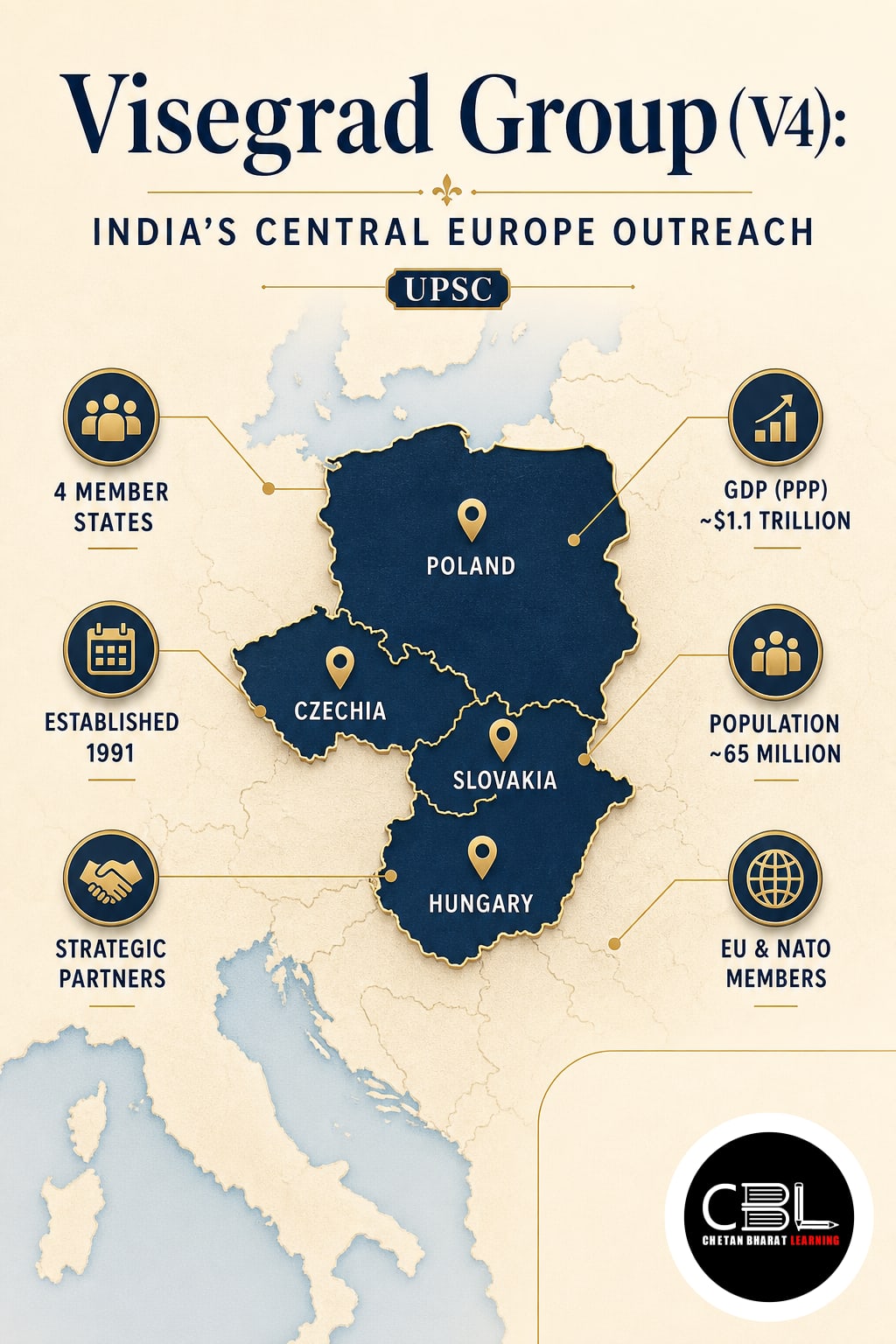

UPSC Mapping
- Prelims: V4 Members, European Groupings and International Organisations
- Mains: GS Paper II – International Relations
Article
Visegrad Group support for India’s permanent UNSC membership has strengthened diplomatic engagement with Central Europe. The first V4–India Foreign Ministers’ Meeting also opened new opportunities for trade, technology and security cooperation. Aspirants can track similar developments through the daily current affairs archive.
Quick Facts
| Established | 1991 |
|---|---|
| Members | Four Central European Countries |
| Nature | Informal Intergovernmental Platform |
| Institution | International Visegrad Fund |
What is Visegrad Group?
The Visegrad Group is an informal platform comprising the Czech Republic, Hungary, Poland and Slovakia. It supports cooperation on political, economic, cultural, energy and security issues affecting Central Europe. The members coordinate their positions without creating a supranational organisation or transferring sovereign authority.
Czechoslovakia, Hungary and Poland established the grouping as the Visegrád Triangle through the 1991 Visegrád Declaration. The division of Czechoslovakia into the Czech Republic and Slovakia created the present four-member arrangement. Its original priorities included democratic transition and integration with the European Union and NATO.
Why is Visegrad Group in News?
Visegrad Group engagement gained attention after the first V4–India Foreign Ministers’ Meeting on the sidelines of the 81st United Nations General Assembly. The participants agreed to strengthen regular political dialogue and develop an annual business forum. Their discussions covered trade, defence, technology, connectivity and people-to-people relations.
V4 countries also supported India’s claim for permanent membership of a reformed UN Security Council. Slovakia described India as an important Global South country and an emerging Indo-Pacific power. The Ministry of External Affairs provides official information on India’s diplomatic engagements with European partners.
Key Features
- Four-member composition: The Visegrad Group brings together the Czech Republic, Hungary, Poland and Slovakia, which share geographical proximity and several experiences arising from post-communist political and economic transformation.
- Informal institutional structure: The grouping has no permanent secretariat, headquarters or binding decision-making authority, allowing members to cooperate selectively while retaining control over their national foreign policies.
- Rotating presidency: Each member holds the presidency for one year and prepares a programme of meetings and priorities, distributing organisational responsibility without establishing a central bureaucracy.
- International Visegrad Fund: The Bratislava-based fund supports cultural, educational, research and civil-society projects that deepen regional cooperation and connect V4 societies with neighbouring countries.
- V4+ cooperation format: The platform engages non-member partners such as India and Japan on specific interests, enabling structured cooperation without offering membership or creating treaty-based obligations.
Challenges
- Divergent foreign-policy positions: Members do not always share identical views on Russia, Ukraine, migration, relations with China or deeper European integration, limiting their ability to present a unified position.
- Absence of binding institutions: The informal structure supports flexibility but provides limited enforcement, continuity and implementation capacity when national governments change their diplomatic or economic priorities.
- Different economic interests: Competition for investment, manufacturing projects and European funds can weaken collective bargaining, particularly when individual members pursue separate arrangements with major external powers.
- Overlap with larger organisations: All four members operate within the European Union and NATO, where broader rules and collective positions may constrain independent regional initiatives.
- Limited public and business engagement: India–V4 relations need stronger institutional links among companies, universities and research organisations to move beyond diplomatic meetings; related developments appear in the international relations section.
Way Forward
India and the Visegrad Group should institutionalise annual ministerial meetings and establish sector-specific working mechanisms. An annual business forum can identify opportunities in automobiles, clean energy, defence production, digital technology and resilient supply chains. Universities and research institutions can expand exchanges through joint academic programmes and scholarships.
India should also use the V4+ format to deepen engagement with Central Europe without treating the region as a single policy bloc. Cooperation must complement India’s wider relationships with the European Union and individual member states. The International Visegrad Fund can support educational and cultural partnerships that provide long-term institutional depth.
Prelims Practice Corner
Q1. Which countries constitute the V4?
(a) Austria, Hungary, Poland and Slovakia
(b) Czech Republic, Hungary, Poland and Slovakia
(c) Czech Republic, Romania, Poland and Slovenia
(d) Croatia, Hungary, Serbia and Slovakia
Answer: (b) The V4 comprises the Czech Republic, Hungary, Poland and Slovakia.
Q2. The original Visegrád Declaration was signed in which year?
(a) 1985
(b) 1989
(c) 1991
(d) 1995
Answer: (c) Czechoslovakia, Hungary and Poland signed the Visegrád Declaration in 1991.
Q3. Which statement correctly describes the institutional structure of the V4?
(a) It has a permanent supranational parliament
(b) It operates under the United Nations Secretariat
(c) It has no permanent secretariat
(d) It functions as a military alliance
Answer: (c) It is an informal platform without a permanent secretariat or supranational authority.
Q4. The International Visegrad Fund is headquartered in which city?
(a) Warsaw
(b) Prague
(c) Budapest
(d) Bratislava
Answer: (d) The International Visegrad Fund operates from Bratislava, Slovakia.
Q5. What does the V4+ format primarily facilitate?
(a) Admission of new permanent members
(b) Dialogue with selected non-member partners
(c) Collective monetary policy
(d) Deployment of a common military force
Answer: (b) The V4+ format enables cooperation with non-member countries on selected issues.
Mains Practice Questions
Q1. Examine the strategic significance of India’s growing engagement with the V4 countries. (250 words, 15 marks)
Answer Structure:
- Intro: Introduce the V4 as an informal Central European cooperation platform.
- Body: Discuss UNSC support, trade, technology, defence, supply chains, education and engagement with the European Union.
- Conclusion: Present the V4+ format as a practical addition to India’s diversified European diplomacy.
Q2. Informal regional groupings offer flexibility but face limitations in achieving policy convergence. Discuss with reference to the V4. (150 words, 10 marks)
Answer Structure:
- Intro: Explain the flexible and non-binding nature of informal regional platforms.
- Body: Cover rotating leadership, limited bureaucracy, divergent interests, weak enforcement and overlap with the EU and NATO.
- Conclusion: Argue for focused cooperation on areas where members share identifiable interests.
FAQs on Visegrad Group
Which countries are members of the V4?
Its members are the Czech Republic, Hungary, Poland and Slovakia. All four countries are located in Central Europe and belong to both the European Union and NATO.
Why is the V4 important for India?
It offers India a platform for coordinated engagement with four Central European economies. Cooperation can cover UNSC reform, trade, technology, defence, education and resilient supply chains.
Is the V4 a formal international organisation?
It is an informal intergovernmental platform without a permanent secretariat or binding authority. Its presidency rotates annually among the four members.
Related Current Affairs
Preparing for UPSC, PCS or HCS?
Talk to a mentor at Chetan Bharat Learning, Chandigarh. Free guidance on choosing the right exam and building a study plan.
Chat on WhatsAppCall 97793 53345UPSC / IAS / PCS coaching in Chandigarh · Trusted by aspirants across Punjab & Haryana
Leave a Reply
You must be logged in to post a comment.