
UPSC Mapping
| Prelims | Indian Economy, Biofuels and Food Security |
|---|---|
| Mains | GS Paper III — Economy, Agriculture and Energy |
Quick Facts
| Early Blending | About 1–1.5% in 2013–14 |
|---|---|
| Intermediate Level | Around 5% in 2019–20 |
| E20 | 20% ethanol + 80% petrol |
| Major Feedstocks | Sugarcane, maize and rice |
What is Ethanol Blending Policy?
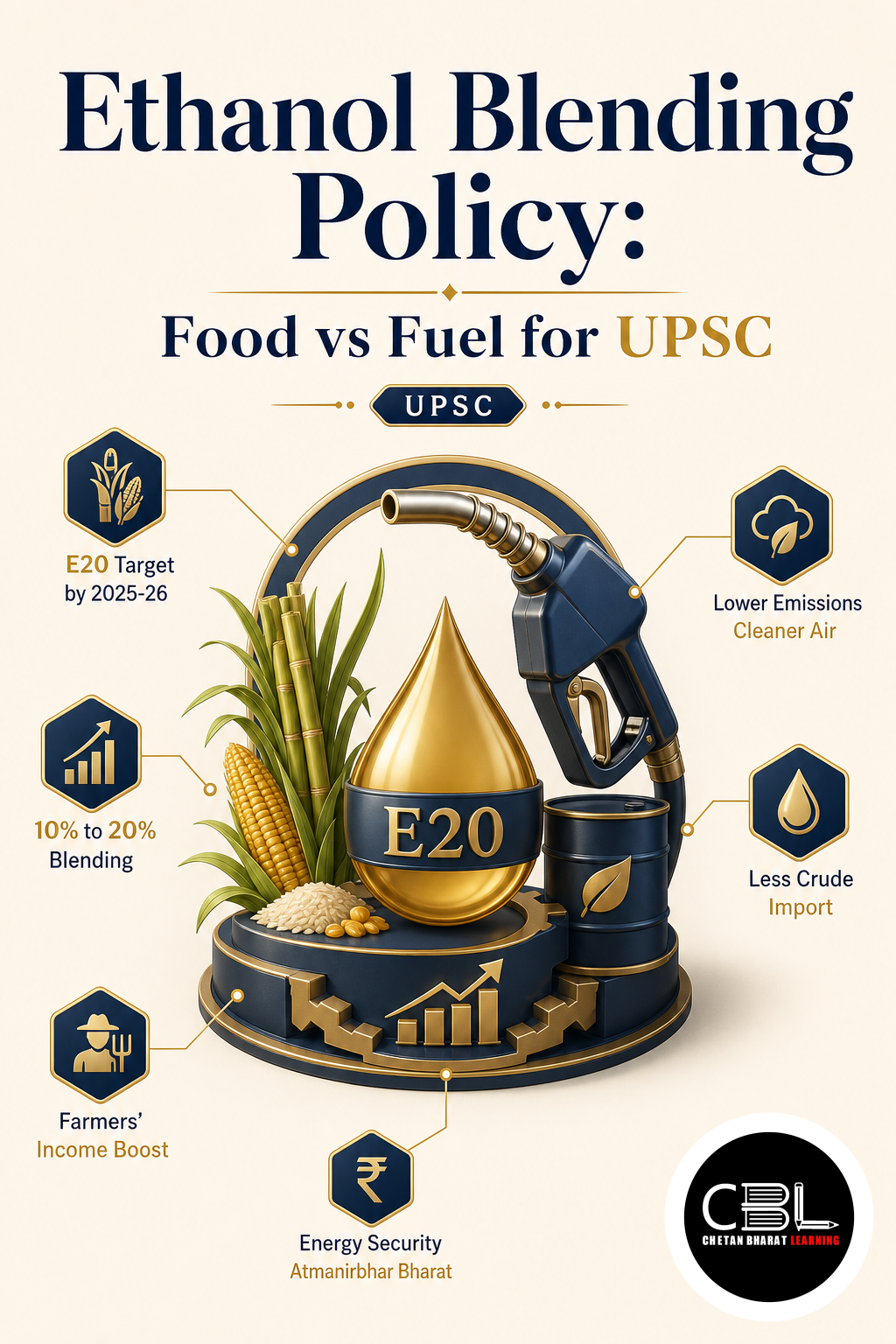
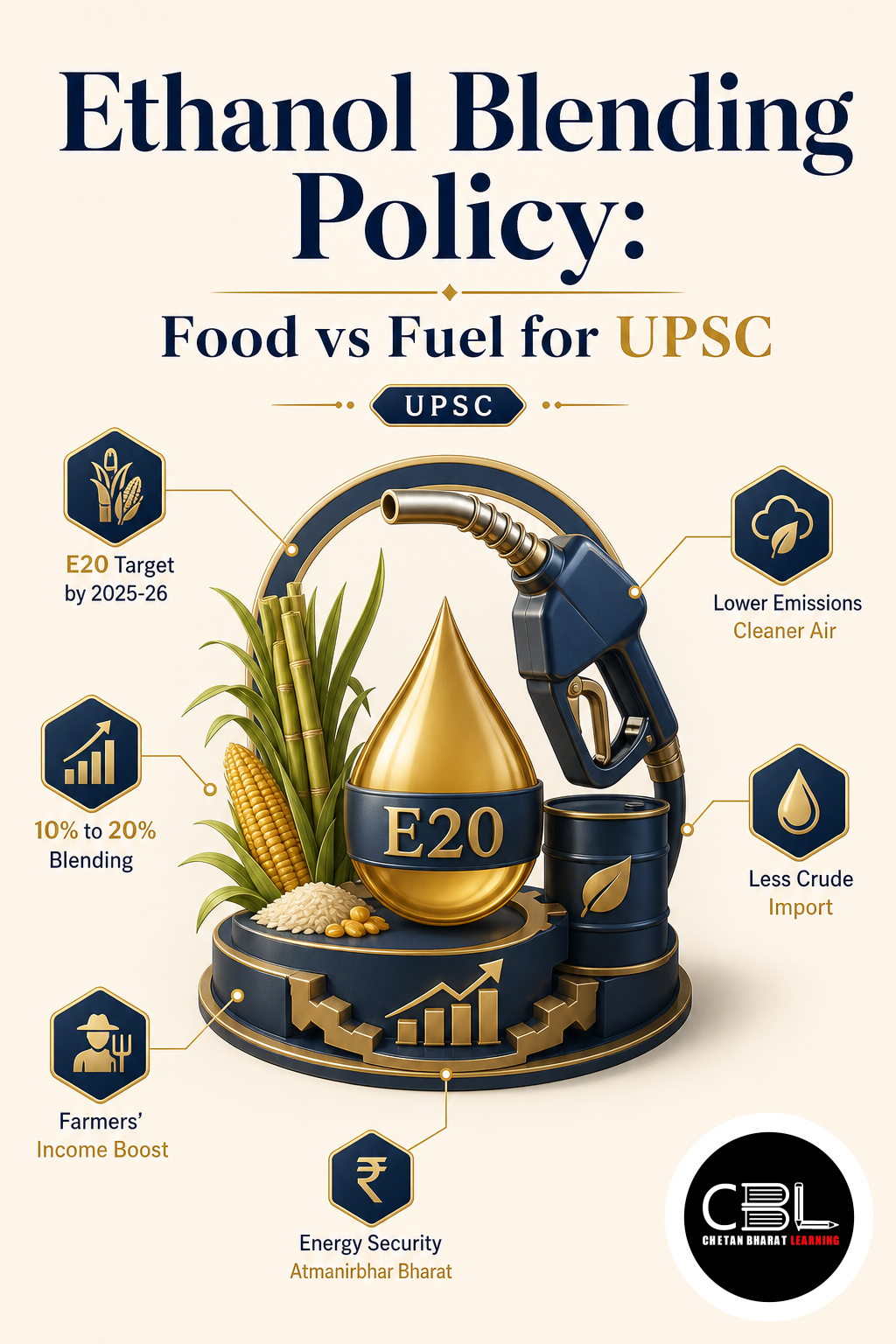
Ethanol is a biofuel produced from agricultural biomass and can be mixed with petrol for use in vehicles. Sugarcane juice, molasses, maize, rice and other grains serve as common feedstocks. E20 denotes a blend of 20% ethanol and 80% petrol, substituting a portion of conventional fossil fuel with domestically produced biofuel.
The policy extends beyond fuel substitution: it reduces the oil import burden, improves energy diversification, creates additional markets for farmers and supports rural economic activity. However, since the same agricultural system also supplies food, animal feed and industrial raw materials, greater fuel demand may compete for crops, land, irrigation water and other resources.
Why is Ethanol Blending Policy in News?
India’s ethanol journey has moved from roughly 1–1.5% blending in 2013–14 to around 5% in 2019–20 and about 20% around 2025–26. Further expansion may require larger quantities of agricultural feedstock, raising concerns over food, feed and water stress. Policymakers now debate how to preserve the benefits of blending without exacerbating agricultural vulnerabilities.
The debate also reflects changing crop-market conditions: stronger fuel demand can influence crop prices even when biofuel demand is not the sole cause of inflation. The recommended approach is flexibility in blending rather than rigid targets.
Key Features
Ethanol blending is a multi-dimensional policy involving fuel imports, agricultural markets, farmer incomes, feed availability and water use.
- Oil-import substitution: Mixing domestic ethanol with petrol reduces dependence on imported petroleum, improving energy diversification.
- Additional farmer market: Ethanol production creates new demand for agricultural output and supports rural incomes.
- Food-versus-fuel linkage: Crops such as maize serve multiple uses—human food, animal feed, industry and fuel—so rising fuel demand may increase competition across markets.
- Different feedstocks, different pressures: Sugarcane uses substantial water, grains raise food-security concerns, and maize is critical for animal feed.
- Water-food-energy nexus: Crop choices influence groundwater use and irrigation demand, linking fuel security with ecological sustainability.
Challenges
The central challenge is to retain energy-security gains without weakening food affordability, livestock economics or water security.
- Food-price pressure: Competition for edible crops during tight supply can magnify shortages and raise consumer food costs.
- Higher animal-feed costs: Diverting maize to fuel increases feed-market competition and can raise prices of eggs and poultry.
- Water stress: Expansion of water-intensive feedstocks can exacerbate groundwater depletion and drought risk.
- Rigid blending targets: Fixed demand during weather shocks intensifies competition for scarce biomass.
- Misleading feedstock substitution: Replacing sugarcane with other crops may transfer burdens between irrigation systems and food/feed markets.
Way Forward
India can strengthen the programme through higher agricultural productivity, better seeds, efficient irrigation and improved storage. Policymakers should prioritise genuine crop surpluses, promote second-generation ethanol from residues and biomass, and diversify feedstocks with sustainability criteria.
A durable policy should remain flexible, productivity-led, water-sensitive and food-security-centric: increasing blending in surplus years and prioritising food and feed requirements during shortages.
Prelims Practice Corner
Q1. What does E20 fuel signify?
(a) 20% petrol and 80% ethanol (b) 20% ethanol and 80% petrol (c) 20% biodiesel and 80% petrol (d) 20% methanol and 80% diesel
Answer
(b) E20 contains 20% ethanol blended with 80% petrol.
Q2. Which of the following can serve as ethanol feedstocks according to the source?
(a) Sugarcane (b) Maize (c) Rice (d) All of the above
Answer
(d) Sugarcane, maize and rice can all contribute feedstock for ethanol production.
Q3. Why can greater maize use for ethanol create a food-system trade-off?
(a) Maize has no industrial use (b) Maize is also an important animal-feed crop (c) Maize cannot produce ethanol (d) Maize requires no water
Answer
(b) Higher ethanol demand can compete with poultry and livestock feed requirements.
Q4. Second-generation ethanol can help reduce direct food competition because it can use which material?
(a) Crop residues and agricultural waste (b) Only edible sugar (c) Imported crude oil (d) Mineral coal
Answer
(a) Crop residues, agricultural waste and biomass can provide non-food feedstock for advanced ethanol production.
Q5. Which approach best reflects the policy principle highlighted in the source?
(a) Stop ethanol blending permanently (b) Keep targets rigid under all conditions (c) Increase ethanol during surpluses and prioritise food during shortages (d) Depend only on one feedstock
Answer
(c) The source recommends flexibility so blending responds to agricultural availability and food-security conditions.
Mains Practice Questions
Q1. India’s ethanol strategy must reconcile energy security with food and water security. Discuss. (10 marks)
Answer Structure:
- Introduction: Explain ethanol blending as a tool for reducing petroleum dependence.
- Body: Cover farmer markets, oil-import substitution, food-versus-fuel competition, feed costs, groundwater stress and differences among sugarcane, grains and maize.
- Conclusion: Recommend flexible blending linked to surpluses, productivity and sustainable resource use.
Q2. Fuel self-reliance should not shift India’s dependence from imported oil to domestic food and water resources. Examine. (15 marks)
Answer Structure:
- Introduction: Frame Atmanirbharta as resilience across energy, agriculture and natural resources.
- Body: Analyse crop competition, animal-feed markets, water intensity, climate risks, rigid targets, second-generation ethanol and the role of genuine agricultural surpluses.
- Conclusion: Advocate a flexible, water-sensitive and food-security-first biofuel strategy.
FAQs on Ethanol Blending Policy
Why does ethanol blending create a food-versus-fuel debate?
Several ethanol feedstocks also serve as food, animal feed or industrial inputs. Strong fuel demand can therefore increase competition when agricultural supply is already tight.
Why is water security relevant to ethanol production?
Feedstock crops require land and water, and some cultivation patterns can intensify irrigation pressure. Biofuel planning must therefore account for groundwater stress, drought conditions and regional crop suitability.
Does the source recommend stopping ethanol blending?
No. It argues for a flexible approach that expands ethanol during surplus conditions and protects food and feed availability during shortages, while promoting productivity and second-generation feedstocks.
Related Current Affairs
Preparing for UPSC, PCS or HCS?
Talk to a mentor at Chetan Bharat Learning, Chandigarh. Free guidance on choosing the right exam and building a study plan.
Chat on WhatsAppCall 97793 53345UPSC / IAS / PCS coaching in Chandigarh · Trusted by aspirants across Punjab & Haryana
Leave a Reply
You must be logged in to post a comment.