

UPSC Mapping
| Prelims | Mains |
|---|---|
| UPI, NPCI, MDR, P2P and P2M Transactions | GS Paper III: Economy, Digital Infrastructure and Inclusion |
Quick Facts
| Effective Date | 15 October 2026 |
|---|---|
| Standard MDR | 0.4% above ₹2,000 |
| Maximum Charge | ₹300 per transaction |
| P2P Transfers | Remain free |
What are UPI Merchant Charges?
UPI Merchant Charges refer to the Merchant Discount Rate, or MDR, applied when an eligible customer pays a business through the Unified Payments Interface. MDR is a payment-processing fee borne by the merchant ecosystem and shared among participating banks, payment applications and service providers according to applicable arrangements. It differs from a direct consumer fee because the payer should not see an additional charge merely for choosing UPI, while the merchant’s settlement reflects the prescribed processing cost.
UPI is an instant mobile-based system developed by the National Payments Corporation of India and overseen by the Reserve Bank of India. It supports person-to-person transfers and person-to-merchant payments through bank accounts, mobile numbers, virtual payment addresses and QR codes. The new rules target a defined segment of commercial payments rather than every transfer, preserving free P2P transactions and small-value usage while creating a revenue stream for maintaining the wider payment network, improving operational resilience, fraud monitoring, dispute resolution and continuing investment in secure acceptance infrastructure, customer education and uninterrupted settlement during exceptional transaction peaks.
Why are UPI Merchant Charges in News?
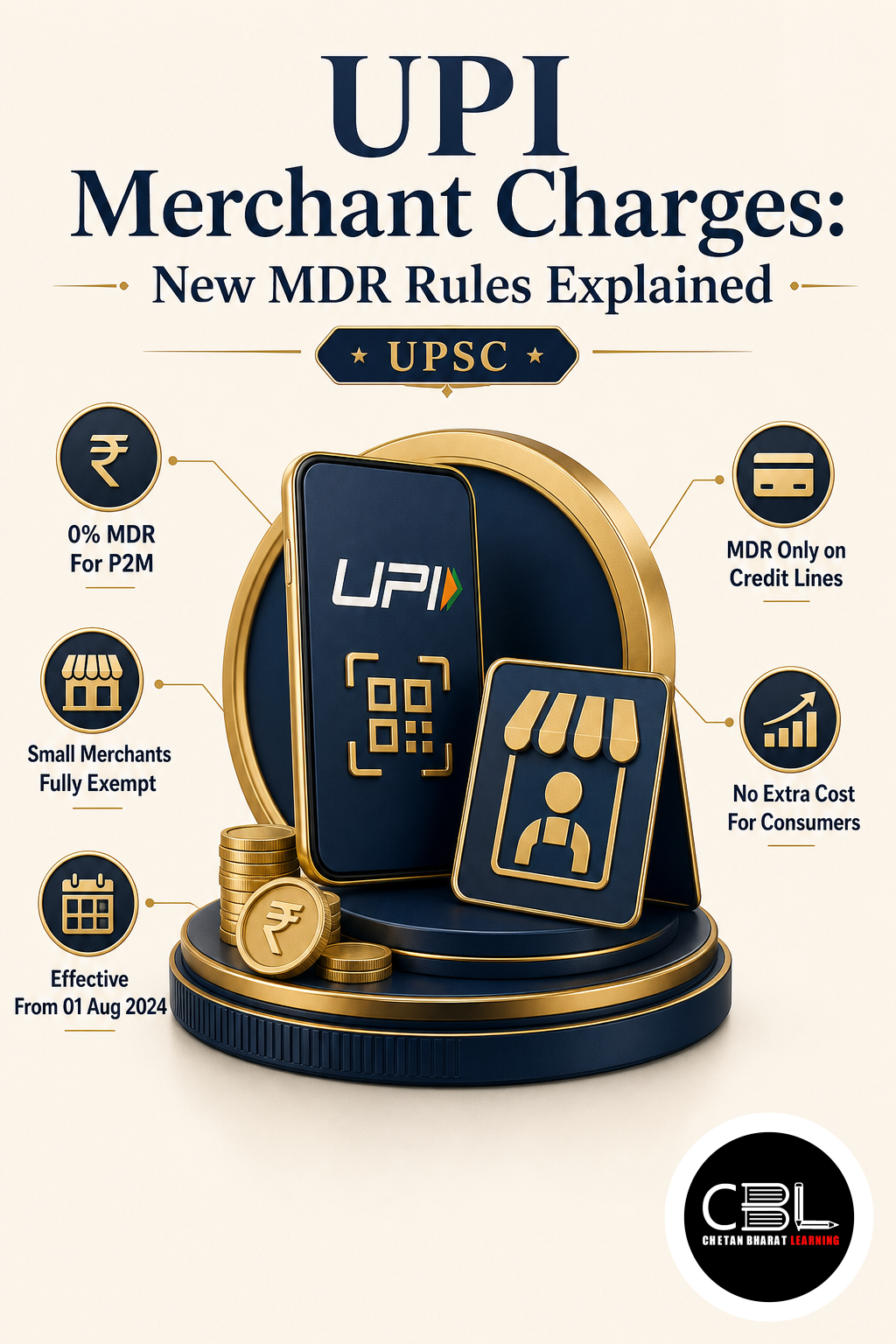
UPI Merchant Charges entered the news after NPCI announced a 0.4 per cent MDR on eligible P2M transactions exceeding ₹2,000, effective from 15 October 2026. The charge is capped at ₹300 for transactions of ₹75,000 or more, preventing the standard percentage from increasing without limit. Specified sectors including railways, fuel, agriculture, utilities, telecom, insurance, credit-card dues and tax payments receive a flat ₹5 treatment above the relevant threshold, reflecting their lower margins or public-service character.
P2P transfers remain free, and merchants receiving up to ₹1 lakh monthly through qualifying QR payments receive protection under the small-merchant framework. The government has also advised banks and payment providers to prevent merchants from transferring MDR directly to customers. The PIB clarification confirms that transactions up to ₹2,000 attract zero MDR, preserving everyday digital payments and financial inclusion while allowing higher-value commercial activity to support system costs.
Key Features
- Targeted P2M coverage: The standard 0.4 per cent rate applies only to eligible merchant payments above ₹2,000, leaving lower-value commercial transactions outside the charge, protecting routine retail payments while recovering part of the cost generated by larger commercial transactions.
- Consumer protection: Individual customers should not bear the MDR as a separate UPI fee, and person-to-person transfers remain free regardless of the transferred amount, preserving a familiar zero-fee experience for families, friends and other individual account holders.
- Charge ceiling: A ₹300 cap limits the processing cost for transactions of ₹75,000 or more, improving predictability for businesses accepting larger digital payments, especially in sectors where the transaction value can otherwise produce a disproportionate percentage-based deduction.
- Sectoral treatment: Selected essential or low-margin categories face a flat ₹5 charge instead of the standard percentage, reducing pressure on services with regulated or narrow margins, although careful category coding remains necessary to prevent unequal treatment of similar businesses.
- Small-merchant support: Protected treatment for qualifying small QR merchants seeks to preserve adoption among neighbourhood shops, informal enterprises and first-time digital-payment users, where even modest processing deductions could encourage a return to cash or informal settlement methods.
Challenges
- Cost pass-through: Merchants may indirectly recover MDR through higher prices, minimum purchase rules or discounts for alternative payment modes despite restrictions on explicit customer surcharges, making price monitoring and clear receipts important for detecting disguised recovery of payment-processing costs.
- Classification disputes: Incorrectly identifying a P2P transfer as commercial activity, or misclassifying a merchant category, can produce charges that are difficult for users to understand or challenge, particularly when applications display only the final settlement amount without explaining the underlying transaction category.
- Merchant behaviour: Some businesses may split bills below the threshold, prefer cash or discourage UPI for larger purchases, weakening traceability and convenience, while also creating artificial transaction patterns that complicate fraud detection and merchant-account monitoring.
- Market concentration: MDR distribution must support banks and service providers without entrenching dominant applications or disadvantaging smaller payment firms and acquiring institutions, requiring transparent revenue sharing and interoperable access to prevent gatekeeping by firms with the largest user bases.
- Grievance redress: Banks, applications and NPCI need consistent disclosure and rapid correction mechanisms, alongside broader analysis in the economy current affairs section, so users can identify the responsible entity and obtain time-bound reversal of an incorrect charge.
Way Forward
The UPI Merchant Charges framework should operate through clear merchant notices, itemised settlement statements and uniform classification rules across banks and applications. Regulators and NPCI should publish complaint data, audit improper surcharging and establish simple channels for correcting merchant category or transaction-type errors. Periodic review must assess whether the ₹2,000 threshold, special-sector rate and small-merchant protection remain proportionate as payment behaviour changes, while independent audits test whether protected merchants receive the intended benefit and cybersecurity and operational resilience receive adequate investment from the resulting revenue.
Policy should preserve competition by disclosing how MDR supports issuers, acquirers, switching infrastructure and customer service without guaranteeing inefficient costs. The RBI payment systems report explains UPI’s architecture and the differing growth of P2P and P2M payments, providing an evidence base for future review. Transparent monitoring, merchant education and effective consumer safeguards can build a sustainable model that funds secure digital public infrastructure without reversing gains in accessibility, convenience and formalisation, particularly for small firms operating beyond major urban centres and users with limited alternatives to mobile payments.
Prelims Practice Corner
- Q1. What does MDR stand for in digital payments?
(a) Merchant Discount Rate (b) Monetary Deposit Ratio (c) Mobile Data Reserve (d) Merchant Debit Rule
Answer: (a) MDR means Merchant Discount Rate charged for processing merchant payments. - Q2. Which transactions remain free under the announced framework?
(a) All foreign payments (b) Person-to-person UPI transfers (c) Every card payment (d) All merchant payments
Answer: (b) P2P transfers remain outside the announced merchant MDR. - Q3. Who developed and operates the core UPI platform?
(a) SEBI (b) NPCI (c) NABARD (d) IRDAI
Answer: (b) NPCI developed and operates the core UPI platform. - Q4. What is the standard announced MDR on eligible P2M payments above ₹2,000?
(a) 0.04% (b) 0.4% (c) 4% (d) 1%
Answer: (b) The standard announced rate is 0.4 per cent. - Q5. P2M in the UPI ecosystem refers to what?
(a) Person-to-market data (b) Public-to-ministry transfer (c) Person-to-merchant payment (d) Payment-to-mobile service
Answer: (c) P2M means a payment from an individual to a commercial entity.
Mains Practice Questions
- Q1. Examine the rationale and possible consequences of introducing MDR on selected high-value UPI payments. (250 words, 15 marks)
- Intro: Define MDR and distinguish P2M from P2P payments.
- Body: Discuss infrastructure funding, merchant costs, inclusion, competition, pass-through risks and transparency.
- Conclusion: Recommend periodic evidence-based review with strong consumer protection.
- Q2. Digital payment policy must balance universal access with financial sustainability. Discuss. (150 words, 10 marks)
- Intro: Present UPI as essential national payment infrastructure.
- Body: Examine operating costs, small-user protection, cybersecurity, innovation and market competition.
- Conclusion: Support transparent pricing that preserves inclusion and system resilience.
FAQs on UPI Merchant Charges
- Will customers pay extra for every UPI transaction?
- No. P2P transfers and eligible merchant payments up to ₹2,000 remain free under the framework, while merchants should not separately pass MDR to customers.
- When will the new MDR framework begin?
- The announced effective date is 15 October 2026. Payment participants must classify eligible transactions and apply the prescribed treatment from that date.
- Why has MDR been introduced for selected payments?
- The fee seeks to support payment infrastructure, cybersecurity and service delivery. Thresholds, caps and exemptions aim to preserve low-cost access for ordinary users and small merchants.
Related Current Affairs
Preparing for UPSC, PCS or HCS?
Talk to a mentor at Chetan Bharat Learning, Chandigarh. Free guidance on choosing the right exam and building a study plan.
Chat on WhatsAppCall 97793 53345UPSC / IAS / PCS coaching in Chandigarh · Trusted by aspirants across Punjab & Haryana
Leave a Reply
You must be logged in to post a comment.