

UPSC Mapping
- Prelims: G20, WTO and International Humanitarian Law
- Mains: GS Paper II: International Relations and Global Institutions
Quick Facts
| Item | Detail |
|---|---|
| G20 Consensus | 1 October 2026 |
| Meeting | G20 Trade Ministerial |
| Host City | Milwaukee, United States |
| UNSC Framework | Resolution 2417 of 2018 |
| Protected Objects | Food, Crops, Livestock and Water |
What is Food Weaponisation?
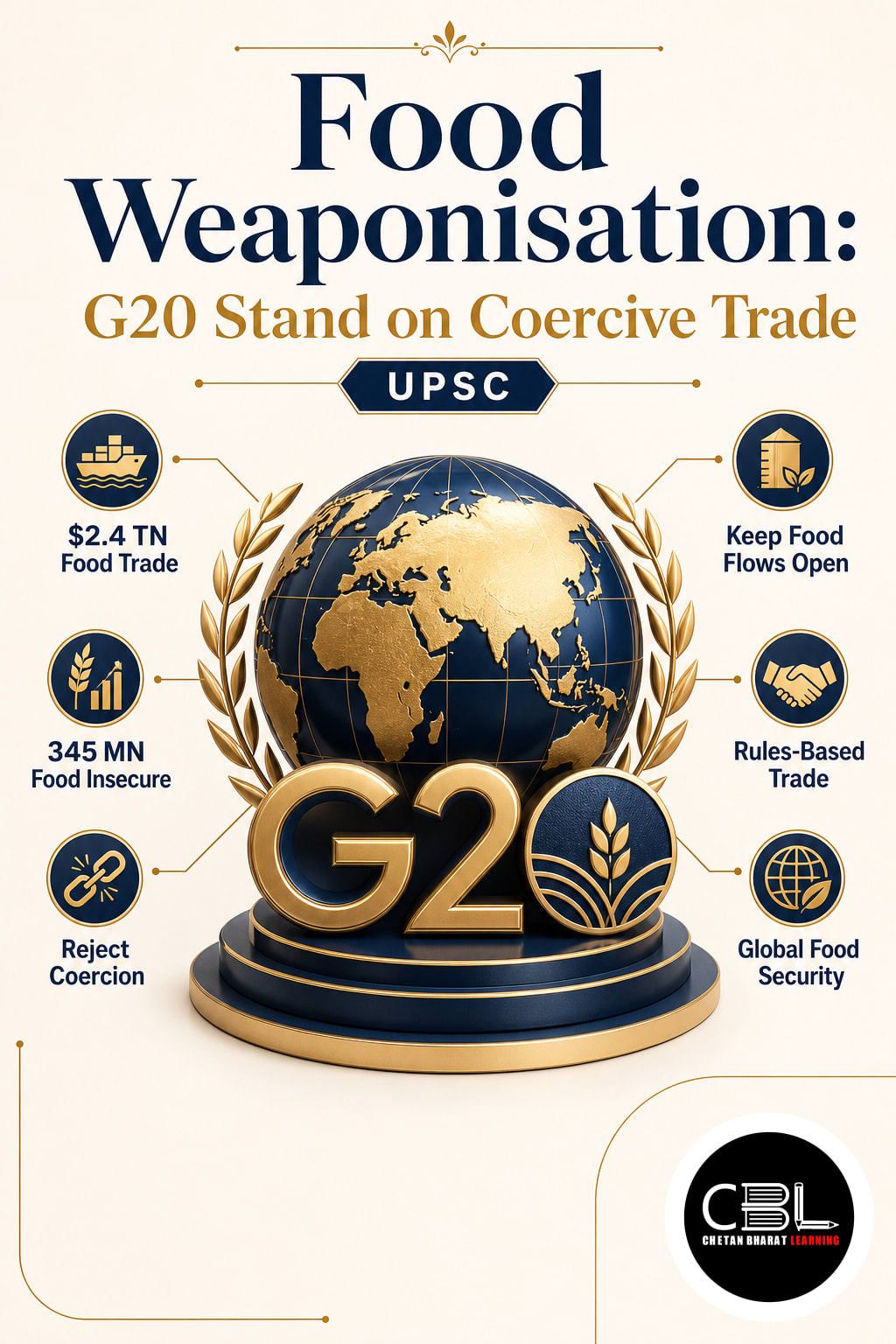
Food Weaponisation means deliberately using food, agricultural products or essential farm inputs to compel political or economic concessions unrelated to food policy. The G20 formulation covers actions that slow, stop, block or redirect these flows to impose coercive pressure. Such conduct can damage livelihoods, market confidence and national resilience far beyond the country directly targeted, particularly where households already spend a large share of income on essential food.
The broader concept also includes conflict practices that deprive civilians of food or destroy systems necessary for survival. These may involve obstructing relief, attacking crops, contaminating water, restricting access to farmland or manipulating humanitarian supplies, with effects continuing long after hostilities through damaged soil, irrigation, storage and transport systems. Legitimate, temporary and transparent measures for domestic food availability require separate assessment because purpose, duration, proportionality and international obligations determine their character.
Why is Food Weaponisation in News?
G20 trade ministers reached consensus on a statement condemning the practice during their meeting in Milwaukee on 1 October 2026. The outcome described coercive manipulation of food trade as a serious humanitarian and economic threat. It also recognised that disrupted agricultural flows can distort competition, undermine international markets and expose import-dependent economies to severe vulnerability, even when the original coercive action targets only one trading partner.
India supported the shared objective but stressed the distinction between coercion and genuine food-security policies. The official Indian statement defended public stockholding, procurement from small farmers and temporary measures during shortages. India also highlighted fertiliser access, policy space for developing countries and fair, transparent and inclusive trade under WTO rules, while warning that shortages of agricultural inputs can develop into wider crises across the Global South.
Key Features
The issue spans trade policy, food systems and humanitarian law, requiring governments to distinguish coercive intent from necessary regulation through evidence and agreed principles that remain credible during shortages, sanctions, wars and sudden market disruption.
- Coercive objective: An attempt to manipulate food or agricultural inputs for unrelated geopolitical concessions, rather than an ordinary measure addressing safety, scarcity or domestic stability, making evidence of purpose and the relationship between the restriction and demanded concession central to any fair determination.
- Multiple instruments: Export bans, blockades, sanctions, transport controls, fertiliser restrictions, destruction of production assets or selective humanitarian access can operate through physical scarcity, higher costs, delayed cultivation, lost income and fear of future disruption.
- System-wide impact: Interference with grain, energy, shipping, fertiliser or finance can raise prices across connected markets, burdening poor households and import-dependent developing countries with limited reserves, fiscal space, alternative suppliers or bargaining power.
- Humanitarian-law protection: International humanitarian law prohibits starving civilians as a method of warfare and protects foodstuffs, agricultural areas, crops, livestock, water installations and irrigation systems, while parties must allow and facilitate impartial humanitarian relief.
- Multilateral response: G20 cooperation, WTO disciplines, the Agricultural Market Information System and exemptions for World Food Programme purchases can reduce uncertainty and protect humanitarian food movements, subject to timely notifications, reliable data, financing and safeguards against disguised protectionism.
Challenges
Preventing Food Weaponisation remains difficult because intent, attribution and legitimate policy space are contested across security, trade and humanitarian settings, while affected populations often require relief before legal responsibility can be conclusively established.
- Definition problem: Disagreement over whether an export restriction protects domestic consumers or deliberately coerces another country, especially during simultaneous shortages, conflict and price volatility.
- Weak enforcement: Fragmented jurisdiction, political vetoes, evidence barriers and limited accountability delay meaningful consequences, especially when access to affected areas is restricted.
- Supply concentration: Dependence on few exporters, routes, fertiliser producers or payment channels allows local disruptions to have disproportionate global effects.
- Collateral restrictions: Broad sanctions and compliance fears can obstruct lawful food and fertiliser transactions even with formal humanitarian exemptions, as intermediaries avoid complex risks.
- Development divide: Rules designed around open trade may insufficiently recognise public stockholding, livelihood protection and price stabilisation needs in developing economies.
Way Forward
Countries should develop a precise test separating legitimate food-security measures from coercive trade action. The framework should examine declared purpose, actual effects, duration, transparency, necessity and availability of less restrictive options. Governments must notify restrictions quickly, protect humanitarian purchases and avoid measures that endanger food, fertiliser and agricultural-input flows to vulnerable economies, while independent review should ensure emergency measures remain necessary as conditions change.
The global community should strengthen market information, diversify suppliers, maintain emergency reserves and fund resilient local production, storage, irrigation and transport infrastructure so vulnerable states can absorb shocks. Parties to conflicts must protect farms, water systems, markets and impartial relief operations under international humanitarian law. The G20 consensus announcement provides a basis for continued cooperation, but progress requires monitoring, dispute settlement and accountability, supported by early-warning systems and predictable financing before food insecurity becomes catastrophic.
Prelims Practice Corner
Q1. UNSC Resolution 2417 primarily addresses the relationship between:
(a) Climate finance and debt (b) Armed conflict and food insecurity (c) Refugees and citizenship (d) Maritime boundaries and fisheries
Answer: (b) Resolution 2417 recognises the link between armed conflict, hunger and food insecurity.
Q2. Which practice is prohibited under international humanitarian law?
(a) Maintaining food reserves (b) Procuring grain from farmers (c) Starving civilians as a method of warfare (d) Inspecting humanitarian consignments
Answer: (c) International humanitarian law prohibits using starvation of civilians as a method of warfare.
Q3. Which of the following are objects indispensable to civilian survival? 1. Crops 2. Livestock 3. Drinking-water installations 4. Irrigation works
(a) 1 and 2 only (b) 2 and 3 only (c) 1, 3 and 4 only (d) 1, 2, 3 and 4
Answer: (d) International humanitarian law specifically protects all four categories.
Q4. The Agricultural Market Information System operates under which forum?
(a) G20 (b) BIMSTEC (c) NATO (d) Arctic Council
Answer: (a) The G20 established the Agricultural Market Information System to improve market transparency and coordination.
Q5. The 2026 G20 consensus on coercive food trade was reached in:
(a) Rome (b) Mumbai (c) Milwaukee (d) Geneva
Answer: (c) G20 trade ministers reached the consensus during their meeting in Milwaukee, United States.
Mains Practice Questions
Q1. Food can become an instrument of geopolitical coercion through both trade restrictions and armed conflict. Analyse. (250 words, 15 marks)
Answer Structure:
- Intro: Define coercive use of food and distinguish trade pressure from conflict-related starvation.
- Body: Cover export controls, blockades, aid obstruction, supply concentration, price transmission, humanitarian law and impacts on developing countries.
- Conclusion: Recommend rules-based trade, protected humanitarian access and enforceable accountability.
Q2. Discuss India’s concerns regarding the distinction between food coercion and legitimate domestic food-security policies. (150 words, 10 marks)
Answer Structure:
- Intro: Link India’s position with food security and farmer livelihoods.
- Body: Examine public stockholding, procurement, temporary restrictions, WTO policy space, transparency and Global South vulnerabilities.
- Conclusion: Support a balanced test based on intent, necessity, duration and humanitarian impact.
FAQs on Food Weaponisation
What does weaponising food through trade mean?
It means manipulating flows of food, agricultural products or essential inputs to exert coercive pressure. The intended objective is usually to secure unrelated economic or political concessions.
Are all food export restrictions coercive?
No. Temporary and transparent restrictions may address genuine domestic shortages or affordability concerns. Their purpose, necessity, duration and wider impact require careful assessment.
How does international law protect food during war?
International humanitarian law prohibits starving civilians as a method of warfare. It also protects essential foodstuffs, farms, crops, livestock, water installations and irrigation works.
Related Current Affairs
Preparing for UPSC, PCS or HCS?
Talk to a mentor at Chetan Bharat Learning, Chandigarh. Free guidance on choosing the right exam and building a study plan.
Chat on WhatsAppCall 97793 53345UPSC / IAS / PCS coaching in Chandigarh · Trusted by aspirants across Punjab & Haryana
Leave a Reply
You must be logged in to post a comment.