
UPSC Mapping
| Prelims | Modern Indian History |
|---|---|
| Mains | GS Paper I: Modern Indian History |
Quick Facts
| Born | 4 October 1884 |
|---|---|
| Birthplace | Vathalagundu, Tamil Nadu |
| Known For | Oratory and Journalism |
| Key Associate | V.O. Chidambaram Pillai |
| Died | 23 July 1925 |
Who was Subramania Siva?
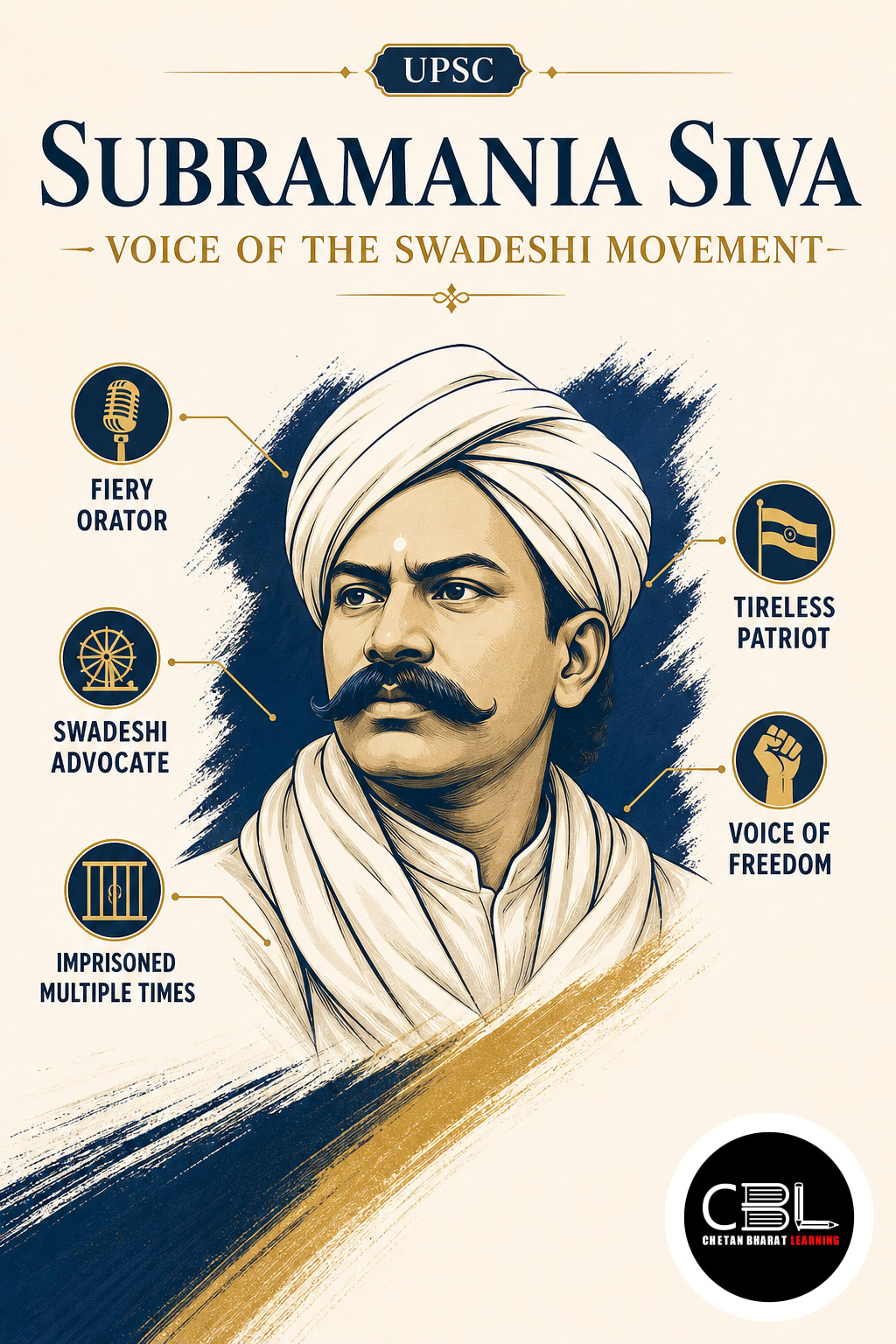
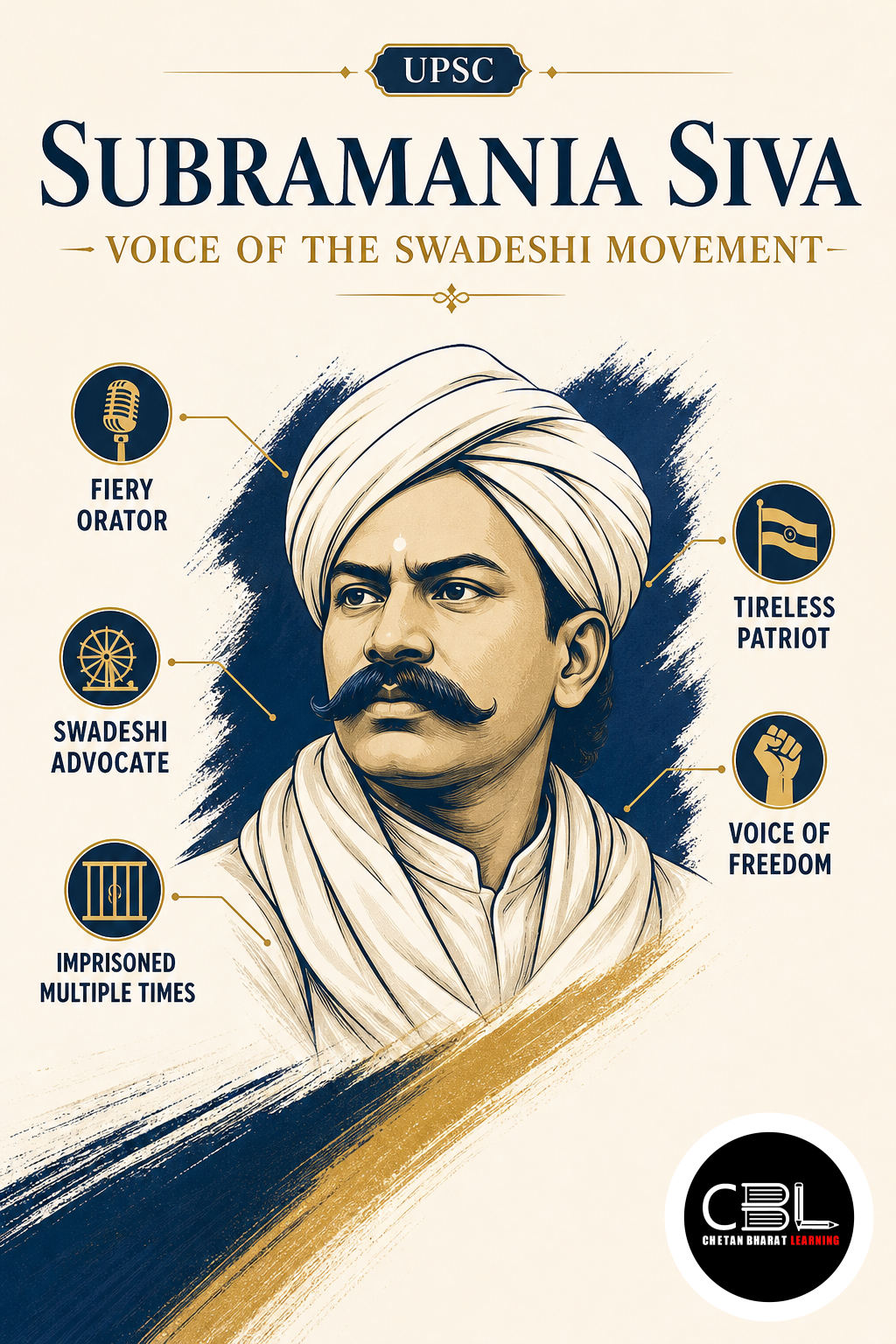
Siva was a nationalist orator, writer and organiser from the Madras Presidency. He brought ideas of Swaraj, boycott and indigenous enterprise to audiences beyond educated urban circles. His accessible Tamil speeches turned abstract political demands into questions of dignity, livelihood and collective responsibility; this method helped transform public meetings into spaces for political education and made nationalism meaningful to traders, workers and ordinary residents.
His political work became closely associated with V.O. Chidambaram Pillai during the Swadeshi upsurge in Tirunelveli and Tuticorin. Their speeches supported national enterprise and challenged colonial economic control, while Padmanabha Iyengar also joined important campaigns. Siva later continued his public work through writing, travel and institution-building despite imprisonment, poor health and official restrictions; his career illustrates how regional languages, print culture and local networks widened the geographical base of Indian nationalism.
Why is Subramania Siva in News?
Vice-President C.P. Radhakrishnan paid tribute on the freedom fighter’s birth anniversary on 4 October 2026. The commemoration highlighted his courage, patriotism and role in spreading the freedom movement across the Madras Presidency. The official recognition also followed floral tributes paid on his death anniversary in July 2026; readers can review the birth-anniversary coverage in the Akashvani report.
Such commemorations matter because national history often foregrounds major organisations while overlooking regional channels of mobilisation. Siva linked the Swadeshi movement with Tamil public culture, economic resistance and popular participation. His story also helps students connect the Surat-era nationalist divide, colonial sedition prosecutions and southern political awakening; the anniversary offers a timely opportunity to study how speeches, newspapers and personal sacrifice sustained opposition to imperial rule.
Key Features
- Powerful public oratory: He travelled widely and used direct Tamil speeches to explain freedom, self-respect and resistance to colonial authority.
- Swadeshi mobilisation: He encouraged indigenous enterprise, boycott and national consciousness alongside V.O. Chidambaram Pillai in southern Tamil districts.
- Tirunelveli action: He helped organise public meetings connected with Bipin Chandra Pal’s release, leading colonial officials to arrest nationalist leaders in March 1908.
- Political journalism: He used publications such as Gnanabhanu to circulate nationalist, spiritual and social ideas despite limited resources and surveillance.
- Enduring regional legacy: His memorial at Papparapatti preserves the memory of a leader who treated political awakening as sustained public service.
Challenges
- Criminalisation of dissent: Colonial authorities prosecuted speeches under restrictive laws, making peaceful nationalist advocacy personally dangerous and legally costly.
- Repeated incarceration: Prison terms interrupted organisation, damaged family life and reduced the continuity of campaigns across districts.
- Severe health burden: Harsh confinement worsened his health, yet official restrictions continued to obstruct travel and public engagement after release.
- Resource limitations: Nationalist journals and touring campaigns depended on modest finances, volunteer networks and uncertain distribution channels.
- Fragmented historical memory: Regional-language activists often receive limited space in national narratives, weakening public understanding of the movement’s diversity.
Way Forward
Public institutions should preserve manuscripts, periodicals, trial records and correspondence through careful conservation and accessible digitisation. Universities can support translations that retain historical meaning while opening Tamil sources to wider scholarship. Museums and curricula should present regional freedom movements within an integrated national framework, explaining connections among leaders, workers, traders and print networks; the Ministry of Culture’s freedom-fighter profile provides a useful starting point for evidence-based public learning.
Commemoration should move beyond ceremonial remembrance towards sustained historical engagement. Guided visits to Papparapatti, annotated editions of his writings and multilingual digital exhibitions can connect younger citizens with the period. Researchers should also examine how oratory, journalism and Swadeshi enterprise reinforced one another in local political practice; such work would place popular mobilisation at the centre of modern Indian history while preserving the complexity of Siva’s contribution.
Prelims Practice Corner
-
Q1. Subramania Siva was most closely associated with which nationalist leader during the Swadeshi movement in southern Tamil Nadu?
- (a) Gopal Krishna Gokhale
- (b) V.O. Chidambaram Pillai
- (c) Surendranath Banerjee
- (d) Khan Abdul Ghaffar Khan
Answer: (b) He worked closely with V.O. Chidambaram Pillai in Tirunelveli and Tuticorin.
-
Q2. The 1908 political mobilisation involving Siva was prominently linked to which region?
- (a) Champaran
- (b) Bardoli
- (c) Tirunelveli and Tuticorin
- (d) Chittagong
Answer: (c) His speeches and arrest became central to mobilisation in Tirunelveli and Tuticorin.
-
Q3. Which publication is associated with Siva’s journalistic work?
- (a) Gnanabhanu
- (b) Young India
- (c) Kesari
- (d) Al-Hilal
Answer: (a) Gnanabhanu carried his nationalist, spiritual and social writings.
-
Q4. Papparapatti, associated with Siva’s memorial, lies in which present-day state?
- (a) Kerala
- (b) Karnataka
- (c) Andhra Pradesh
- (d) Tamil Nadu
Answer: (d) Papparapatti is in Dharmapuri district of Tamil Nadu.
-
Q5. Consider the following statements: 1. Siva promoted nationalist ideas through public speaking. 2. He participated in Swadeshi-era mobilisation with V.O. Chidambaram Pillai. Which statement is correct?
- (a) 1 only
- (b) 2 only
- (c) Both 1 and 2
- (d) Neither 1 nor 2
Answer: (c) Both statements accurately describe his role in the freedom struggle.
Mains Practice Questions
-
Q1. Examine the role of regional oratory and journalism in expanding the Swadeshi movement in southern India. (250 words, 15 marks)
Answer Structure:
- Intro: Place the Swadeshi movement within the post-Partition of Bengal nationalist phase.
- Body: Discuss Tamil oratory, print networks, indigenous enterprise, Tirunelveli mobilisation and colonial repression.
- Conclusion: Show how regional communication converted national ideas into popular political participation.
-
Q2. Subramania Siva’s career reveals both the reach of nationalism and the coercive nature of colonial rule. Discuss. (150 words, 10 marks)
Answer Structure:
- Intro: Introduce him as a Tamil orator, writer and Swadeshi organiser.
- Body: Cover mass speeches, association with V.O.C., sedition prosecution, imprisonment and health consequences.
- Conclusion: Connect his sacrifice with the broader democratisation of India’s freedom struggle.
FAQs on Subramania Siva
- Why is he important in the Indian freedom struggle?
- He popularised Swadeshi, Swaraj and resistance through Tamil speeches and journalism. His work helped extend nationalist politics into southern towns and wider public life.
- What was his connection with V.O. Chidambaram Pillai?
- The two leaders worked together during Swadeshi mobilisation in Tirunelveli and Tuticorin. Siva’s oratory complemented Chidambaram Pillai’s organisational and economic initiatives.
- Where is his principal memorial located?
- Tamil Nadu maintains a memorial at Papparapatti in Dharmapuri district. The site recalls his later activities and the state’s continuing public commemoration of his legacy.
Related Current Affairs
Preparing for UPSC, PCS or HCS?
Talk to a mentor at Chetan Bharat Learning, Chandigarh. Free guidance on choosing the right exam and building a study plan.
Chat on WhatsAppCall 97793 53345UPSC / IAS / PCS coaching in Chandigarh · Trusted by aspirants across Punjab & Haryana
Leave a Reply
You must be logged in to post a comment.