

UPSC Mapping
Prelims
- Environment and Ecology
Mains
- GS Paper III: Biodiversity and Conservation
| Study Year | 2026 |
|---|---|
| Peak Level | Above 120 dB |
| Study Sample | 123 bird species |
| Region | South America |
Article
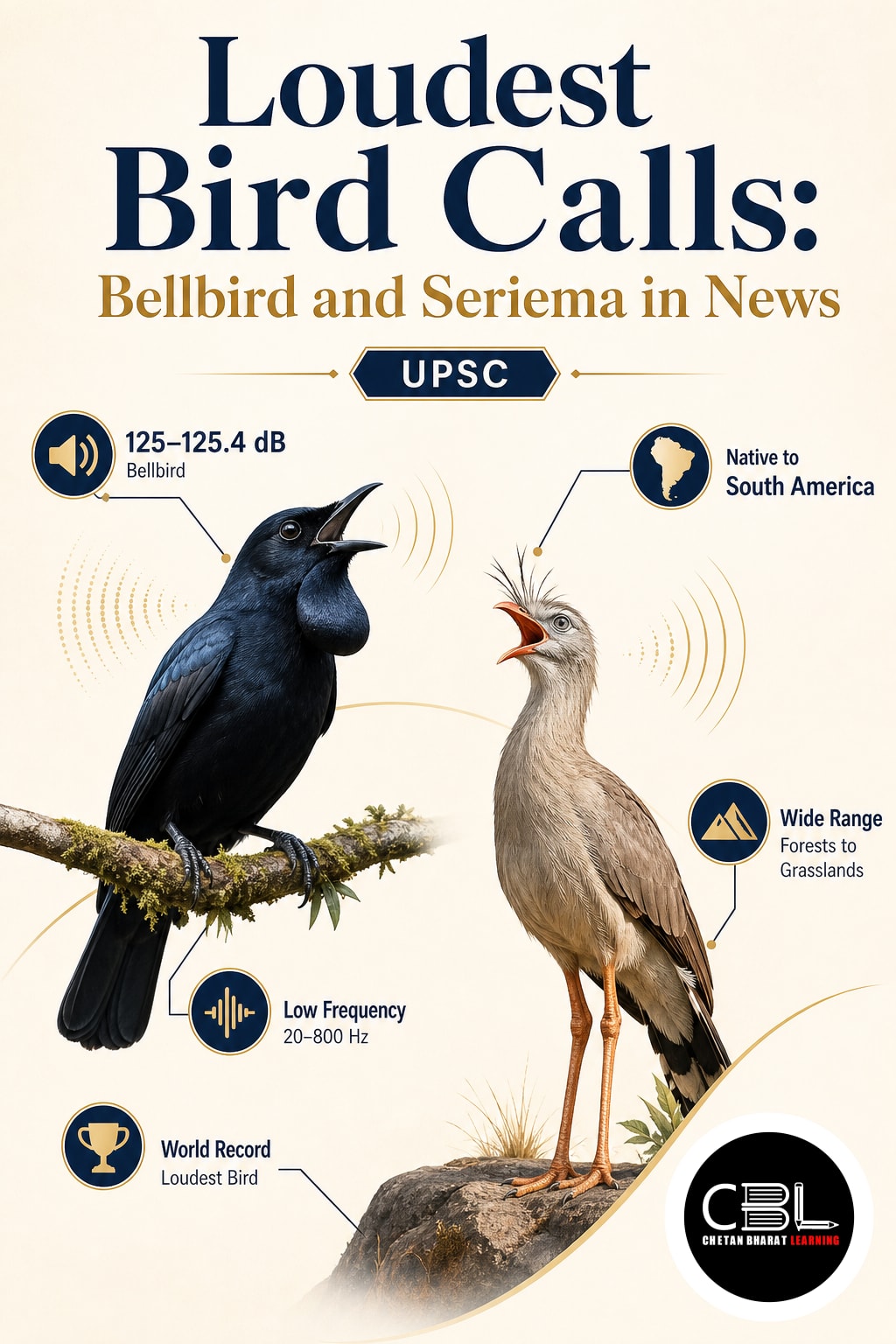
Loudest Bird Calls have placed two South American species under scientific scrutiny. The bare-throated bellbird and red-legged seriema now offer a useful case study in bioacoustics, evolution and conservation. Their contrasting lifestyles also show why comparative biology needs evidence from many species.
What are Loudest Bird Calls?
Loudest Bird Calls refer to avian vocalisations that produce exceptionally high sound pressure levels. Scientists compare them at a standard distance because amplitude falls as sound travels from its source. A decibel is a logarithmic unit, so modest numerical changes may represent large differences in acoustic intensity, while peak readings also differ from prolonged exposure, which matters when interpreting biological and human-hearing effects.
The bare-throated bellbird, Procnias nudicollis, is a fruit-eating forest bird of the Atlantic Forest. The red-legged seriema, Cariama cristata, is a tall terrestrial bird of grasslands and savannas across central and eastern South America. These calls serve communication rather than noise production alone; birds use them to attract mates, defend space or maintain contact across difficult terrain.
Why are Loudest Bird Calls in News?
A 2026 study in the journal Evolution identified both species as candidates for the world record. Researchers measured 123 species, including 113 without earlier amplitude records, and found a 58-decibel range across the sample. The lowest value was 64 dB at one metre in a hummingbird, while a cotinga reached 122 dB, and this wide spread created a stronger basis for testing evolutionary explanations than isolated record claims.
Both featured species produced peak measurements above 120 dB, placing them near the previously recognised white bellbird. The University of Massachusetts research report explains the field methods and the study’s evolutionary questions. Researchers did not declare an uncontested winner because readings depend on individuals, call types and recording conditions; the result chiefly expands the evidence base for avian communication rather than settling a popular ranking.
Key Features
- Bellbird vocal display: The male produces a metallic, hammer-like song from forest perches to advertise itself to potential mates.
- Seriema duet: The ground-dwelling bird gives penetrating calls that can carry across open grasslands and dry scrub.
- Standardised measurement: Researchers combined portable sound meters with laser rangefinders to correct amplitude for distance.
- Morphological association: Larger bodies and wider beak gapes generally correlated with higher maximum vocal amplitude across species.
- Ecological complexity: Habitat density, aerial mobility and mating system showed no unequivocal effect on maximum amplitude.
Birds generate sound through the syrinx, an organ located where the trachea divides into the bronchi. Respiratory muscles drive air through this structure, while membranes and surrounding tissues shape each vocalisation. Unlike the human larynx, the syrinx can control airflow near two bronchial passages, and this arrangement helps birds produce complex frequency patterns, although loudness still depends on the whole respiratory system.
Body size can support stronger airflow and larger sound-producing structures, yet anatomy does not act alone. Posture, call direction, display behaviour and the listener’s position also influence the recorded level. A bird may aim a display toward a nearby receiver, creating a much stronger reading along that path; scientists must therefore collect repeated observations before treating a maximum as representative of an entire species.
The bellbird and seriema make an instructive comparison because their ecologies differ sharply. One occupies forest canopies and eats fruit, while the other walks across open country and consumes insects and small vertebrates. As a frugivore, the bellbird can disperse seeds and contribute to forest regeneration, while the seriema functions as a terrestrial predator and belongs to Cariamiformes, an order linked with extinct terror birds.
The contrast weakens simple claims that one habitat or mating system automatically produces louder birds. It instead highlights convergent outcomes, where different evolutionary pathways may generate similarly powerful signals. Sexual selection may favour conspicuous male displays in bellbirds, while territorial or social communication may matter for seriemas; comparative analysis separates such possibilities from assumptions based on one remarkable observation.
Challenges
Extreme vocal amplitude creates scientific opportunities, but reliable interpretation requires careful sampling and habitat protection.
- Field variation: Distance, wind, vegetation, microphone direction and individual behaviour can alter measurements taken outside laboratories.
- Limited coverage: Thousands of bird species still lack comparable amplitude records, restricting broad evolutionary conclusions.
- Habitat loss: Forest clearance and fragmentation reduce suitable areas for the near-threatened bare-throated bellbird.
- Acoustic interference: Traffic, machinery and other human noise can mask signals and change animal communication behaviour.
- Public misunderstanding: Peak decibel values can mislead when reports omit distance, weighting, duration and measurement conditions.
Conservation status also demands a species-specific reading. BirdLife records the bare-throated bellbird as Near Threatened, while the red-legged seriema remains Least Concern because it retains a very large range. The bellbird depends on forest habitats across parts of Brazil, Paraguay and Argentina, while fragmentation can isolate feeding and breeding areas even where small forest patches remain.
A lower risk category does not remove the need for monitoring. Land conversion, fire regimes, hunting pressure and disturbance can affect local populations before global assessments register a major change. Scientists also need repeated surveys because absence from a recorder does not always prove local disappearance; weather, season and temporary silence can reduce acoustic detections.
Sound data can strengthen conventional surveys because automated recorders cover long periods and difficult terrain. Aspirants can connect this approach with broader themes in the daily current affairs archive, including biodiversity indicators and technology-assisted conservation. Yet recordings require trained classification, transparent metadata and safeguards against false identification; open reference libraries can improve verification and allow researchers to revisit older sound files as analytical methods advance.
Way Forward
Researchers should expand comparable sampling across continents, seasons, sexes and behavioural contexts. Common protocols for distance, frequency weighting and peak duration would make Loudest Bird Calls easier to compare without overstating record claims. Researchers should publish uncertainty ranges and raw contextual data wherever ethical and practical; such transparency would distinguish repeatable biological patterns from exceptional individual performances.
Conservation agencies should pair passive acoustic monitoring with field counts and habitat mapping. Protecting Atlantic Forest remnants, maintaining open-habitat mosaics and using the BirdLife species assessment can support evidence-based priorities for these ecologically distinct birds. Local communities can help protect feeding sites, reduce disturbance and report changes in seasonal presence; long-term cooperation should connect acoustic science with land-use planning, protected areas and restoration programmes.
Prelims Practice Corner
Q1. Which scientific name belongs to the bare-throated bellbird?
- (a) Cariama cristata
- (b) Procnias nudicollis
- (c) Procnias albus
- (d) Chunga burmeisteri
Answer: (b) Procnias nudicollis is the scientific name of the bare-throated bellbird.
Q2. The red-legged seriema is primarily associated with which habitat?
- (a) Polar tundra
- (b) Mangrove swamp
- (c) Grassland and savanna
- (d) Alpine meadow
Answer: (c) The species mainly inhabits open grasslands, savannas and dry scrub in South America.
Q3. Consider the following statements: 1. The syrinx is the principal vocal organ of birds. 2. A bird’s recorded sound amplitude remains unchanged with distance. Which is correct?
- (a) 1 only
- (b) 2 only
- (c) Both 1 and 2
- (d) Neither 1 nor 2
Answer: (a) The syrinx produces avian sounds, while measured amplitude declines as distance increases.
Q4. Which pairing correctly matches the species with its IUCN category?
- (a) Bellbird—Endangered; seriema—Vulnerable
- (b) Bellbird—Near Threatened; seriema—Least Concern
- (c) Bellbird—Least Concern; seriema—Endangered
- (d) Both—Critically Endangered
Answer: (b) BirdLife lists the bare-throated bellbird as Near Threatened and the seriema as Least Concern.
Q5. The 2026 comparative study found the clearest positive association between maximum vocal amplitude and:
- (a) Body size and beak gape
- (b) Migration distance
- (c) Nest colour
- (d) Egg number
Answer: (a) Larger body size and wider beak gape tended to accompany greater maximum amplitude.
Mains Practice Questions
Q1. Explain how bioacoustic research can improve biodiversity monitoring and conservation planning. (150 words, 10 marks)
Answer Structure
- Intro: Define bioacoustics and its relevance to detecting vocal species.
- Body: Cover passive monitoring, remote-area coverage, population trends, noise mapping and methodological limits.
- Conclusion: Recommend integrating sound records with field surveys and habitat data.
Q2. Distinct habitats can produce similarly extreme animal signals through different evolutionary pathways. Discuss with reference to the bellbird and seriema. (250 words, 15 marks)
Answer Structure
- Intro: Introduce convergent outcomes in acoustic communication.
- Body: Compare habitats, morphology, mating systems, vocal behaviour and the study’s inconclusive ecological predictors.
- Conclusion: Emphasise multi-factor research and species-specific conservation responses.
FAQs on Loudest Bird Calls
Which two birds crossed 120 dB in the 2026 study?
The bare-throated bellbird and red-legged seriema produced peak measurements above 120 dB. Researchers described both as candidates for the world’s loudest bird.
Why must researchers record the distance from a calling bird?
Sound pressure decreases as it travels from the source. Distance measurements let researchers standardise readings and compare species more fairly.
Do the two species share the same habitat?
No. The bellbird inhabits Atlantic Forest, while the seriema mainly uses open grasslands, savannas and scrub.
Related Current Affairs
Preparing for UPSC, PCS or HCS?
Talk to a mentor at Chetan Bharat Learning, Chandigarh. Free guidance on choosing the right exam and building a study plan.
Chat on WhatsAppCall 97793 53345UPSC / IAS / PCS coaching in Chandigarh · Trusted by aspirants across Punjab & Haryana
Leave a Reply
You must be logged in to post a comment.