
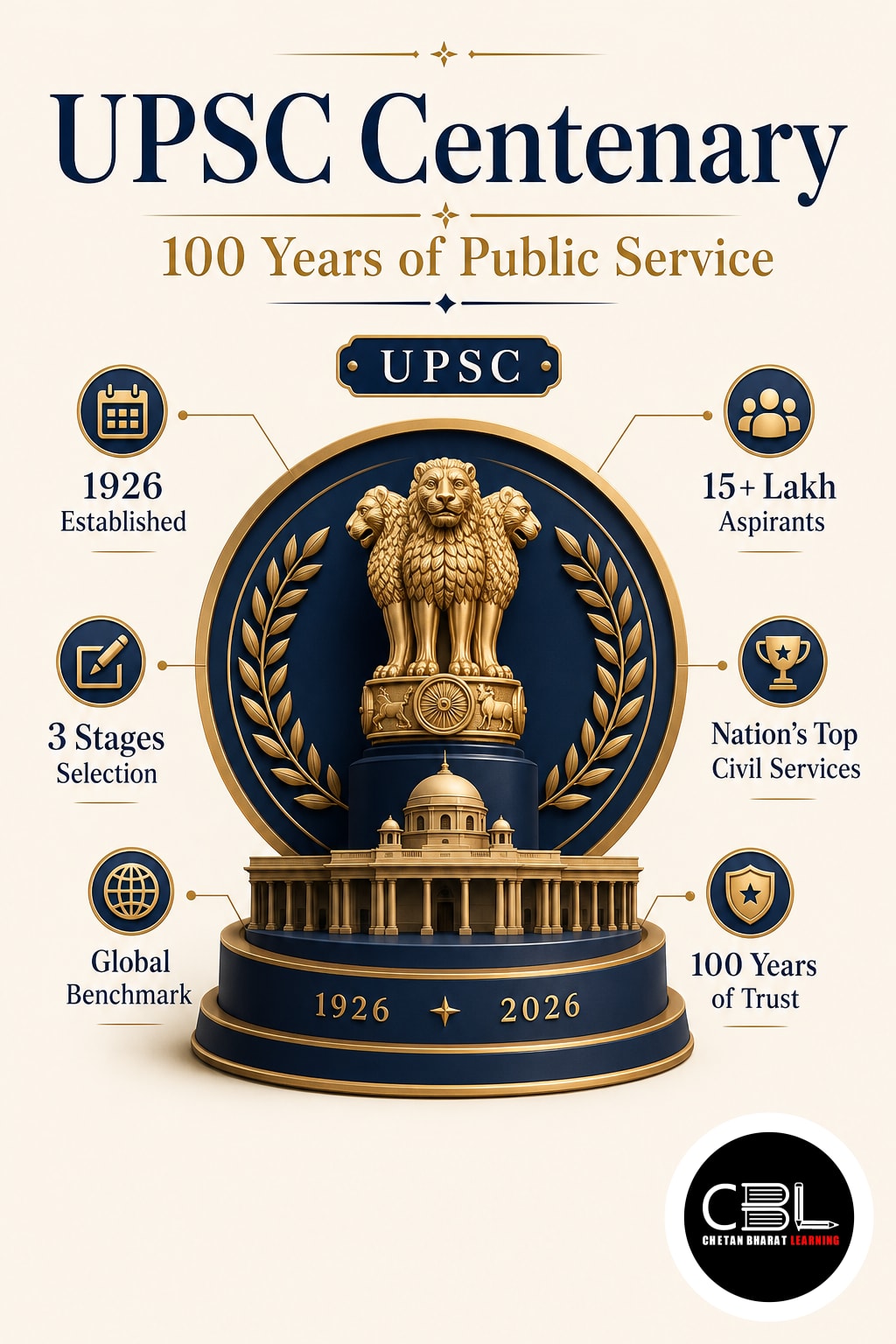

UPSC Mapping
Important for
| Exam | Topic |
|---|---|
| Prelims | Constitutional Bodies and Articles 315-323 |
| Mains | GS Paper II: Governance and Constitutional Bodies |
Quick Facts
| Established | 1 October 1926 |
| Constitutional Status | 26 January 1950 |
| Constitutional Part | Part XIV |
| Key Articles | Articles 315-323 |
| Centenary Event | Manthan, New Delhi |
What is UPSC Centenary?
The UPSC Centenary commemorates the institutional journey that began when India’s first Public Service Commission started functioning on 1 October 1926. Initially advisory under the Government of India Act, 1919, it represented an early attempt to separate recruitment from executive discretion, applying common standards across services and widening Indian participation.
After independence, the Constitution transformed it into the Union Public Service Commission on 26 January 1950 under Part XIV (Articles 315-323), granting functional safeguards and financial autonomy so recruitment advice remains insulated from political pressure while ensuring accountability through constitutional reporting.
Why is UPSC Centenary in News?
The Commission concluded its centenary with the two-day Shatabdi Samaroh-Manthan at Bharat Mandapam, New Delhi. Discussions on future-ready civil services, administrative innovation and constitutional values featured key functionaries. The Prime Minister released a commemorative coin, postage stamp and a volume on 100 landmark judgments affecting UPSC.
In its official announcement, UPSC emphasised trust, transparency and technology for the next century, linking examination reform with broader efforts to build ethical, citizen-focused institutions able to address development, security and regulatory challenges.
Key Features
- Constitutional foundation: Articles 315-319 establish UPSC’s composition, tenure and removal safeguards, limiting arbitrary executive interference.
- Broad mandate: Article 320 tasks UPSC with examinations, appointments, promotions, transfers, disciplinary advice and service-rule recommendations.
- Accountability: Under Article 323, UPSC submits an annual report to the President for placement before Parliament, allowing legislative scrutiny.
- Financial safeguard: UPSC expenses are charged on the Consolidated Fund of India, ensuring independence from annual appropriation uncertainties.
- Operational scale: About 250 recruitment processes annually across diverse services, coordinated through an 18-month-ahead examination calendar.
Challenges
- Fair assessment: Designing exams to test aptitude and reasoning without bias toward coaching access or regional disparities.
- Digital inclusion: Ensuring online processes are accessible despite connectivity gaps and digital-literacy barriers.
- Security and privacy: Balancing facial authentication and data analytics with robust cybersecurity, clear retention policies and human review mechanisms.
- Transparency expectations: Providing timely answer keys and grievance systems while safeguarding question security and confidentiality.
- Future-ready recruitment: Testing durable competencies for climate, AI and regulatory challenges without sacrificing neutrality or comparability.
Way Forward
In its second century, UPSC should reinforce independence while making recruitment transparent, accessible and responsive. Recommendations include expanded multilingual support, predictable timelines, structured grievance redress, technology audits for bias and privacy, and research on selection-to-performance correlation.
Provisional answer keys, randomised interview boards and inter-commission learning frameworks can deepen trust when consistently applied with clear deadlines and candidate feedback.
Prelims Practice Corner
-
Q1. The first Public Service Commission in India began functioning in:
- (a) 1919
- (b) 1926
- (c) 1935
- (d) 1950
Answer: (b) 1 October 1926.
-
Q2. Public Service Commissions are covered under which Part of the Constitution?
- (a) Part X
- (b) Part XII
- (c) Part XIV
- (d) Part XVI
Answer: (c) Part XIV.
-
Q3. Which Article primarily specifies the functions of Public Service Commissions?
- (a) Article 315
- (b) Article 320
- (c) Article 322
- (d) Article 323
Answer: (b) Article 320.
-
Q4. UPSC submits its annual report to the:
- (a) Prime Minister
- (b) Chief Justice of India
- (c) President
- (d) Lok Sabha Speaker
Answer: (c) President.
-
Q5. Which statement about UPSC expenditure is correct?
- (a) It is voted annually by Parliament
- (b) It is charged on the Consolidated Fund of India
- (c) It comes from the Contingency Fund
- (d) It is financed by State governments
Answer: (b) Charged on the Consolidated Fund of India.
Mains Practice Questions
-
Q1. Examine how the constitutional safeguards of UPSC support impartial and merit-based public recruitment in India. (250 words, 15 marks)
Answer Structure:
- Intro: UPSC as independent constitutional body under Part XIV.
- Body: Appointment/removal safeguards, financial autonomy, reporting duties, Article 320 mandate, advisory limits.
- Conclusion: Institutional independence underpins public trust and equal opportunity.
-
Q2. Technology can improve public recruitment only when accompanied by transparency and inclusion. Discuss. (150 words, 10 marks)
Answer Structure:
- Intro: Frame digital reform as efficiency tool, not end itself.
- Body: Authentication, answer keys, grievance portals, cybersecurity, privacy, accessibility, digital exclusion, independent audits.
- Conclusion: Technology must align with constitutional values and candidate-centred safeguards.
FAQs on UPSC Centenary
- When was the first Public Service Commission established in India?
- India’s first Public Service Commission began functioning on 1 October 1926. The Constitution later transformed it into UPSC from 26 January 1950.
- What marked the completion of one hundred years?
- The Manthan programme concluded the centenary celebrations at Bharat Mandapam in 2026, with a commemorative coin, postage stamp and compilation of landmark judgments released.
- Is UPSC limited to conducting the Civil Services Examination?
- No. UPSC conducts multiple recruitment processes and advises on appointments, promotions, service rules, disciplinary matters and induction into All-India Services.
Related Current Affairs
Preparing for UPSC, PCS or HCS?
Talk to a mentor at Chetan Bharat Learning, Chandigarh. Free guidance on choosing the right exam and building a study plan.
Chat on WhatsAppCall 97793 53345UPSC / IAS / PCS coaching in Chandigarh · Trusted by aspirants across Punjab & Haryana
Leave a Reply
You must be logged in to post a comment.