
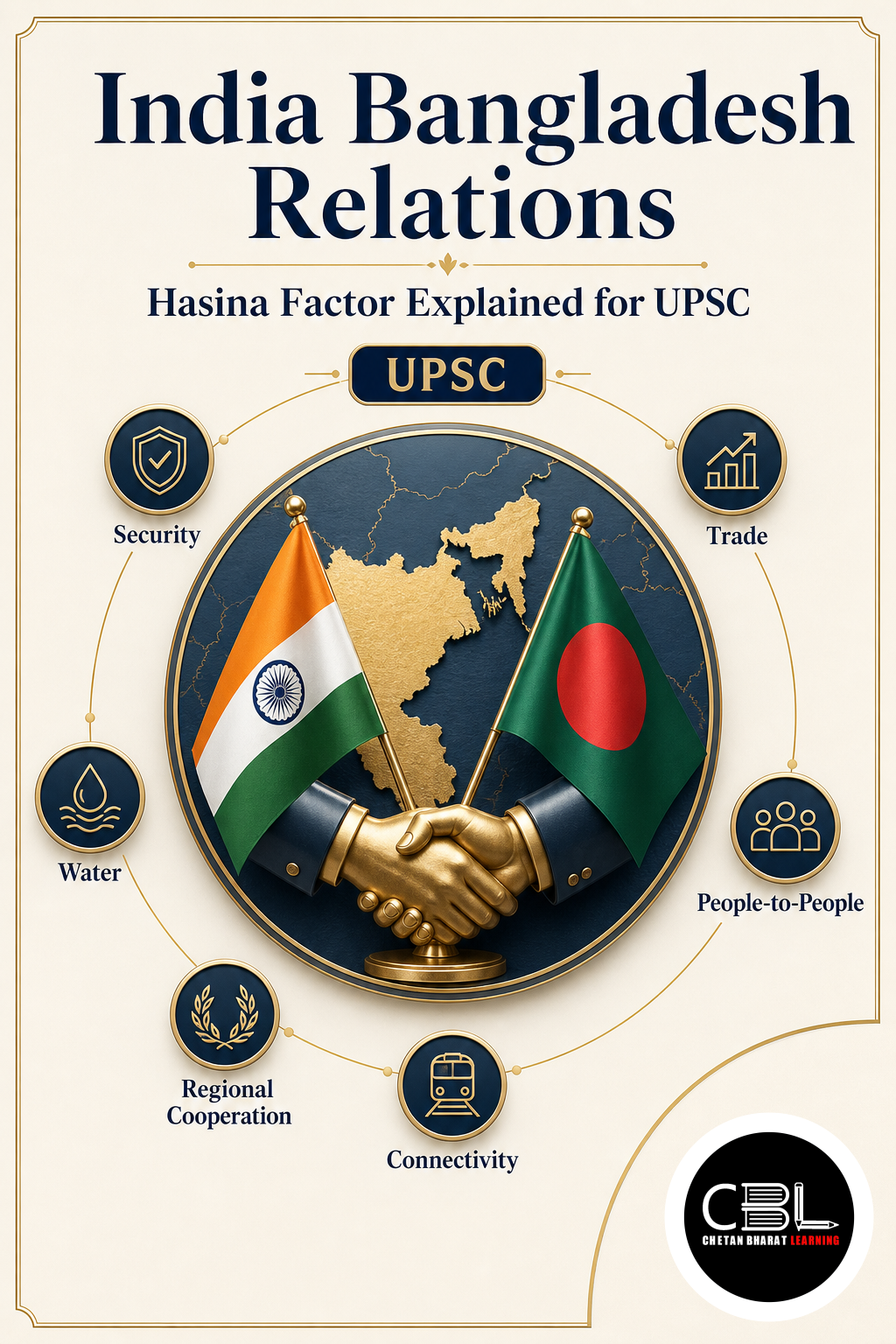

India Bangladesh Relations
India Bangladesh Relations is in focus after the passage highlighted the debate surrounding former Bangladesh Prime Minister Sheikh Hasina’s reported interest in returning to politics and its implications for bilateral ties. The article stresses that India’s engagement with Bangladesh should remain institutional and not depend on any single political leader or party.
Why in News?
Sheikh Hasina, currently residing in India after the political developments of 2024, expressed her desire to return to Bangladesh and re-enter politics. The report notes that political tensions have resurfaced, raising questions about the future trajectory of India-Bangladesh relations.
The key message highlighted by the passage is that bilateral relations should be built on long-term institutional cooperation rather than individual political personalities.
Background: Bangladesh Political Crisis (2024)
- Mass student-led protests intensified.
- Violent clashes occurred during the unrest.
- Sheikh Hasina resigned and left Bangladesh.
- An interim administration was formed.
- The passage mentions Nobel laureate Muhammad Yunus as heading the interim government.
- The report states that Sheikh Hasina announced her intention to return to politics.
Why is Bangladesh Important for India?
- Shared History: Deep historical, cultural and linguistic connections.
- Trade: An important economic partner.
- Security: Cooperation against cross-border crime and insurgency.
- Regional Stability: A stable Bangladesh contributes to peace in eastern India.
- Maritime Importance: Shared interests in the Bay of Bengal.
Strategic Importance of Bangladesh
- Geographical Significance: Gateway to India’s eastern and northeastern regions.
- Economic Importance: Important trade partner and transit route.
- Security Dimension: Counter-terrorism and border management.
- Maritime Significance: Central to the Bay of Bengal and the Indo-Pacific region.
India’s Longest Land Border
India shares its longest international land border with Bangladesh, extending for more than 4,000 kilometres. Several Indian states including West Bengal, Assam, Meghalaya, Tripura and Mizoram share boundaries with Bangladesh.
The border has significant implications for trade, migration, connectivity and cultural exchanges.
Bangladesh: Gateway to Northeast India
- Provides shorter routes and lowers transport costs.
- Improves road, rail, inland waterways and port connectivity.
- Facilitates implementation of India’s Act East Policy.
Importance of the Bay of Bengal
- Maritime Trade: Major sea communication routes.
- Blue Economy: Marine resources and fisheries.
- Regional Security: Maritime cooperation and disaster response.
- Indo-Pacific: Increasing strategic importance.
Security Cooperation
- Counter-terrorism and cross-border security.
- Joint efforts against smuggling and illegal trafficking.
- Countering fake currency and financial crimes.
- Intelligence sharing and coordinated operations.
Water Diplomacy
India and Bangladesh share several important transboundary rivers, including the Ganga, Teesta, Brahmaputra, Feni, Manu, Kushiara and others. Water sharing remains significant for agriculture, livelihoods and regional cooperation.
Why ‘Hasina-Proof’ Relations?
While governments may change, national interests remain constant. Therefore, bilateral diplomacy should remain institutional, stable and long-term instead of becoming dependent on individual leaders.
India’s Diplomatic Dilemma
The report explains that India has historically maintained close relations with Sheikh Hasina while simultaneously needing constructive engagement with any future government in Bangladesh. Balancing continuity with evolving political realities is identified as a major diplomatic challenge.
China’s Growing Presence
- Infrastructure investment.
- Roads, bridges and port development.
- Defence cooperation.
- Increasing economic engagement.
- Strategic implications for India’s security and the Indo-Pacific region.
UPSC Relevance
GS Paper II: International Relations, India’s Neighbourhood, Bilateral Relations and Regional Cooperation.
Prelims: India-Bangladesh border, Bay of Bengal, Act East Policy, shared rivers.
Mains: Neighbourhood First Policy, connectivity, regional security, water diplomacy and India’s strategic interests.
Prelims Practice
- Which country shares India’s longest international land border according to the passage? Answer: Bangladesh.
- Which major water body is central to India-Bangladesh maritime cooperation? Answer: Bay of Bengal.
- Which policy benefits from connectivity through Bangladesh? Answer: Act East Policy.
- Which type of cooperation is emphasised for border management? Answer: Counter-terrorism and coordinated security cooperation.
- According to the passage, India’s relations with Bangladesh should primarily be based on what principle? Answer: Institutional diplomacy rather than dependence on individual political leaders.
Mains Practice
Q1. Discuss the strategic importance of Bangladesh in India’s Neighbourhood First Policy.
Q2. Explain how connectivity, maritime cooperation and water diplomacy shape India-Bangladesh relations.
Related Current Affairs
Preparing for UPSC, PCS or HCS?
Talk to a mentor at Chetan Bharat Learning, Chandigarh. Free guidance on choosing the right exam and building a study plan.
Chat on WhatsAppCall 97793 53345UPSC / IAS / PCS coaching in Chandigarh · Trusted by aspirants across Punjab & Haryana
Leave a Reply
You must be logged in to post a comment.