
UPSC Mapping
- Prelims: Indian Economy and MSME Sector
- Mains: GS Paper III: Economy, Industry and Employment
Quick Facts
| Cabinet Approval | 6 October 2026 |
|---|---|
| Government Commitment | ₹10,000 crore |
| Investment Form | Direct equity |
| Fund Vehicle | Alternative Investment Fund framework |
Article
What is SME Growth Fund?
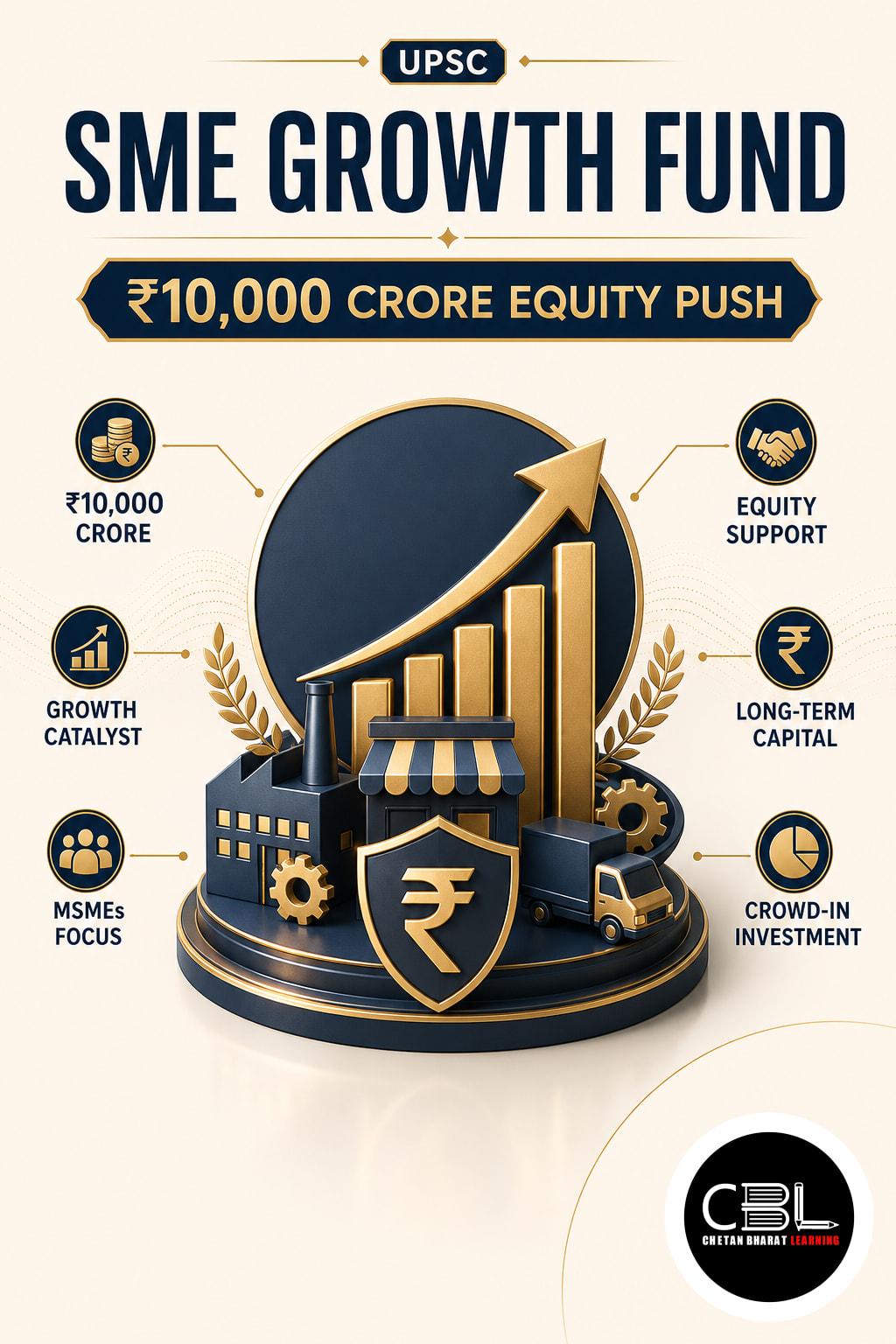
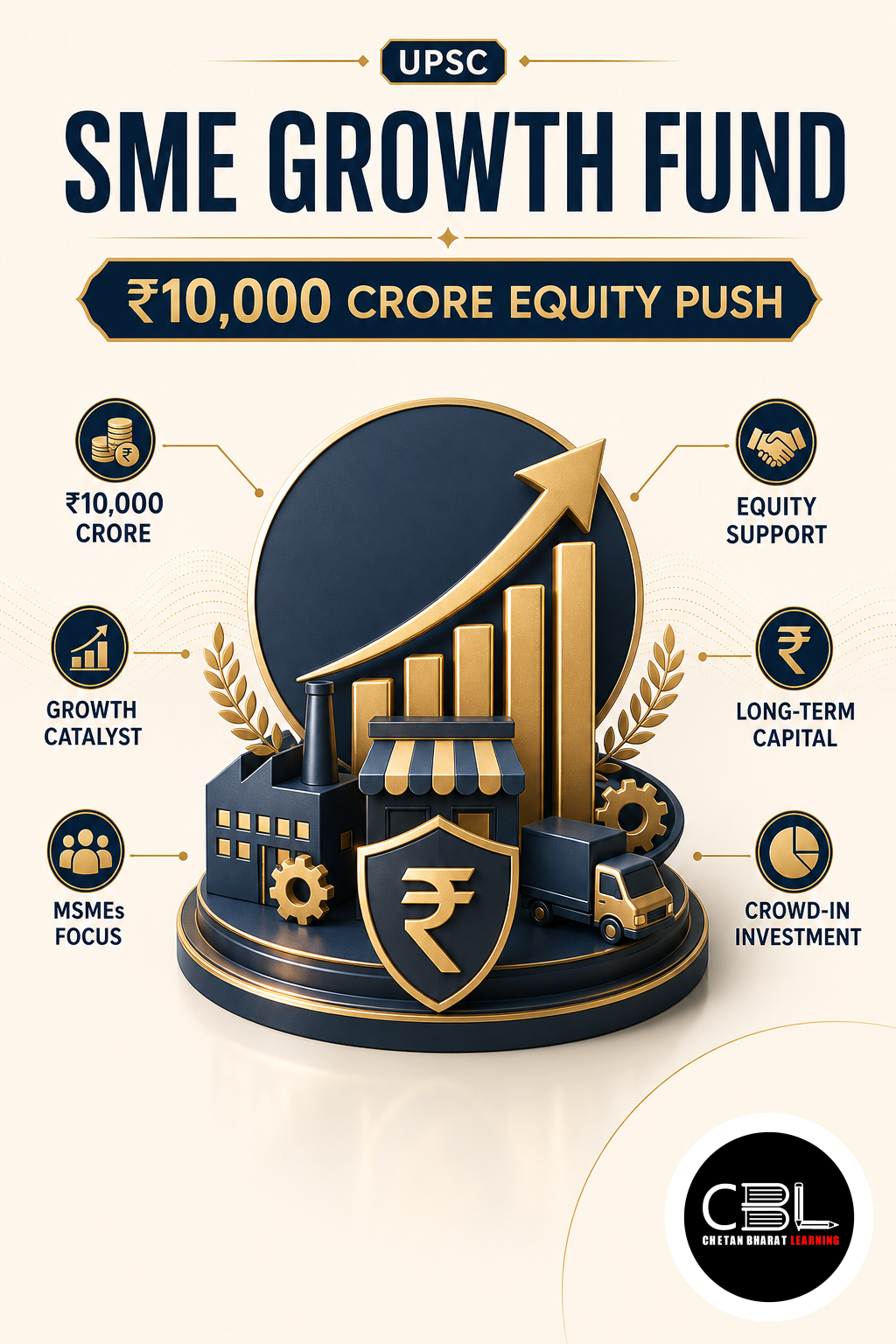
The SME Growth Fund is a government-backed initiative for direct equity investments in high-potential small and medium enterprises. It will provide patient growth capital to businesses showing commercial viability and the capacity to scale. Returns will therefore depend on enterprise performance rather than a pre-agreed lending schedule.
The government will commit an aggregate ₹10,000 crore to an Alternative Investment Fund established under the framework. Unlike a conventional loan, equity capital shares business risk and does not create fixed interest or instalment obligations. The design can attract additional investors if public commitment reduces perceived market risk.
Why is SME Growth Fund in News?
The Union Cabinet approved the government’s ₹10,000 crore commitment on 6 October 2026. The measure implements an announcement made under the Union Budget 2026-27 strategy for equity, liquidity and professional support to MSMEs. Cabinet approval converts the budget proposal into an authorised framework for subsequent implementation.
The Cabinet announcement identifies a structural shortage of long-term equity for growth-stage SMEs. Existing funds often concentrate on early-stage ventures and micro enterprises, leaving scalable small and medium firms with a financing gap. This middle segment often needs larger investments and longer holding periods than start-up finance provides.
Key Features
- Patient equity: The fund will provide long-term risk capital instead of adding another fixed repayment burden.
- Viability-based selection: High-potential SMEs must demonstrate a workable business model and credible scalability.
- Manufacturing priority: A majority allocation will support small and medium manufacturing-focused enterprises.
- Regional reach: The SME Growth Fund will consider industrial clusters located in Tier-II and Tier-III cities.
- Growth uses: Capital may support technology adoption, capacity expansion, acquisitions, exports and strategic investments.
Challenges
- Selection risk: Fund managers must identify scalable firms without favouring only established or well-connected applicants.
- Information gaps: Weak accounts, informal practices and limited disclosures can complicate fair enterprise valuation.
- Regional imbalance: Better-advised firms in large cities may capture capital unless outreach reaches smaller industrial clusters.
- Governance concerns: Publicly supported equity requires transparent criteria, conflict safeguards and independent performance monitoring.
- Exit pressure: Commercial return timelines may conflict with the patient capital needed for technology-intensive manufacturing.
Way Forward
Authorities should publish detailed eligibility, appraisal, governance and exit rules before investments begin. The SME Growth Fund needs measurable indicators covering additional private capital, productivity, exports, quality employment, regional distribution and enterprise survival. Baseline data should be captured before funding so later impact claims remain verifiable.
Fund managers should coordinate with credit platforms, cluster institutions and professional bodies while preserving independent investment decisions. Regular disclosures and outcome evaluations, supported by official policy factsheets, can align commercial discipline with inclusive industrial development. Parliamentary and public scrutiny should focus on additionality, not merely amounts invested.
Prelims Practice Corner
Q1. What is the approved Government of India commitment for the fund?
- (a) ₹2,000 crore
- (b) ₹5,000 crore
- (c) ₹10,000 crore
- (d) ₹25,000 crore
Answer: (c) The Union Cabinet approved an aggregate government commitment of ₹10,000 crore.
Q2. The fund will operate through which investment framework?
- (a) Alternative Investment Fund
- (b) Consolidated Sinking Fund
- (c) Deposit Insurance Fund
- (d) National Investment Fund
Answer: (a) The direct equity vehicle will operate as an Alternative Investment Fund under the framework.
Q3. Which group will receive the majority allocation under the announced strategic focus?
- (a) Micro trading firms
- (b) Large listed companies
- (c) Manufacturing-focused SMEs
- (d) Foreign sovereign funds
Answer: (c) A majority allocation is intended for small and medium manufacturing-focused enterprises.
Q4. Under the criteria effective from April 2025, what is the turnover ceiling for a small enterprise?
- (a) ₹50 crore
- (b) ₹100 crore
- (c) ₹250 crore
- (d) ₹500 crore
Answer: (b) A small enterprise has an annual turnover ceiling of ₹100 crore.
Q5. Which statement best distinguishes patient equity from a conventional term loan?
- (a) It requires monthly interest only
- (b) It creates no ownership interest
- (c) It shares business risk without fixed instalments
- (d) It is available only for exports
Answer: (c) Equity investors share business risk and do not impose fixed loan instalments.
Mains Practice Questions
Q1. How can patient equity capital address the financing constraints faced by growth-stage Indian SMEs? (150 words, 10 marks)
Answer Structure:
- Intro: Distinguish long-term equity from conventional collateral-based debt.
- Body: Cover risk sharing, technology adoption, capacity expansion, exports, governance benefits and possible ownership dilution.
- Conclusion: Link transparent equity support with productive and employment-intensive scale-up.
Q2. Evaluate the potential and implementation challenges of India’s ₹10,000 crore equity initiative for small and medium enterprises. (250 words, 15 marks)
Answer Structure:
- Intro: Place the initiative within the Union Budget’s three-pronged MSME strategy.
- Body: Examine manufacturing, exports, clusters and jobs alongside selection, valuation, governance, access and exit risks.
- Conclusion: Recommend independent management, public disclosures and outcome-based evaluation.
FAQs on SME Growth Fund
Is the initiative a loan scheme?
No. It is designed for direct equity investment through an AIF framework rather than conventional fixed-repayment lending.
Which enterprises will receive priority?
High-potential small and medium firms with demonstrated viability and scalability are the target. Manufacturing-focused enterprises will receive a majority allocation.
How can the fund support Tier-II and Tier-III cities?
It can invest in SMEs operating within industrial clusters in smaller cities. Such investment may strengthen local supply chains, regional industry and quality employment.
Related Current Affairs
Preparing for UPSC, PCS or HCS?
Talk to a mentor at Chetan Bharat Learning, Chandigarh. Free guidance on choosing the right exam and building a study plan.
Chat on WhatsAppCall 97793 53345UPSC / IAS / PCS coaching in Chandigarh · Trusted by aspirants across Punjab & Haryana
Leave a Reply
You must be logged in to post a comment.