

UPSC Mapping
| Prelims | Indian Economy, UPI and digital payments |
|---|---|
| Mains | GS Paper III – Indian Economy |
Quick Facts
| Payment System | UPI |
|---|---|
| Network Institution | NPCI |
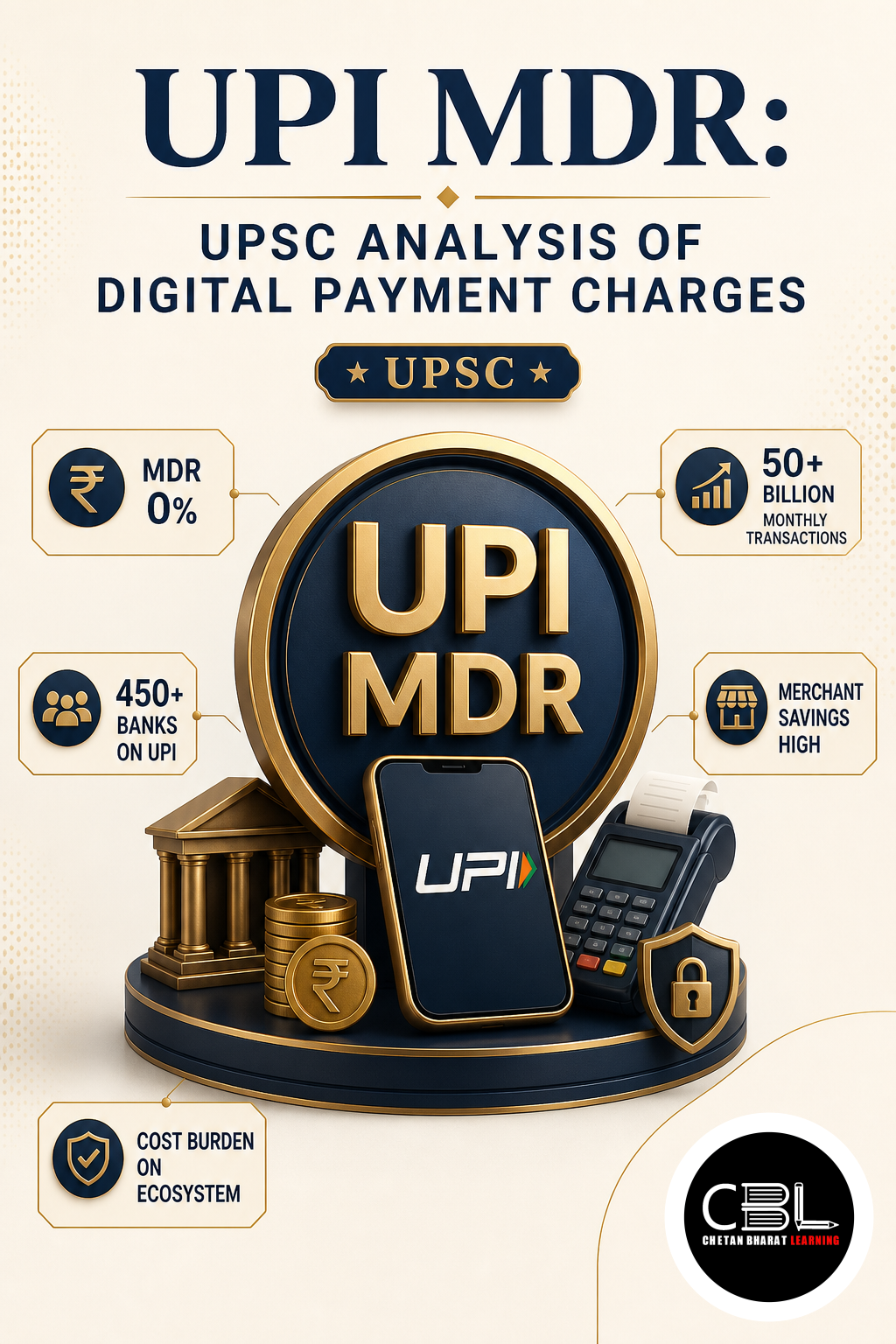
| Current Model | Zero MDR for most UPI transactions |
| Bill in Focus | Taxation Laws (Amendment) Bill, 2026 |
Article
UPI MDR has entered the policy debate as Parliament considers changes concerning charges on specified digital-payment transactions. The issue matters because India’s Unified Payments Interface has grown into a major part of everyday payments, while the existing zero-MDR model has supported widespread adoption. The supplied material focuses on the distinction between merchant discount rate, taxation and payment-system sustainability, making it relevant for UPSC Economy and digital public infrastructure. For wider revision, aspirants can use the current affairs archive to connect this issue with digital economy and financial inclusion topics.
What is UPI MDR?
UPI MDR refers to the merchant discount rate associated with processing a digital payment. In a payment ecosystem, the charge can involve the merchant, banks, payment-system participants and other service providers that support transaction processing.
An MDR is a payment-processing charge connected with the functioning of the payment ecosystem, whereas a tax is a compulsory levy imposed by the government. This distinction is important for both conceptual clarity and UPSC Prelims.
Why is UPI MDR in News?
The Lok Sabha cleared the Taxation Laws (Amendment) Bill, 2026, with provisions concerning the legal framework for charges connected with specified digital-payment transactions. The proposed framework creates a legal pathway for levying MDR or related charges in specified circumstances rather than automatically imposing a charge on every UPI transaction.
The debate is significant because UPI has generally operated with zero MDR for most transactions. This model has helped keep digital payments accessible to consumers and merchants, while the growing payment ecosystem also requires sustainable infrastructure, technology, security and innovation.
Key Features
- Unified payment interface: UPI enables interoperable digital payments across participating banks and payment applications.
- Merchant discount rate: MDR represents a processing charge within the payment ecosystem and should not be treated as a government tax.
- Zero-MDR model: UPI has remained free for consumers and generally operated with zero MDR for most transactions.
- Specified transactions: The proposed framework concerns identified digital-payment transactions and does not automatically make every UPI payment chargeable.
- Consumer protection: The policy debate must balance ecosystem sustainability with affordability, accessibility and continued digital-payment adoption.
UPI supports several transaction relationships. Person-to-person payments transfer funds between individuals, while person-to-merchant payments involve a customer paying a business. The distinction matters because merchant transactions directly connect payment costs with the economics of businesses.
Challenges
- Affordability: New payment charges could affect the cost structure of merchants, particularly where margins are narrow.
- Small-merchant impact: Smaller businesses may have less capacity to absorb additional transaction costs than larger merchants.
- Digital inclusion: Cost increases should not weaken the accessibility that helped digital payments expand across diverse user groups.
- Ecosystem sustainability: Payment infrastructure requires investment in technology, cybersecurity, settlement systems and customer support.
- Policy calibration: The design of any charge needs clarity about eligible transactions, rates, incidence and safeguards against unintended effects.
The central challenge is to avoid treating accessibility and sustainability as mutually exclusive goals. A carefully designed framework should preserve the network effects created by widespread UPI adoption while ensuring that the ecosystem can finance innovation and resilience.
Way Forward
The policy approach should prioritise financial inclusion and payment-system sustainability together. Any charge should be calibrated carefully, with clear rules on which transactions are covered and how the burden is distributed among merchants, payment participants and other stakeholders.
Policy design should also protect the strengths of UPI: interoperability, ease of use, fast settlement and broad accessibility. Continued investment in cybersecurity, reliability and innovation can strengthen the system without undermining the consumer-friendly character that supported its expansion.
For UPSC preparation, the broader lesson is that digital public infrastructure involves more than building a technology platform. Policymakers must also design sustainable economic models, maintain trust, protect users and ensure that innovation remains accessible to citizens and businesses.
Prelims Practice Corner
- Q1. Consider the following statements about UPI MDR:
- (a) MDR is a compulsory tax imposed by the government
- (b) MDR is a payment-processing charge in the digital-payment ecosystem
- (c) MDR applies only to cash transactions
- (d) MDR is unrelated to merchants
Answer: (b) MDR is a payment-processing charge and should be distinguished from a government tax.
- Q2. Which institution is associated with the operation of India’s UPI infrastructure?
- (a) NPCI
- (b) SEBI alone
- (c) NITI Aayog alone
- (d) Election Commission of India
Answer: (a) NPCI. The National Payments Corporation of India operates the UPI platform within India’s payment ecosystem.
- Q3. Which of the following best describes a P2P UPI transaction?
- (a) Payment from one individual to another individual
- (b) Payment from a government to a bank
- (c) Payment from a merchant to a stock exchange
- (d) Payment made only through cash
Answer: (a) P2P means person-to-person, involving a payment between individuals.
- Q4. Why is the distinction between MDR and tax important?
- (a) They are identical concepts
- (b) MDR is a processing charge, while tax is a compulsory government levy
- (c) Tax is charged only by merchants
- (d) MDR is a constitutional tax
Answer: (b) The two have different economic and legal meanings.
- Q5. The policy debate around UPI charges primarily requires balancing which two objectives?
- (a) Accessibility and sustainability
- (b) Cash and barter
- (c) Imports and monsoon rainfall
- (d) Inflation and population census
Answer: (a) The supplied material emphasises maintaining accessibility while ensuring a sustainable digital-payment ecosystem.
Mains Practice Questions
-
Q1. Explain the significance of UPI for India’s digital economy and discuss the policy concerns surrounding merchant charges. (10 marks)
Answer Structure:
- Intro: Define UPI as an interoperable digital-payment infrastructure and identify its role in India’s digital economy.
- Body: Cover financial inclusion, merchant adoption, reduced dependence on cash, network effects, payment infrastructure costs, MDR, affordability and ecosystem sustainability.
- Conclusion: Emphasise calibrated policy that preserves accessibility while supporting a resilient payment ecosystem.
-
Q2. Digital public infrastructure must remain both accessible and financially sustainable. Examine this statement in the context of UPI. (15 marks)
Answer Structure:
- Intro: Introduce UPI as a major component of India’s digital public infrastructure.
- Body: Discuss accessibility, zero-MDR adoption, consumer benefits, merchant economics, infrastructure expenditure, cybersecurity, innovation, stakeholder incentives and policy calibration.
- Conclusion: Recommend a sustainable model that protects affordability and preserves trust in India’s digital payment architecture.
FAQs on UPI MDR
-
What is UPI MDR?
UPI MDR refers to the merchant discount rate associated with processing a digital payment. It is a payment-processing charge and should not be confused with a government tax.
-
Does UPI MDR mean every UPI transaction will become chargeable?
No. The proposed framework creates a legal pathway for charges on specified digital-payment transactions. It does not automatically make every UPI transaction chargeable.
-
Why is UPI important for the Indian economy?
UPI supports fast, interoperable digital payments involving consumers, merchants, banks and technology providers. Its importance extends to financial inclusion, reduced dependence on cash and the development of India’s digital public infrastructure.
Related Current Affairs
Preparing for UPSC, PCS or HCS?
Talk to a mentor at Chetan Bharat Learning, Chandigarh. Free guidance on choosing the right exam and building a study plan.
Chat on WhatsAppCall 97793 53345UPSC / IAS / PCS coaching in Chandigarh · Trusted by aspirants across Punjab & Haryana
Leave a Reply
You must be logged in to post a comment.