
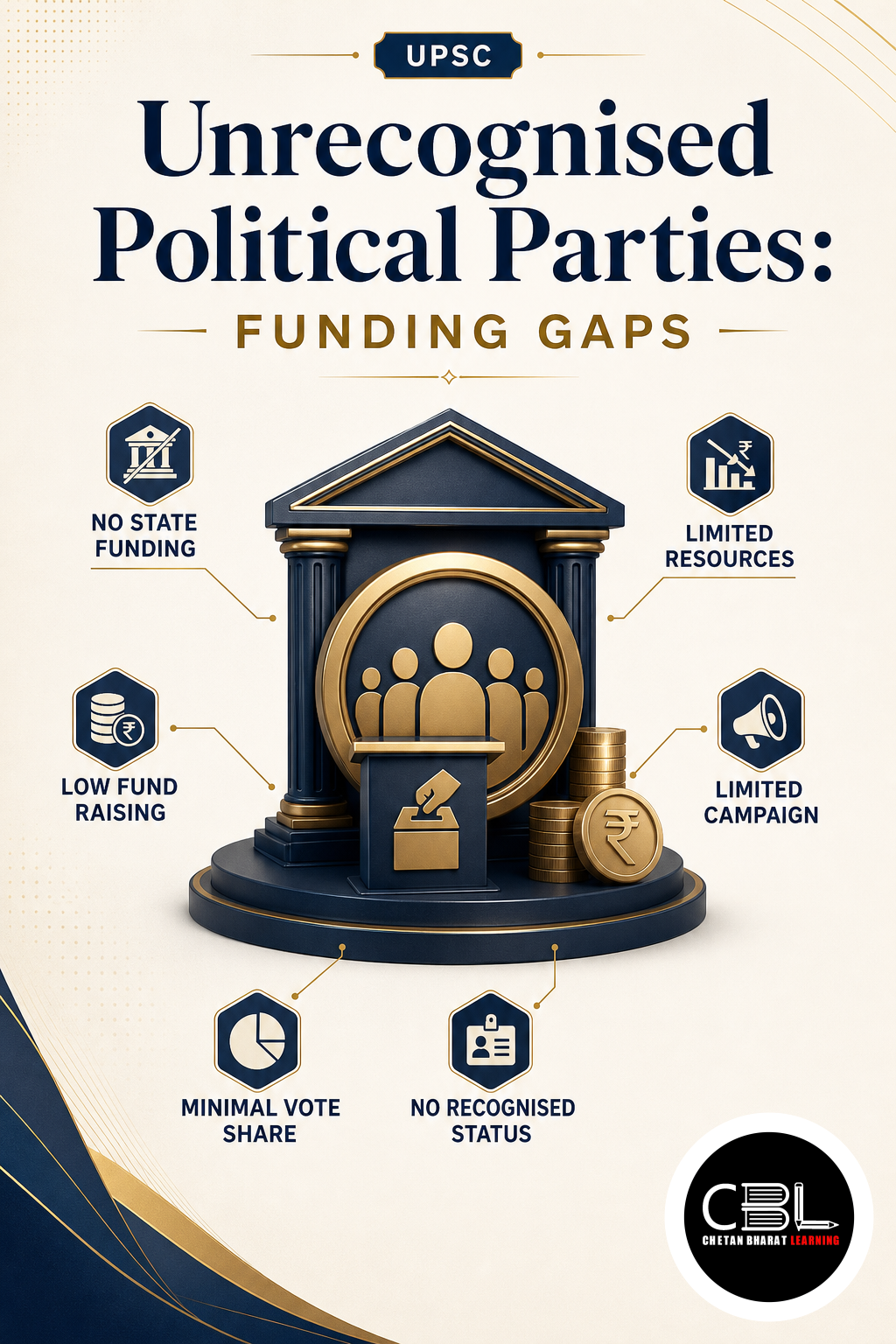

Unrecognised Political Parties have returned to scrutiny after reports of exceptionally large donations to six Gujarat-based organisations. Their limited electoral activity contrasted sharply with their declared funding, renewing concerns about financial transparency and regulatory enforcement. The issue links party registration, tax treatment and electoral integrity, themes covered in the polity current affairs section.
| Important for | |
|---|---|
| Prelims | RPA 1951, ECI and Political Party Registration |
| Mains | GS Paper II: Electoral Reforms and Governance |
| Quick Facts | Details |
|---|---|
| Registration Law | Section 29A, RPA 1951 |
| Registering Authority | Election Commission of India |
| Disclosure Provision | Section 29C, RPA 1951 |
| Key Judgment | INC v Institute of Social Welfare, 2002 |
What are Unrecognised Political Parties?
Unrecognised Political Parties are organisations registered with the Election Commission under Section 29A of the Representation of the People Act, 1951. They have not satisfied the electoral performance criteria required for recognition as a national or state party. Registration and recognition are therefore separate legal stages with different conditions and privileges.
A registered party must affirm allegiance to the Constitution and the principles specified by law. Registration can facilitate regulated political participation, access to a common symbol under applicable conditions and a larger list of star campaigners than an unregistered association. It can also support tax-related benefits when the party follows reporting, audit and payment rules.
Why are Unrecognised Political Parties in News?
A media investigation reported that six Gujarat-based registered parties received about ₹1,700 crore in donations during 2023-24. The same report stated that they fielded only 15 candidates collectively in the 2024 Lok Sabha election. The figures, drawn from election disclosures and watchdog data, appear in this political funding report.
The scale of funding does not itself prove illegality, and regulators must establish wrongdoing through evidence and due process. Yet large receipts combined with weak public activity, unavailable reports or doubtful office details create legitimate compliance questions. The episode has intensified demands for donor traceability, timely disclosures and stronger coordination between election and tax authorities.
Key Features
The legal framework seeks to encourage political participation while imposing minimum financial accountability on registered organisations.
- Statutory registration: Section 29A authorises the Election Commission to register eligible associations that submit prescribed documents and constitutional commitments.
- Separate recognition: National or state recognition depends on vote and seat criteria under the Election Symbols Order, not registration alone.
- Donation disclosure: Section 29C requires parties to report contributions above the prescribed threshold and links compliance with tax exemption.
- Non-cash requirement: Political parties must receive donations exceeding ₹2,000 through banking or other permitted non-cash modes.
- Campaign facilities: Eligible registered parties may seek a common symbol and nominate up to twenty star campaigners under applicable election rules.
The system intentionally leaves space for small and emerging parties that lack immediate electoral success. New organisations may represent regional concerns, marginalised groups or policy positions ignored by established competitors. Any reform must therefore distinguish a genuinely developing party from a paper entity created mainly for financial misuse.
Political finance rules operate across several statutes and institutions. The Election Commission receives party filings, while tax authorities examine exemptions, deductions and suspicious transactions. Banks, auditors and enforcement agencies may hold additional evidence needed to establish whether declared donations reflect genuine political support.
Public disclosure performs a democratic function beyond routine accounting compliance. Voters can examine whether funding patterns appear consistent with a party’s stated activity, candidates and geographic presence. Timely publication also allows journalists and civil-society organisations to identify anomalies for lawful regulatory examination.
Challenges
The central challenge is closing opportunities for abuse without restricting political association or unfairly favouring established parties.
- Limited deregistration power: The Representation of the People Act gives the Election Commission no broad authority to cancel registration for inactivity or routine non-compliance.
- Paper-party problem: Organisations may retain registration despite little visible activity by contesting occasional seats or maintaining only formal records.
- Fragmented oversight: Election disclosures, income-tax returns, audit statements and banking data sit with different authorities and may not receive coordinated scrutiny.
- Weak public access: Missing, delayed or poorly searchable reports prevent voters, journalists and researchers from assessing donors, expenditure and organisational activity.
- Risk of overcorrection: Deregistration based only on electoral defeat could suppress genuine small parties and reduce democratic competition.
In Indian National Congress v Institute of Social Welfare, the Supreme Court held that the Commission lacks a general review power after registration. Cancellation remains possible in narrow situations, including registration obtained through fraud, loss of the required constitutional allegiance or a government declaration that the organisation is unlawful. This judgment protects quasi-judicial finality but exposes a statutory enforcement gap.
Administrative delisting exercises can remove parties that cannot be located at their registered addresses from an operational list. Delisting does not automatically create the same legal consequence as statutory deregistration in every situation. Aspirants can follow related reform debates through the daily current affairs archive.
Compliance design also creates incentives that parties may satisfy formally without demonstrating meaningful democratic activity. A token candidacy can show election participation while revealing little about internal elections, membership or public programmes. Regulators need objective indicators that capture organisational reality without judging a party’s ideology or popularity.
Data quality remains crucial because similar party names, changing addresses and delayed filings can produce mistaken conclusions. Authorities should verify identities and reconcile reporting periods before alleging diversion or tax abuse. Consistent filing formats would make cross-checking faster and reduce arbitrary enforcement against compliant smaller organisations.
Way Forward
Parliament should create clear statutory grounds and procedures for deregistration, supported by notice, evidence, a hearing and judicial review. The framework could target prolonged inactivity, fraudulent filings and repeated failure to submit mandatory reports rather than mere electoral defeat. The Law Commission’s electoral reform report recommended action where a party fails to contest parliamentary or assembly elections for ten consecutive years.
Authorities should create interoperable digital checks across election filings, tax returns and verified bank transactions. Public dashboards should display audited accounts, contribution reports, election participation and compliance status in accessible formats. Risk-based scrutiny, proportionate penalties and transparent appeals can deter shell operations while preserving genuine political pluralism among Unrecognised Political Parties.
Prelims Practice Corner
Q1. Political parties register with the Election Commission under which provision?
- (a) Section 8 of the RPA 1951
- (b) Section 29A of the RPA 1951
- (c) Article 324 only
- (d) Tenth Schedule
Answer: (b) Section 29A provides the statutory framework for registering political parties.
Q2. Registration and recognition of a political party are best understood as what?
- (a) Identical legal statuses
- (b) Separate processes with different conditions
- (c) Powers exercised only by Parliament
- (d) Judicial functions of High Courts
Answer: (b) Registration occurs under the RPA, while recognition depends on electoral performance criteria.
Q3. Section 29C of the Representation of the People Act primarily concerns which matter?
- (a) Candidate disqualification
- (b) Contribution reporting
- (c) Constituency delimitation
- (d) Election petition trials
Answer: (b) Section 29C deals with declarations concerning contributions received by political parties.
Q4. The Supreme Court’s 2002 ruling on party deregistration established which principle?
- (a) The ECI has unlimited cancellation power
- (b) Only Parliament may register parties
- (c) The ECI lacks general deregistration power except in narrow cases
- (d) Every inactive party automatically loses registration
Answer: (c) The Court recognised limited exceptions but rejected a broad review power.
Q5. Which reform would most directly address repeated non-filing by registered parties?
- (a) Abolishing party registration
- (b) Clear statutory penalties and due-process deregistration
- (c) Removing all donation disclosures
- (d) Granting automatic national status
Answer: (b) Defined penalties and hearing-based deregistration would strengthen compliance without arbitrary action.
Mains Practice Questions
Q1. Examine the legal and institutional gaps governing the registration, funding and deregistration of political parties in India. (250 words, 15 marks)
Answer Structure:
- Intro: Distinguish registration under Section 29A from recognition based on electoral performance.
- Body: Cover disclosures, tax oversight, limited deregistration power, fragmented enforcement, transparency and safeguards for small parties.
- Conclusion: Recommend statutory reform combining due process with stronger financial accountability.
Q2. Political finance reform must deter shell entities without restricting democratic pluralism. Discuss. (150 words, 10 marks)
Answer Structure:
- Intro: Frame the tension between open political participation and prevention of financial misuse.
- Body: Analyse disclosure gaps, token participation, proportional penalties, digital scrutiny, hearings and appeal safeguards.
- Conclusion: Support transparent and neutral regulation based on conduct rather than ideology or electoral success.
FAQs on Unrecognised Political Parties
What does registered but unrecognised mean?
The Election Commission has registered the organisation under Section 29A. It has not met the electoral performance requirements for national or state recognition.
Can the Election Commission deregister any inactive party?
No general statutory power permits cancellation merely for inactivity. The Supreme Court has recognised only narrow exceptions under the existing framework.
How can political funding transparency improve?
Authorities can publish searchable filings, match reports with banking and tax data, and enforce proportionate penalties. Any deregistration process should include notice, hearing and appeal rights.
Related Current Affairs
Preparing for UPSC, PCS or HCS?
Talk to a mentor at Chetan Bharat Learning, Chandigarh. Free guidance on choosing the right exam and building a study plan.
Chat on WhatsAppCall 97793 53345UPSC / IAS / PCS coaching in Chandigarh · Trusted by aspirants across Punjab & Haryana
Leave a Reply
You must be logged in to post a comment.