
Introduction
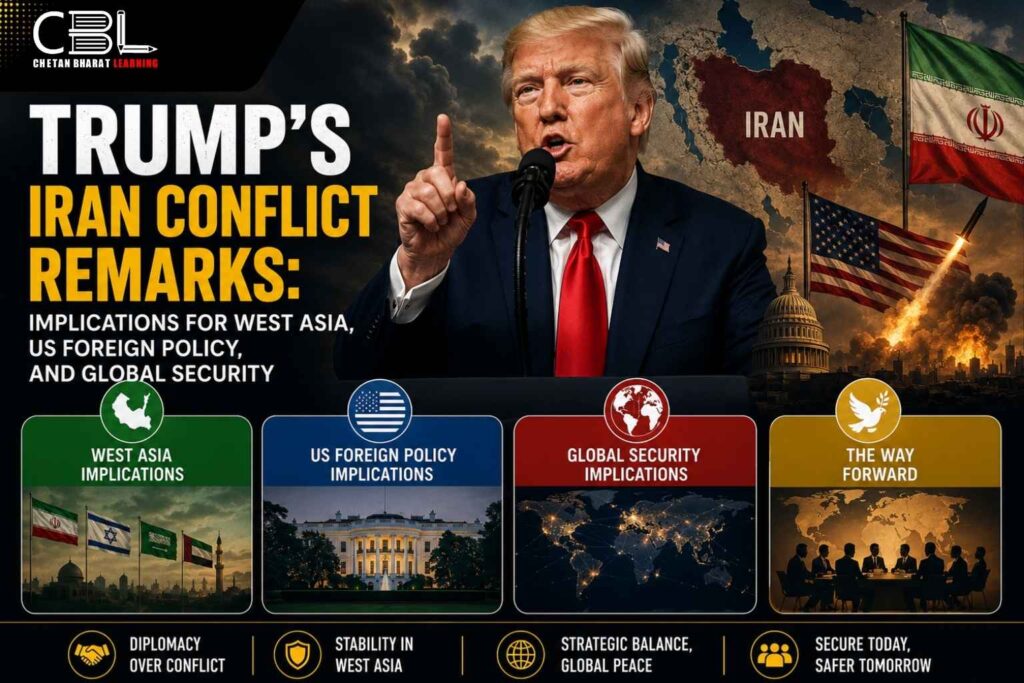
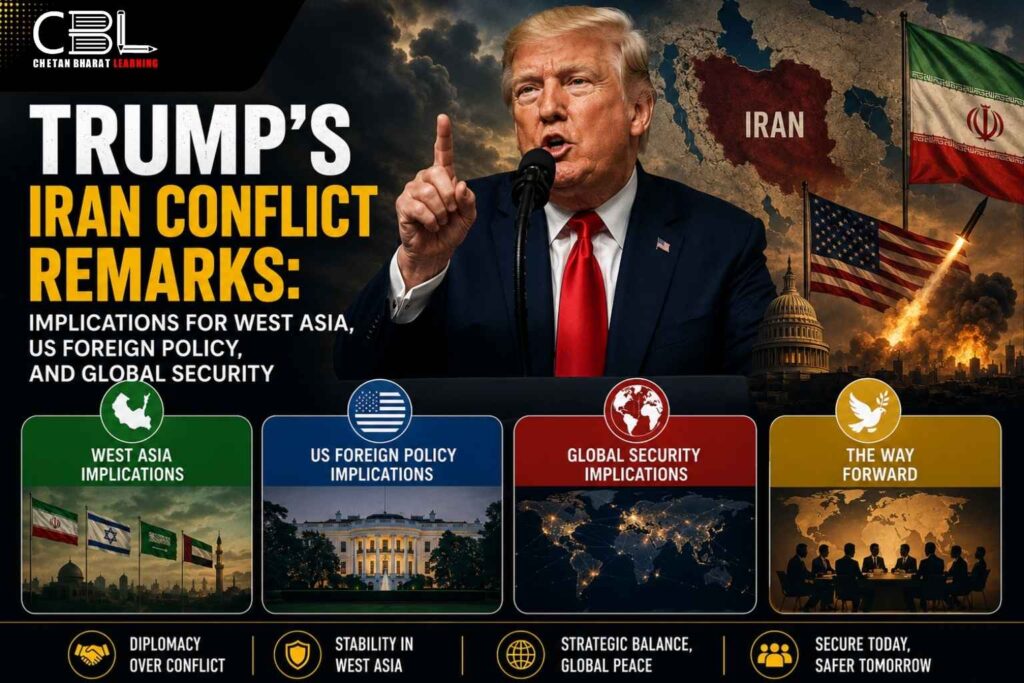
Former US President Donald Trump has once again become the centre of global attention after defending his position on the ongoing Iran conflict. Trump rejected criticism that military action involving Iran contradicts his long-standing promise of avoiding “endless wars.” His remarks come at a time when tensions in West Asia remain high, with Iran, Israel, Hezbollah, and several international actors deeply involved in an increasingly complex geopolitical landscape.
The statement has generated widespread debate among policymakers, security experts, and international observers. Supporters argue that preventing Iran from acquiring nuclear weapons is essential for global security, while critics claim that any military involvement risks dragging the United States into another prolonged conflict in the Middle East.
For UPSC aspirants, this issue is important because it connects International Relations, global security, energy security, and contemporary geopolitical developments.
Understanding Trump’s Position on the Iran Conflict
Donald Trump built much of his political identity around opposition to long and expensive military interventions abroad. Throughout his campaigns, he repeatedly criticised previous US administrations for engaging in wars that consumed significant resources without delivering clear strategic outcomes.
However, the Iran conflict has presented a unique challenge to this narrative. Trump argues that actions designed to stop Iran from developing nuclear weapons should not be viewed as “new wars.” According to him, limited military operations aimed at protecting American interests and preventing nuclear proliferation are fundamentally different from large-scale military occupations.
This distinction is central to Trump’s defence. He believes that strategic action taken today could prevent a larger conflict tomorrow. Nevertheless, critics remain sceptical and warn that even limited interventions can trigger wider regional instability.
The debate reflects a broader question in international politics: can military force be used selectively without escalating into a prolonged conflict?
Why the Iran Conflict Matters Beyond the Middle East
The Iran conflict is no longer merely a regional issue. It has evolved into a matter of international significance because of its impact on global trade, energy security, and geopolitical stability.
Iran occupies a strategically important position in West Asia and sits near critical maritime routes that connect energy producers with global markets. Any escalation involving Iran immediately raises concerns about disruptions in oil supplies, shipping routes, and international commerce.
Financial markets often react quickly to developments in the region. Rising tensions typically lead to higher crude oil prices, increased shipping costs, and greater uncertainty for investors. As a result, governments across the world closely monitor developments in the conflict.
The situation demonstrates how regional conflicts can produce consequences far beyond their immediate geographical boundaries.
Lebanon’s Growing Importance in the Iran-Israel Conflict
One of the most important developments in recent months has been the increasing significance of Lebanon in the broader confrontation between Iran and Israel.
While Gaza remains a major focus of international attention, many analysts believe Lebanon has become equally important from a strategic perspective. This is primarily due to Hezbollah’s presence and its close relationship with Iran.
For Tehran, Lebanon represents far more than a neighbouring country. It serves as a critical component of Iran’s regional security architecture. Through Hezbollah, Iran maintains significant influence in the region and possesses an important deterrent against potential Israeli military actions.
This explains why developments in Lebanon frequently influence ceasefire negotiations and diplomatic discussions. Iran increasingly views the Lebanese front as central to protecting its long-term strategic interests.
The Role of Hezbollah in Iran’s Regional Strategy
Hezbollah remains one of the most influential actors in West Asia. Since its emergence in the 1980s, the organisation has developed into a major military, political, and social force within Lebanon.
For Iran, Hezbollah serves multiple strategic purposes. It acts as a deterrent against Israel, strengthens Tehran’s regional influence, and provides leverage during international negotiations.
Iran considers Hezbollah a key element of its broader regional strategy. Any effort to weaken Hezbollah is often viewed by Tehran as an attempt to reduce its influence across West Asia.
Consequently, Iran closely links developments in Lebanon with broader discussions regarding ceasefires, regional security, and diplomatic settlements.
This relationship helps explain why Lebanon has become such an important factor in the current conflict.
EU Sanctions and the Strait of Hormuz Issue
Another important aspect of the crisis is the European Union’s decision to impose sanctions on Iranian individuals and entities associated with activities in the Strait of Hormuz.
The Strait of Hormuz is one of the world’s most critical maritime chokepoints. A substantial portion of global oil exports passes through this narrow waterway, making its security essential for the global economy.
European leaders argue that protecting freedom of navigation is necessary to maintain stable energy supplies and secure international trade routes. Iran, however, views many Western actions as part of a broader campaign aimed at restricting its regional influence.
The sanctions demonstrate how economic tools have become increasingly important in international diplomacy. While military actions often dominate headlines, sanctions can significantly shape long-term geopolitical outcomes.
Impact on Global Energy Security
Energy security remains one of the most important concerns arising from the Iran conflict. Any disruption in the Strait of Hormuz can have immediate consequences for international energy markets.
Oil-importing nations closely watch developments in the region because supply disruptions can increase fuel prices and contribute to inflation. Higher transportation costs often affect industries ranging from manufacturing to agriculture.
The conflict has also highlighted the vulnerability of global energy networks. Even the perception of instability can influence market behaviour and create economic uncertainty.
For this reason, governments worldwide continue to encourage diplomatic engagement and peaceful conflict resolution.
Implications for India
India has significant strategic, economic, and energy-related interests in West Asia. The region supplies a substantial share of India’s crude oil imports and hosts millions of Indian workers.
Any escalation in the conflict could increase India’s energy costs, affect trade routes, and create challenges for economic planning. Rising crude oil prices often contribute to inflationary pressures and impact fiscal management.
At the diplomatic level, India has maintained a balanced approach by engaging with all major stakeholders in the region. This strategy allows New Delhi to protect its interests while supporting regional stability.
The situation highlights the importance of energy security and strategic diplomacy in India’s foreign policy framework.
Students preparing through UPSC Coaching in Chandigarh and IAS Coaching in Chandigarh should closely follow these developments because they provide excellent case studies in international relations and geopolitical strategy.
The Debate Over “No New Wars”
Trump’s comments have revived an important debate within American politics regarding the use of military force abroad.
Supporters argue that preventing nuclear proliferation is a legitimate national security objective and may sometimes require limited military action. They believe that strategic interventions can prevent larger conflicts in the future.
Critics, however, caution that history provides numerous examples where limited operations gradually expanded into prolonged military engagements. They argue that military action should always be considered carefully because unintended consequences can be difficult to control.
This debate reflects broader questions about the future direction of US foreign policy and America’s role in global security affairs.
What Lies Ahead?
The future trajectory of the Iran conflict remains uncertain. Diplomatic negotiations continue alongside military posturing, creating a complex environment where both cooperation and confrontation remain possible.
Several factors will shape future developments, including US policy decisions, Iran’s regional strategy, Israeli security concerns, Hezbollah’s actions, and international diplomatic efforts.
The outcome will not only influence West Asia but also affect global energy markets, trade routes, and international security arrangements.
As tensions continue, the international community faces the challenge of balancing deterrence, diplomacy, and regional stability.
UPSC Relevance
Prelims
- Iran
- Hezbollah
- Lebanon
- Strait of Hormuz
- European Union Sanctions
GS Paper II
- International Relations
- India and West Asia
- Foreign Policy
GS Paper III
- Energy Security
- Internal Security
- Economic Impact of Geopolitical Conflicts
Essay Topics
- Global Security Challenges
- Diplomacy in Conflict Resolution
- Energy Security and Geopolitics
FAQs
Why did Trump defend his actions regarding Iran?
Trump argues that preventing Iran from acquiring nuclear weapons is a security measure rather than participation in an endless war.
Why is Lebanon important in the Iran-Israel conflict?
Lebanon hosts Hezbollah, one of Iran’s closest regional allies, making it strategically important for Tehran.
What is the significance of the Strait of Hormuz?
It is a crucial maritime route through which a large share of global oil exports passes.
How can the Iran conflict affect India?
The conflict can influence energy prices, trade routes, inflation, and India’s energy security.
Why is this topic important for UPSC?
It covers International Relations, Energy Security, Foreign Policy, and Contemporary Global Affairs.
Conclusion
Donald Trump’s remarks on the Iran conflict have reopened discussions about military intervention, nuclear security, and the future of US foreign policy. At the same time, the evolving situation involving Iran, Israel, Lebanon, and the European Union demonstrates the interconnected nature of modern geopolitical conflicts.
The conflict extends far beyond the battlefield. It influences energy markets, international diplomacy, regional stability, and economic security across the world. For India and the broader international community, understanding these developments is essential for navigating an increasingly complex geopolitical environment.
Related Current Affairs
Preparing for UPSC, PCS or HCS?
Talk to a mentor at Chetan Bharat Learning, Chandigarh. Free guidance on choosing the right exam and building a study plan.
Chat on WhatsAppCall 97793 53345UPSC / IAS / PCS coaching in Chandigarh · Trusted by aspirants across Punjab & Haryana
Leave a Reply
You must be logged in to post a comment.