

UPSC Mapping
| Prelims | Science & Tech |
|---|---|
| Mains | GS Paper 3 |
Quick Facts
| Global Thorium Share | ~25 Per Cent |
|---|---|
| Target Capacity | 100 GWe by 2047 |
| Core Isotope | Thorium-232 |
| Key Legislation | SHANTI Act |
What is thorium nuclear strategy?
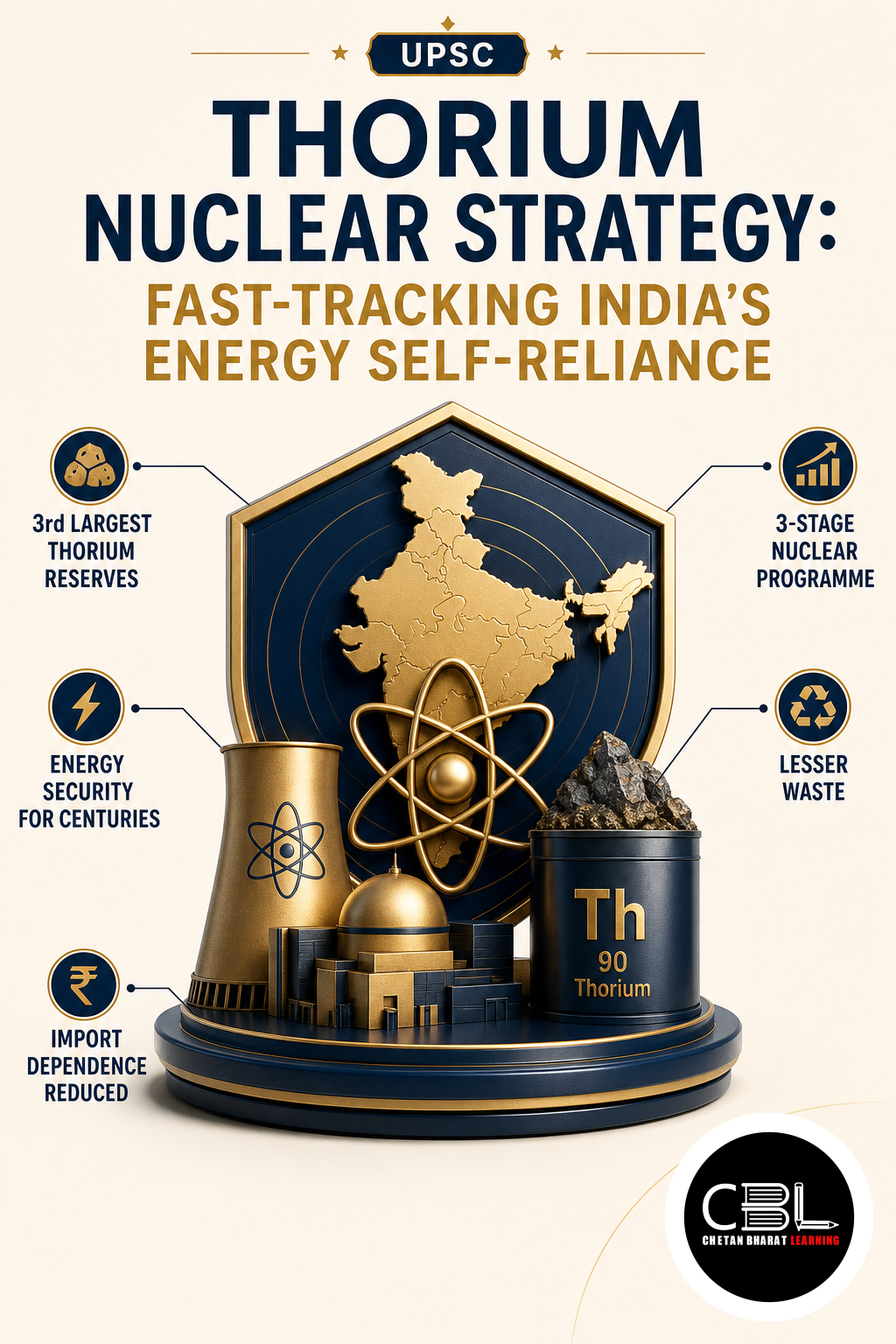
Devised by Dr. Homi J. Bhabha in the 1950s, India’s three-stage nuclear programme was specifically designed to bypass the country’s limited domestic uranium reserves and leverage its massive thorium reserves. The strategy recognizes that controlling underlying fuel cycles guarantees long-term national security.
Stage 1 involves PHWRs using natural uranium, producing plutonium-239 as a byproduct. Stage 2 utilizes Fast Breeder Reactors (FBRs) to multiply the fissile material and convert fertile Thorium-232 into fissile Uranium-233. Stage 3 envisions Advanced Heavy Water Reactors (AHWRs) running on a self-sustaining Thorium-U-233 cycle, granting India complete energy independence for centuries.
Why is thorium nuclear strategy in News?
The push for thorium integration has gained renewed momentum as India targets 100 gigawatt-electric (GWe) of nuclear capacity by 2047. You can review official energy transition guidelines via this CEA portal for precise infrastructure frameworks.
Furthermore, CEA Chairperson Ghanshyam Prasad highlighted that the final rules under the upcoming SHANTI Act will be ready in the coming months. This legislation aims to streamline private sector participation in the civil nuclear space, which is critical for mobilizing the estimated $228 billion required to achieve the 100 GWe target and scale up advanced thorium research.
Key Features
The modern nuclear landscape relies on several sophisticated mechanisms to promote strategic resilience and domestic fuel sovereignty.
- Abundant Reserves: India possesses approximately 25 per cent of the world’s known thorium reserves, primarily found in the monazite sands of Kerala and Andhra Pradesh.
- Fertile vs Fissile: Thorium-232 is not fissile; it cannot sustain a nuclear chain reaction on its own. It must absorb a neutron to become highly fissile Uranium-233.
- PHWR Bridge: Kakodkar’s recommendation to introduce thorium bundles into current PHWRs serves as a practical bridge to build operational experience before deploying dedicated Stage 3 AHWRs.
- Strategic Autonomy: Mastering the thorium cycle insulates India from volatile global uranium markets and historical restrictions imposed by the Nuclear Suppliers Group (NSG).
Challenges
Despite the massive potential, cracking the thorium code presents several severe structural and technological hurdles today.
- Radiation Hazards: The U-233 produced from thorium is inevitably contaminated with U-232, which emits high-energy gamma radiation. This makes fuel fabrication highly hazardous and requires expensive remote-handling robotics.
- Technological Gestation: Developing commercial-scale Fast Breeder Reactors and AHWRs involves massive capital expenditure, complex metallurgy, and prolonged testing phases.
- Regulatory Hurdles: Site selection, land acquisition, and the strict nuclear liability regime continue to delay the rapid expansion of the nuclear footprint.
- Private Sector Hesitation: The high upfront costs and long gestation periods of nuclear projects deter private capital without robust state-backed financial guarantees and clear regulatory frameworks.
Way Forward
The administration must accelerate R&D in Advanced Heavy Water Reactors and molten salt breeder reactors to master the thorium fuel cycle. Finalizing the SHANTI Act rules will provide the necessary legal clarity and liability frameworks to attract private capital. Providing dedicated sovereign guarantees will drastically lower the cost of capital for these mega-projects.
Check the latest Department of Atomic Energy updates for strategic indigenous innovation frameworks. The government must periodically review its baseline methodologies to ensure they reflect current global climate finance realities. Continuous refinement of the thorium strategy will guarantee that India achieves genuine technological sovereignty.
Prelims Practice Corner
Q1. Who conceptualized India’s three-stage nuclear power programme?
- (a) Vikram Sarabhai
- (b) Homi J. Bhabha
- (c) Raja Ramanna
- (d) APJ Abdul Kalam
Answer: (b) Dr. Homi J. Bhabha devised the three-stage programme to leverage India’s thorium reserves.
Q2. Which isotope of thorium is primarily utilized in India’s nuclear strategy?
- (a) Thorium-230
- (b) Thorium-232
- (c) Thorium-234
- (d) Thorium-228
Answer: (b) Thorium-232 is the fertile isotope that is converted into fissile Uranium-233.
Q3. Why is Thorium-232 not directly usable as a standalone nuclear fuel?
- (a) It is highly radioactive
- (b) It is fertile, not fissile
- (c) It melts at low temperatures
- (d) It absorbs too many neutrons
Answer: (b) It is fertile, meaning it must absorb a neutron to become fissile U-233 before it can sustain a chain reaction.
Q4. What is the primary role of Fast Breeder Reactors (FBRs) in the second stage of the programme?
- (a) To burn nuclear waste
- (b) To convert Thorium-232 into Uranium-233
- (c) To enrich natural uranium
- (d) To produce heavy water
Answer: (b) FBRs use Pu-239 to generate more fissile material and breed U-233 from the thorium blanket.
Q5. Which upcoming legislation is expected to facilitate private sector entry into India’s civil nuclear space?
- (a) Atomic Energy Act
- (b) SHANTI Act
- (c) Nuclear Liability Act
- (d) Energy Conservation Act
Answer: (b) The SHANTI Act aims to streamline regulations and open the sector to private participation.
Mains Practice Questions
Q1. Discuss the rationale behind India’s three-stage nuclear power programme and the strategic significance of its vast thorium reserves. (10 marks)
Answer Structure:
- Intro: Introduce Dr. Homi Bhabha’s vision to bypass limited uranium reserves by leveraging India’s 25% share of global thorium.
- Body: Detail the three stages (PHWRs, FBRs, AHWRs) and explain the transition from fertile Th-232 to fissile U-233. Highlight how this guarantees centuries of energy independence.
- Conclusion: Conclude that mastering the thorium cycle is the ultimate key to India’s strategic autonomy and long-term energy security.
Q2. “Achieving 100 GWe of nuclear capacity by 2047 requires not just capital, but technological mastery over the thorium fuel cycle and regulatory modernization.” Analyze. (15 marks)
Answer Structure:
- Intro: Highlight the $228 billion investment requirement and the recent push by scientists like Anil Kakodkar to integrate thorium into existing PHWRs.
- Body: Analyze the technological hurdles (U-232 radiation hazards, complex metallurgy) and the regulatory bottlenecks (site selection, liability). Discuss the role of the upcoming SHANTI Act in attracting private capital.
- Conclusion: Suggest that blending sovereign guarantees with indigenous R&D and private sector innovation will ensure India meets its ambitious clean energy targets.
FAQs on thorium nuclear strategy
Why is the third stage of the nuclear programme so critical for India?
The third stage relies on Advanced Heavy Water Reactors (AHWRs) that use a self-sustaining cycle of Thorium-232 and Uranium-233. Since India has abundant thorium but limited uranium, mastering this stage guarantees energy independence for several centuries without relying on foreign fuel imports.
What are the safety challenges associated with the thorium fuel cycle?
When Thorium-232 is irradiated to produce fissile Uranium-233, it also produces trace amounts of Uranium-232. U-232 decays into isotopes that emit extremely high-energy gamma rays, making the handling and fabrication of thorium-based fuel highly hazardous and requiring specialized remote-controlled robotics.
How does the SHANTI Act impact the future of India’s nuclear sector?
The SHANTI Act is expected to provide the comprehensive legal and regulatory framework required for private sector participation in nuclear energy. By clarifying liability and streamlining site-selection processes, it aims to attract the massive private capital needed to achieve the 100 GWe target by 2047.
Related Current Affairs
Preparing for UPSC, PCS or HCS?
Talk to a mentor at Chetan Bharat Learning, Chandigarh. Free guidance on choosing the right exam and building a study plan.
Chat on WhatsAppCall 97793 53345UPSC / IAS / PCS coaching in Chandigarh · Trusted by aspirants across Punjab & Haryana
Leave a Reply
You must be logged in to post a comment.