

UPSC Mapping
- Prelims: Science & Geography
- Mains: GS Paper I & III
Article
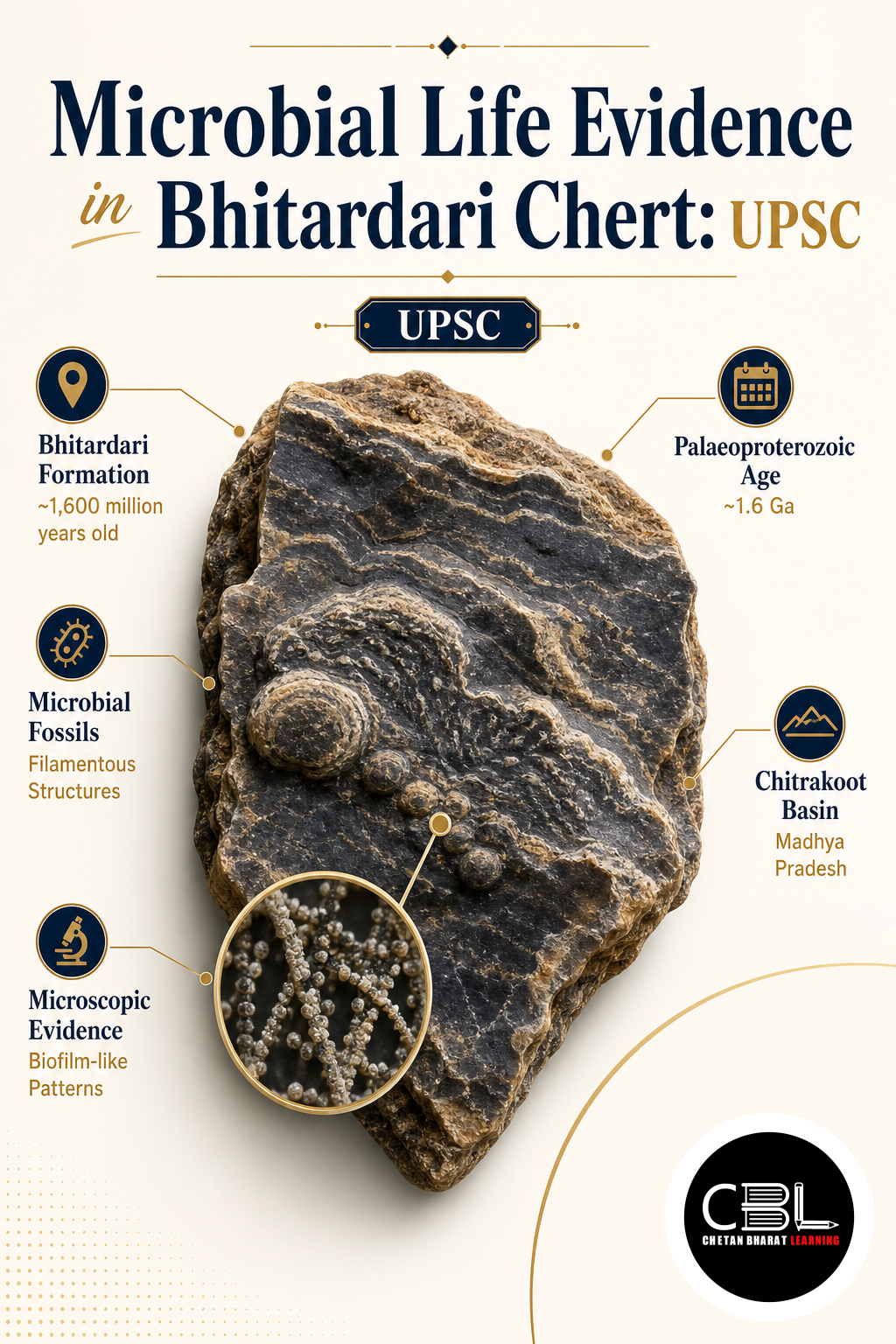
Microbial life evidence dating back 3.497 billion years has been found in a chert rock from Bhitardari in Jharkhand’s Singhbhum Craton. This discovery pushes back the timeline of confirmed biosignatures on Earth. For more scientific updates, visit the daily current affairs archive.
| Location | Bhitardari, Jharkhand |
|---|---|
| Age | 3.497 billion years |
| Method | U-Pb dating, Raman spectroscopy |
What is the Microbial Life Evidence in Bhitardari Chert?
The microbial life evidence in Bhitardari chert consists of microscopic alternating layers of pale silica and dark carbonaceous material preserved in sedimentary chert rock. Scientists used uranium-lead (U-Pb) dating on trapped zircon crystals to determine a Paleoarchean age of 3.497 billion years, making it the oldest directly dated rock with a confirmed biosignature on Earth.
Raman spectroscopy and carbon isotope analysis confirmed that the organic matter is biologically derived, not abiotic. This discovery places Bhitardari chert ahead of earlier candidates in Greenland and Australia, which were either disputed or indirectly dated. The microbial life evidence provides crucial insights into early Earth’s biosphere.
Why is Microbial Life Evidence in News?
This microbial life evidence has garnered global attention because it pushes back the timeline of confirmed life on Earth and offers new data on the early evolution of microorganisms. The study was published in a leading journal and challenges previous claims of older biosignatures that lacked direct dating.
India’s Singhbhum Craton, already known for its ancient rocks, now hosts the oldest directly dated biosignature. This has implications for astrobiology and our understanding of life’s origins on Earth and potentially on other planets. For official scientific updates, check PIB for announcements from Indian research institutions.
Key Features of the Discovery
- Direct dating: U-Pb dating of zircon crystals provides a precise age of 3.497 billion years, unlike indirect dating methods used previously.
- Biogenic confirmation: Raman spectroscopy and carbon isotope analysis clearly differentiate biological from abiotic carbon.
- Sedimentary context: The chert is sedimentary, preserving primary biological structures rather than later contamination.
- Geological stability: The Singhbhum Craton is one of Earth’s oldest and most stable continental blocks, ensuring pristine preservation.
- Global significance: It surpasses other candidate sites (Greenland, Australia) in terms of direct dating and unambiguous biosignatures.
Challenges in Studying Early Microbial Life
- Rarity of ancient rocks: Rocks older than 3.5 billion years are extremely rare and often metamorphosed, destroying original textures.
- Contamination risk: Modern microbial contamination can produce misleading signals, requiring rigorous contamination controls.
- Abiotic mimics: Non-biological processes can form structures and isotopic signatures that resemble life, leading to false positives.
- Dating uncertainties: Not all rocks contain dateable minerals like zircon, making direct dating challenging.
- Limited techniques: High-resolution analyses (e.g., ion microprobe) are expensive and not widely available.
For more on science and technology, explore the science & technology current affairs section.
Way Forward for Study of Early Life
Building on this microbial life evidence, future research will focus on refining the evolutionary timeline of early metabolism and the environmental conditions that supported life. Expanding the search to other ancient cratons, such as the Pilbara in Australia, can help establish a global picture of early Earth’s biosphere.
Advances in micro-analytical techniques, including high-resolution mass spectrometry and synchrotron-based imaging, will enable more detailed characterisation of biosignatures. International collaboration, like the Deep Carbon Observatory, can accelerate discoveries. For astrobiological implications, refer to NASA’s astrobiology page for comparative planetary studies.
Prelims Practice Corner
- Q1. In which Indian state is the Bhitardari chert located?
(a) Odisha (b) Jharkhand (c) West Bengal (d) Chhattisgarh
Answer: (b) Jharkhand - Q2. What dating method was used to determine the age of the chert?
(a) Radiocarbon dating (b) Uranium-lead (U-Pb) dating (c) Potassium-argon dating (d) Fission-track dating
Answer: (b) U-Pb dating - Q3. Which technique confirmed the biological origin of the organic matter?
(a) Electron microscopy (b) Raman spectroscopy and carbon isotope analysis (c) X-ray diffraction (d) Mass spectrometry
Answer: (b) Raman spectroscopy and carbon isotope analysis - Q4. What is the Singhbhum Craton?
(a) A mountain range (b) An ancient stable continental block (c) A river basin (d) A desert region
Answer: (b) An ancient stable continental block - Q5. Why is this discovery considered significant?
(a) It is the oldest known fossil (b) It is the oldest directly dated rock with confirmed biosignature (c) It proves life originated in India (d) It contains complex multicellular organisms
Answer: (b) Oldest directly dated rock with confirmed biosignature
Mains Practice Questions
- Discuss the significance of the Bhitardari chert discovery for our understanding of early life on Earth. (15 marks)
- Intro: Introduce the discovery and its context (Singhbhum Craton, age).
- Body: Methods used (U-Pb dating, Raman, isotopes), confirm biogenicity, compare with other candidates, discuss implications.
- Conclusion: Importance of direct dating and further research.
- Evaluate the challenges in identifying and dating ancient microbial life and how the Bhitardari study overcomes them. (10 marks)
- Intro: Common challenges: rarity, contamination, abiotic mimics, dating issues.
- Body: How Bhitardari addressed each: direct dating, sedimentary context, multiple techniques.
- Conclusion: Importance of integrated multidisciplinary approaches.
FAQs on Microbial Life Evidence
What is chert?
Chert is a hard, fine-grained sedimentary rock composed of microcrystalline or cryptocrystalline silica. It often preserves microfossils and sedimentary structures.
Why is the Singhbhum Craton important for studying early Earth?
The Singhbhum Craton contains Paleoarchean rocks (>3.5 billion years old) that have been well-preserved due to their stability, providing a window into early Earth’s crust and biosphere.
How does this discovery impact astrobiology?
It shows that microbial life can be reliably identified in ancient rocks, refining criteria for detecting biosignatures on Mars or other planets, where similar sedimentary rocks may exist.
Related Current Affairs
Preparing for UPSC, PCS or HCS?
Talk to a mentor at Chetan Bharat Learning, Chandigarh. Free guidance on choosing the right exam and building a study plan.
Chat on WhatsAppCall 97793 53345UPSC / IAS / PCS coaching in Chandigarh · Trusted by aspirants across Punjab & Haryana
Leave a Reply
You must be logged in to post a comment.