
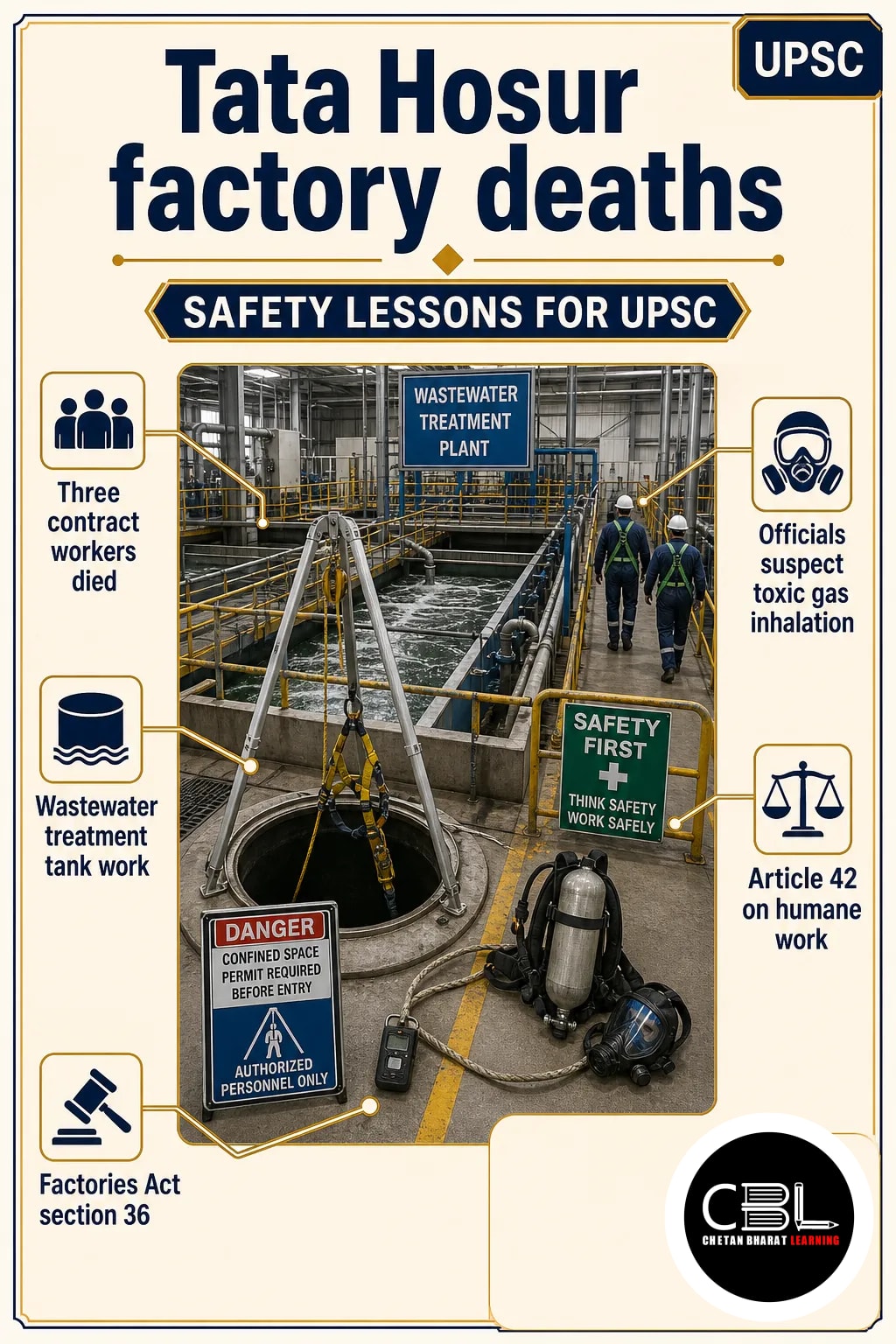
Tata Hosur factory deaths have brought contract-worker safety into focus after three maintenance workers died at an iPhone components plant in Tamil Nadu. The incident connects national governance with industrial safety and supply-chain oversight.
Quick answer: The Tata Hosur factory deaths occurred on 9 November 2026 at a Tata Electronics plant in Krishnagiri district. Three contract workers died while servicing a wastewater treatment tank. Officials suspect toxic gas inhalation; however, police said post-mortem examinations would determine the cause. The district administration, Tata and Apple have initiated inquiries.
What happened at the Hosur plant?
Three members of a four-person maintenance crew collapsed while working at a filtration tank on Monday evening. According to the Krishnagiri district collector’s office, B Akmal collapsed first after trying to look inside. M Sarathikumar then went to check on him and collapsed; P Kaveri subsequently went in after them.
The fourth worker called for help, and the three were taken to a private hospital in Hosur. However, the hospital pronounced them dead. Their bodies were sent to the Government Medical College Hospital in Krishnagiri for post-mortem examinations.
District officials suspect toxic gas inhalation, but the precise cause remains subject to examination. A Directorate of Industrial Safety and Health official said the crew lacked proper safety measures. Therefore, the inquiry must establish both the cause of death and the circumstances of the work.
Where did the incident occur?
The incident occurred at Tata Electronics’ components factory in Vanniyapuram, near Uddanapalli and Hosur. The plant was closed for Deepavali, although maintenance work was under way.
| Feature | Details |
|---|---|
| Components plant | Makes iPhone back panels and precision-machined metal casings. |
| Separate plant | A Tata facility in the same compound assembles finished iPhones. |
| Treatment operation | Nalco Water, a unit of Ecolab, operated the treatment plant. |
| Employment chain | Nalco Water subcontracted work to another company that employed the workers. |
The casings require specialised tooling and surface finishing; on premium phones, they also provide a frame for other components. According to Reuters, India makes about a quarter of the world’s iPhones. Consequently, safety at supporting facilities matters to a significant manufacturing supply chain.
Why is tank maintenance a safety concern?
Tank maintenance can expose workers to hazardous atmospheres and difficult rescue conditions. A confined space may contain toxic gases or insufficient oxygen; however, the specific hazard in this case awaits investigation.
A second worker may enter to help a collapsed colleague without knowing the danger. Thus, an unplanned rescue can place additional people at risk. The sequence at Hosur makes emergency preparedness an important subject for inquiry, without establishing why each worker collapsed.
Maintenance also differs from routine production because it may require entry into equipment, isolation of machinery and coordination across employers. For comparison, the Visakh refinery fire provides another context for studying industrial emergency response.
Which legal and constitutional principles matter?
Workplace safety draws on constitutional protections and statutory rules, although investigators must identify the law applicable to this incident.
| Provision | Relevance |
|---|---|
| Article 21 | Protects life and personal liberty. |
| Article 42 | Directs the state to secure just and humane conditions of work and maternity relief. |
| Concurrent List, Entry 24 | Covers the welfare of labour, including conditions of work. |
| Factories Act, 1948, Section 36 | Contains safeguards concerning dangerous fumes and gases in confined spaces. |
Article 42 is a Directive Principle rather than a directly enforceable fundamental right. In addition, Section 36 offers a static reference for confined-space regulation; its applicability here depends on the law in force and the inquiry’s findings.
What governance challenges does the case highlight?
The Tata Hosur factory deaths highlight the difficulty of coordinating safety across a layered contracting chain. Several questions require investigation rather than assumptions about legal liability.
- Contract oversight: Investigators must establish who assigned the task and who controlled access, equipment and supervision.
- Safety assurance: They must also examine what precautions the crew received and why the official considered them inadequate.
- Rescue readiness: The successive collapses make it important to examine emergency procedures and the availability of trained rescue support.
- Worker protection: In addition, employment records and contractual arrangements matter when determining applicable benefits and responsibilities.
These questions connect with wider debates on labour welfare and social security. However, an inquiry must establish the facts before assigning responsibility to any party.
The site also had a chemical-storage fire in September 2024 that halted component production. Separately, the Tamil Nadu Pollution Control Board intervened this year over allegations concerning nearby farm wells. Tata said it answered the regulator’s questions and that the board dropped further action; neither episode establishes the cause of the present deaths.
How can similar risks be reduced?
Prevention requires a documented safety system covering both employees and subcontracted workers. The following measures are policy options, not findings about which safeguards were absent at Hosur.
- Assess before entry: Test the atmosphere, isolate relevant equipment and use an entry permit for hazardous confined-space work.
- Plan rescues: Train a designated rescue team and provide suitable equipment; unprotected entry should not be the response to a collapse.
- Clarify responsibilities: Specify safety duties across the site operator, service provider and subcontractor, and verify compliance before work begins.
- Strengthen oversight: Regulators should examine records, worker training and emergency drills; companies should act on inquiry findings and communicate corrective steps.
Finally, manufacturing growth and worker protection should be treated as complementary goals. Reliable investigations, preventive controls and access to applicable benefits can help translate that principle into practice.
Source: The Indian Express, 10 November 2026
State PCS General Studies can test factory safety, contract labour and the role of state enforcement agencies through this case. In addition, candidates can connect industrial accident prevention with district administration and emergency response.
Prelims Practice Corner
Mains Practice Questions
Frequently Asked Questions
How many workers died at the Hosur Tata factory?
Three contract workers died. They were part of a four-person maintenance crew working at a wastewater treatment tank.
Was toxic gas confirmed as the cause of the deaths?
No, officials suspected toxic gas inhalation, but police said post-mortem examinations would determine the cause. Therefore, the suspected cause should not be presented as a confirmed finding.
What does the Hosur factory make?
It makes iPhone components, including back panels and precision-machined metal casings. In addition, a separate Tata plant in the compound assembles finished iPhones.
Which constitutional provision addresses humane working conditions?
Article 42 directs the state to secure just and humane conditions of work. However, it is a Directive Principle, not a directly enforceable fundamental right.
Related Current Affairs
Preparing for UPSC, PCS or HCS?
Talk to a mentor at Chetan Bharat Learning, Chandigarh. Free guidance on choosing the right exam and building a study plan.
Chat on WhatsAppCall 97793 53345UPSC / IAS / PCS coaching in Chandigarh · Trusted by aspirants across Punjab & Haryana









Leave a Reply
You must be logged in to post a comment.